
Many of you won’t be old enough to remember the Iranian revolution in 1979 and what led to it. The Imperial monarchy was abolished and a theocratic republic created. It’s a strange two tier system, where there is an elected parliament (the Majis), government and president, who are in effect, beneath the Mullahs and their Supreme Leader. Elements of the state such as the IRGC (Iranian Republican Guard Corps) are in effect controlled directly by the Supreme Leader, with a small degree of influence from the President. You cannot become President or stand for the Majis without having gone through a selection and approval process run by the Guardian Council – the Mullahs.
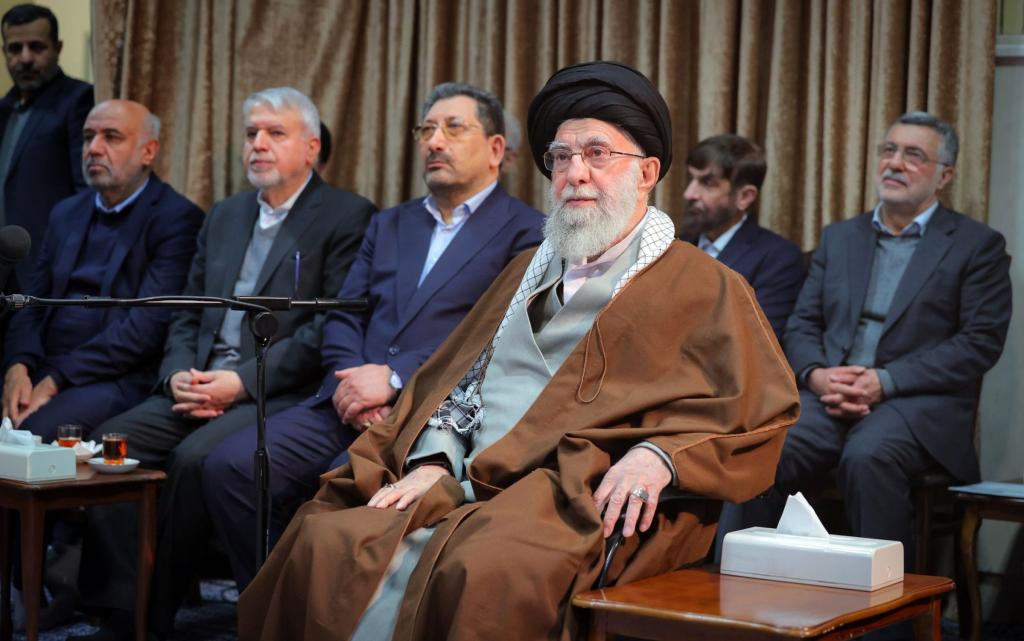
The Mullahs amend their selection process to find a candidate that either suits their agenda completely (Such as Aminajhad early this century, who turned out to be a disaster), or the latest, seen as a 60-40 in favor of the current system and yet acknowledging there is considerable disquiet in the country. He seems mildly reformist and has managed to put the brakes on some recent legislation being enforced likely to cause public anger – the now infamous female hijab laws.
Iran is a tinder box. It is not a democracy despite the vote, because nobody gets to choose who the candidates are – they are preselected from a roster and the winner is almost preordained.
The system has led to an isolated, power hungry and deeply corrupt religious elite and their supporters, propped up by the IRGC which itself, is the owner of multiple businesses and lucrative monopoly industries like mobile phone services, who’s profits are used to support its elites.
Iran however is in a mess. Despite being one of the world’s largest oil & gas producers, it is suffering through one of the worst winters in years. There is simply, no gas to power peoples homes or the gas fired power stations Iran uses to provide electricity. Factories and shopping centers and schools are shut, homes freezing, offices closed and rolling blackouts the norm.
The cause, a lack of gas, which is a shocking statement to make about one of the biggest potential producers in the Middle East. The country is short of around 350m cubic meters a day. It has no other way of generating electricity.
Over a dozen of the gas power plants have been shut down simply because there isn’t the gas to power them. Even the Iranians who run important agencies like the Coordination Council of Industries that works with government have admitted it’s a ‘catastrophe and the worst it has ever been’. The President merely apologized and asked for everyone to turn down the heating in their homes by another 2 centigrade.
The overarching cause has been how Iran has gone about its obsessions and the price the country is now having to pay for them.
Iran earned about $250 billion from oil sales between 2018-2023, the last year there is data. You would think that it would be a top priority to maintain the oil and gas sector to maximize these resources, especially when the country is so heavily sanctioned. But no, it spent $50 billion on supporting the Assad Regime in Syria – for which it now has absolutely nothing to show for it.
Another $20 billion was spent on developing Hamas and principally Hezbollah in Lebanon, again now with nothing at all to show for it. Another £5 billion has gone on supporting and arming the Houthis – again with little of any real value to show for it. So some $75 billion has basically been thrown away for nothing.
All of this could have been used to improve the energy security of the country, improve its industries and their efficiency, build storage facilities for gas to cover harsh winters like this years.
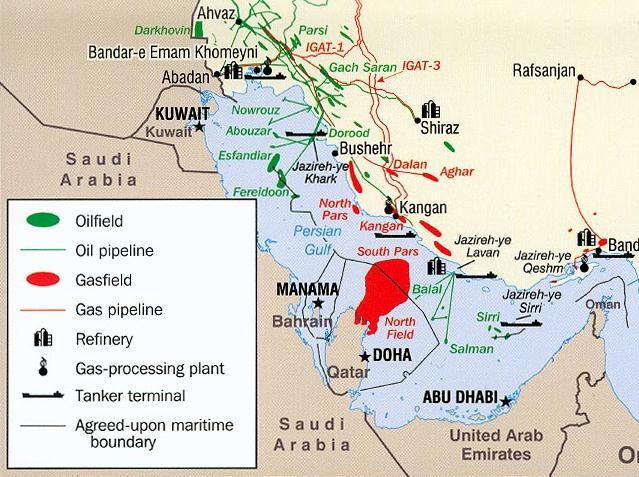
Iran shares access to the vast South Fars North Dome Gas Field, the world’s largest single such field, with Qatar. Qatar extracts the gas and liquefies it, exporting it as LNG around the world. It sells more gas than it does oil, and gas is now the Qatari’s life blood. Iran on the other hand uses it to supply 70% of its own gas needs. Sanctions prevent the Iranians from fully utilizing the gas field.
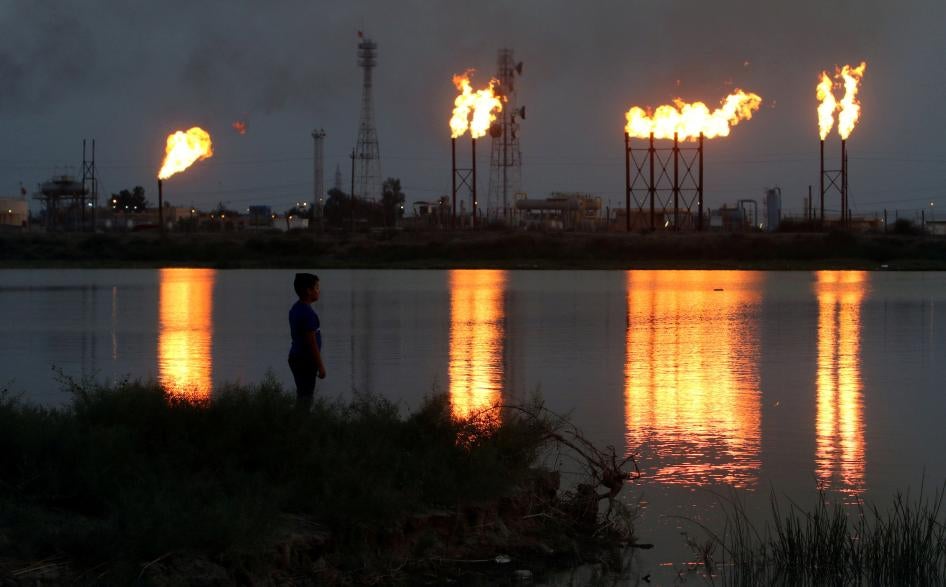
As an example, Qatar does not flare off the excess gas from any oil or gas extraction unless it has to. Iran has no choice, it simply doesn’t have the equipment, which it could produce domestically in most cases, but has never spent the money to do so. Qatar uses it and sells it, Iran literally burns it off into the atmosphere.
The giant gas field is actually in decline on the Iranian side, only some $70 billion in investments is required to keep it producing its current volumes, money Iran said last year it would spend. In many ways it has no choice. Cheap energy is vital to the regime retaining power, it’s widely considered the only decent aspect of the regimes policies by Iranians, although few understand the vast cost.
This may seem like a minor detail, but it is two things, financially irresponsible and chronically wasteful. Industry and offices, shops and schools are shutting down while gas fields burn off what they need because nobody has spent any money to use it. Russia is the only country that flares more than Iran. Iran loses 21 billion cubic meters a year of gas from flaring – the equivalent of 61 days – two months – of national gas use at normal levels in winter, which would easily have seen it through the current crisis.
A NATION OF SUBSIDIES
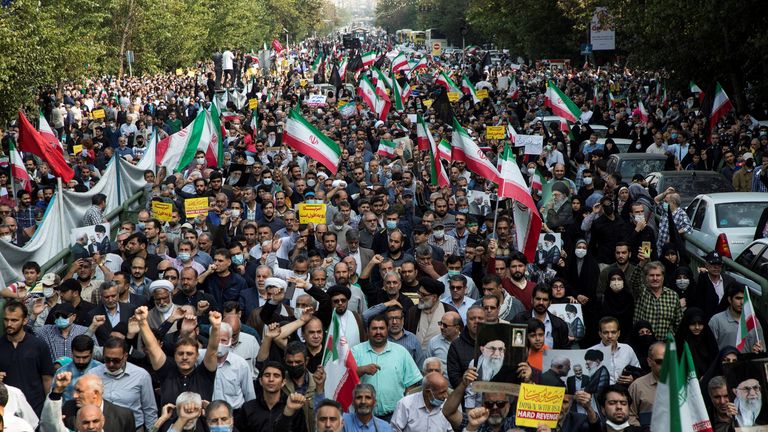
Iran is spending a staggering $163 billion a year subsidizing the cost of petrol and diesel, as well as gas. 1 lire of petrol costs US$0.38. The government spends 27% of GDP on subsidies. The highest in the world. In 2019 the entire country erupted in severe protests – caused by an attempt to cut energy subsidies. Iranians just don’t understand how cheap their fuel is until the subsidies are taken away.
THE WAR WITH ISRAEL
2024 saw the disaster of the conflict with Israel. Iran came off far worse – the missile and drone attacks were largely negated and billions of dollars in missiles proved impotent. Israeli air strikes made it clear the situation was now very much reversed.
A little noticed Israeli raid on Iran in February last year destroyed two gas pipelines that fed Isfahan. This caused dramatic shortages before the pipelines could be fixed, again in the middle of winter. To hide what had happened from the public the Iranian government drew down from its gas reserves until July and then didn’t have the capacity to replace them before this winter.
Iran’s public humiliation this year and its loss of face in Syria and Lebanon, let alone the devastating attacks against the Houthis, have driven it into the arms off its neighbor Russia. In order to raise income it was eager to supply weapons, missiles and drones especially to be used against Ukraine, something I remain sure Ukraine will not forget in a hurry. The trade between the two – and the price often paid to Iran in technology and raw material swaps across the Caspian Sea ports, has helped both Iran and Russia. Irans involvement with China for example – a recent cargo of solid fuels for rocket motors was seen departing from China for Iran, varies again from low level tech and oil transfers to more significant help keeping Iran going and avoiding sanctions. Bilateral trade with China is deliberately obfuscated to keep both sides hidden from the sanctions regime.
Sanctions of course are next on the list. The new US Administration is likely to tighten them even further. The last time was bad enough and it caused severe internal economic harm in Iran, as was intended. This time the Iranians are expecting worse, and this time they don’t have the leverage of their proxies and the threat they pose to Middle East peace.
Fears exist that Israel could destroy much of Iran’s gas infrastructure in a strike – and that means almost certainly major internal uprisings and even the possibility of revolution. Yet that will likely only happen if Iran makes the mistake of attacking Israel first.
Iran’s obsession with Israel and its need to crush the Israeli regime is a worn out and clearly failing cliché – if they could just step away from it their whole national outlook would be very different. Their equally ludicrous obsession with the United States is as much about creating demons to isolate the nation and give it focus, but the people of Iran are sick of the arguments, have long seen through it and want it dropped – as the protests have made very clear. Yet the religious obsession and the propaganda of the IRGC still have these policies at the centre of – and fundamentally the reason the regime justifies its existence.
WAR IN THE EAST
Iran borders three countries on its North Eastern and Eastern border. Turkmenistan, Afghanistan and nuclear armed Pakistan. Across all three of them lies a hot, arid, often mountainous desert area. Earthquakes are common, but across all three are yet another ethnic group that has no national representation anywhere (rather like the Kurds in the west) – the Baluchis. The Turkmen to the NE are rarely of concern, but the Afghans and Pakistanis, both at government and insurgent level, almost continuously ignore the border and the Iranians are just as bad.
There is an almost endless stream of raids, counter raids, fire fights and border incursions that have gone on for years. At one time in 2024 getting so heated that Iranian Air Force units attacked Baluchis in Pakistan. Pakistani Air Force units crossed into Iran and attacked a military outpost used by the Baluchi’s in Iran, to make a point things were getting out of hand. Both sides this time, backed away from further escalation. Baluchi insurgents are determined to make the two fight each other in order to highlight their own movement. They nearly managed it, with Iranian Government forces attacking Pakistani Government forces because the other side had attacked insurgents neither support in their respective territories, a ludicrous situation.
Later the Iranian Air Force attacked Taliban units in Afghanistan they say attacked an Iranian outpost. At least three other tit-for-tat attacks have happened – often with the Baluchi separatists at the centre of trouble. The three countries are considered inside the top tier of those affected by insurgency – Pakistan and Afghanistan are in the top five.
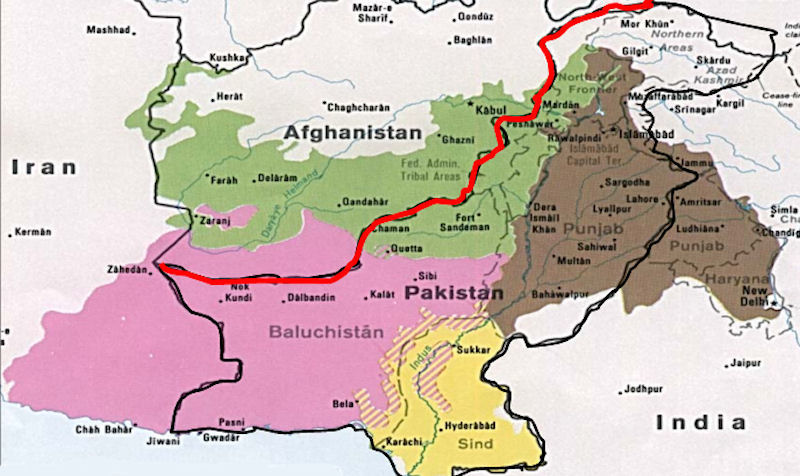
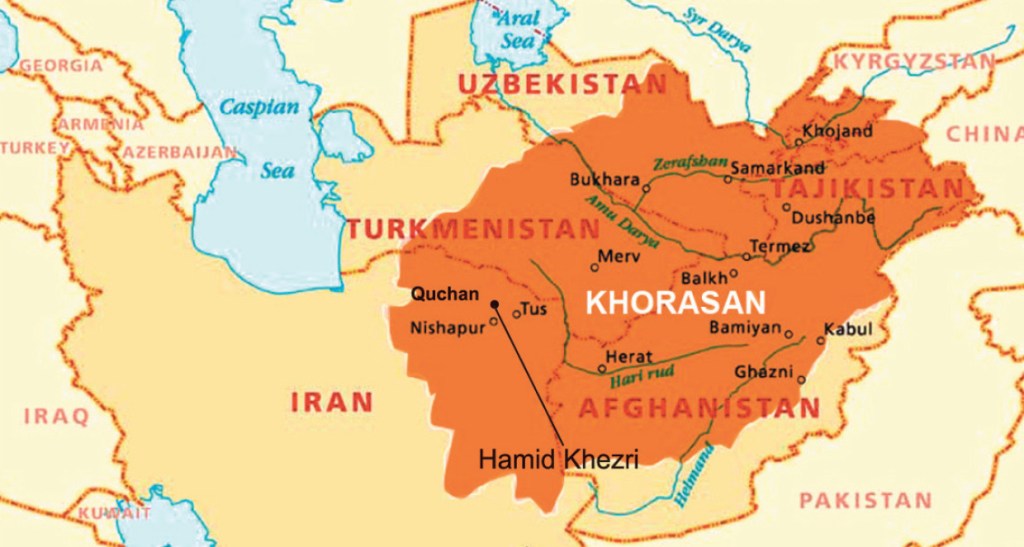
History plays its part here. The west of Afghanistan and the South West and upper part of Pakistan, along with a large swathe of Iran and Turkmenistan contain the now defunct Emirate of Khorasan, a state erased in the late 1800’s by Russia, Persia as Iran was then known, and the British. Khorasan is rich in history and part of the ancient Silk Road. It was so heavily disputed it never truly gelled as a state. With Afghanistan eventually created the border was drawn on the Durand Line, between it and modern Pakistan, then part of Britain’s Indian Empire. A British official, Durand sat in his office and calculated how far from their positions British infantry could fire and used that to form the border that exists today. The point is to demonstrate that no thought at all was given to local communities, geography or historical precedent. The Pashtun people were heavily divided. The Taliban loathe it and consider the border an anachronism.
Afghans in essence want the area of Baluchistan. Clearly neither Iran or Pakistan will tolerate the Taliban’s desire. The Baluchis and the Pashtuns are both a divided people and they have seen much similarity between them. Baluchis are loathed by the Iranians because they refuse to speak Farsi and have noticeable cultural differences.
Saudi Arabia and the US sponsor Baluchi groups inside Iran. On top of that vast amounts of abandoned US equipment have strengthened all of the militants.
Last year eleven Iranian police officers were killed by Baluchi’s, Iran attacked Pakistani bases and they attacked the Iranians again. The militants also hate the Chinese and have murdered over a dozen in Pakistan.
Another battle is the water dispute between Iran and Afghanistan. The Helmand River is unusual in that it runs NE-SW through Afghanistan and drains its sometimes plentiful waters into a handful of lakes just inside Iranian territory. Both sides have tried to agree who continues to use the water. However the water has been inconsistent, fighting has been so bad that at one time Iran had 200,000 troops on the border for an invasion.
Iran is unable to stabilize its own territory, the level of insurgents and the multi-faceted nature of so many competing groups, the willingness of the national governments to retaliate against each other, have caused a rising spiral of action and counter action. There’s a deliberate effort to trip the Pakistanis and the Iranians in particular into a war that will further the cause of the separatists. It’s also getting worse every passing month as separatist groups multiply. There are now over 200.
Yet strangely the Iranians, obsessed as they are with Israel, and perhaps because the East of Iran is not especially productive or lucrative, do not give it the attention it probably deserves. Those who study the area think that it is tiptoeing its way into a profound uprising and conflict that will be especially destructive to Pakistan and Iran, even as they look to blame each other.
WAR IN THE WEST
Iran doesn’t want to admit its greatest fear, which is an American attack on its military infrastructure so profound that it cannot recover. Couple that to the ever increasing power of Israel and the strategic advantages it now has in the Middle East, having completely undermined Irans best laid plans.
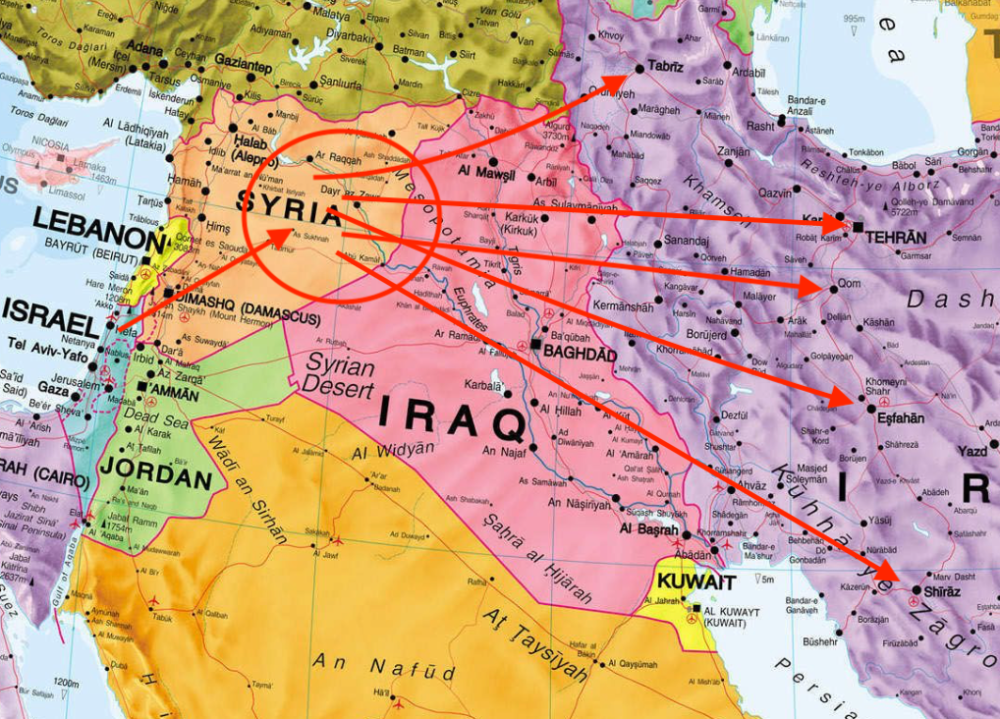
Yet it is this obsession with Israel – shared only by the Mullahs and the IRGC at a deep level, spoken of by those who know their lives depend on supporting the policy, that cripples Iran. Iran and Israel were regularly cooperative before the fall of the Shah, Reza Palhavi in 1979. Iran has wasted billions of dollars, thousands of lives – mostly of Palestinians and Syrians, Iraqis and others but rarely their own from the very first day of the Revolution now 46 years ago. They have chosen to be the victim party while an elite strip the country of resources and wealth for their own well being. Ruthless oppression and violence is the preferred methodology of retaining power, but it came so close to losing control in 2019 & 2023 it scared the regime into being loudly oppressive while at the same time not actually implementing its policies, just in case it was one step too far. The clerics know they are on dangerous ground. That’s why frank admissions and apologies over the energy situation have been forthcoming. Refusing to admit anything has been source of huge frustration in the past.
There is plenty of reason now for the Supreme Leader to set a different course but he will not. Iran doesn’t have what it takes to engage the US or the Israelis. If it would accept that and move on from its need to spread pain and terror, of confronting Israel at every turn, it could exist in peace and address the needs of the people and the country, and deal with the ever increasing conflict in the East before it gets out of hand – which it is fast doing. However the religious caste seem fundamentally incapable of seeing the world change around them. Perpetual war with Israel has them trapped in a cycle of pointless and clearly unwinnable warfare.
Yet they have now also allied themselves to Russia so deeply that Ukraine and Israel are cooperating far more closely than ever before, and not before time. The Arab states have no more desire to go to war with Israel, many have diplomatic relations, even the Saudis are slowly moving that way. Iran’s position is looking increasingly illogical, tired and frankly pointless. Yet these are cards they want to play. And like all of these countries it’s about self-preservation – not of the country, but of the regime. It is those who rule who are trying to hold onto their power. Just as Putin, Xi, Kim and all the other mock authoritarians like Fico and Vucic, and Orban, and even Erdogan. Power and wealth are their objectives. People don’t come into it.
All the time others oppose their regimes, they band together and will do anything to hold on. That is what makes them dangerous and that is why we cannot stop opposing them. To a degree Iran has been put back in its box, but it will not stop trying to get back out of it, by any means necessary. Until the theocratic regime is ended and Iranians can behave as human beings, which the majority really want, to travel, to study, to have contacts with the west, Iran will forever be subject to the threat of war. War it either brings on itself or tries to impose on others.
The Analyst.
militaryanalyst.bsky.social

 The Military Analyst