
This is a deep dive into the missile and its uses, along with the political stress its caused in Germany and amongst its allies.
Taurus KEPD 350 is a German-Swedish air-launched cruise missile developed by Taurus Systems GmbH, a joint venture between MBDA Deutschland and Saab Bofors Dynamics. It is designed for precision strikes against hardened and high-value targets, including bunkers, command centers, airfield and port facilities, ammunition depots, ships, and bridges – and we all know the one bridge these actually could bring down.
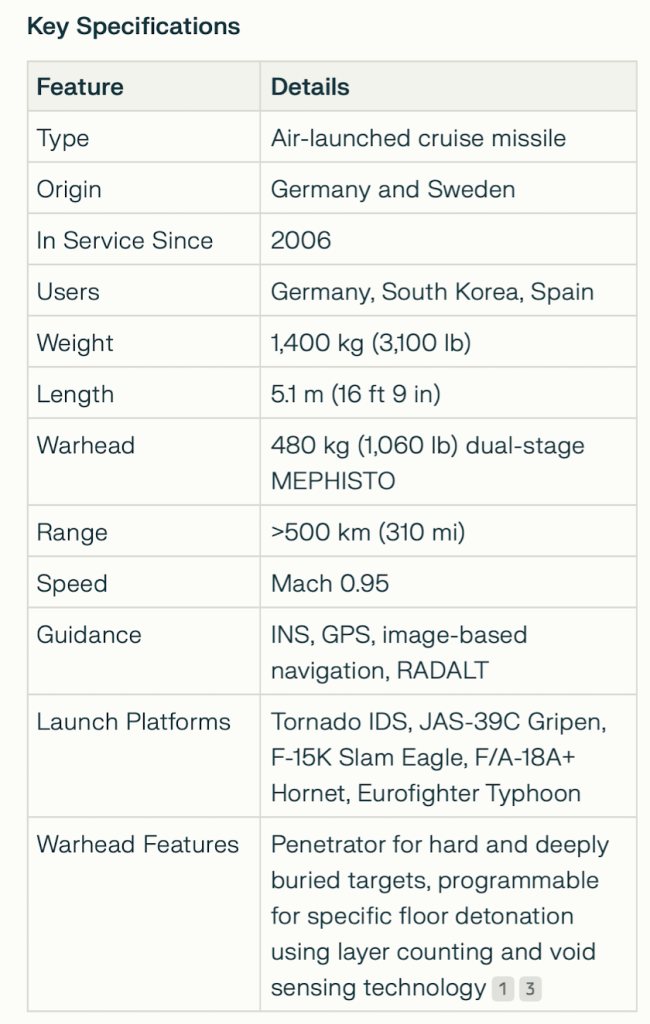
The key to the Taurus is the MEPHISTO (if their was a winner for best acronym this might be it: Multi-Effect Penetrator Highly Sophisticated and Target Optimised and the name is derived from Mephistopheles or Mephisto the Chief Devil or demon of German folklore), is its warhead and understanding how different it is to the Storm Shadow and SCALP-EG variants is crucial. While it encompasses many of the same mission profiles, MEPHISTO is far more sophisticated.
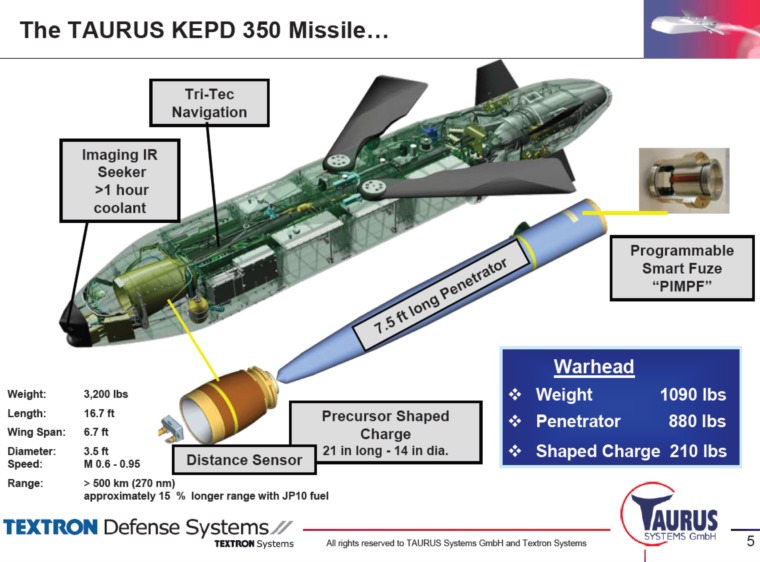
How the MEPHISTO Warhead Works
• Dual-Stage Penetration and Detonation:
The warhead consists of two main charges:
• An initial precursor or shaped charge penetrates the target’s outer layer, such as reinforced concrete or armor.
• The main blast-fragmentation charge detonates after the warhead has penetrated into the structure, maximizing internal destruction.
• Programmable Intelligent Multi-Purpose Fuse (PIMPF):
The warhead uses an advanced programmable fuse that incorporates gap-sensing and layer-counting technology. This allows the warhead to:
• Detect and count the number of material layers it passes through.
• Sense gaps (such as rooms or voids) within a structure.
• Delay detonation until the optimal location is reached, such as a specific floor or interior chamber, ensuring maximum effect against deeply buried or multi-layered targets.
• Precision Targeting:
The missile’s guidance system enables it to strike with high accuracy, even in complex environments or when GPS is denied. The warhead’s programmable fuse can be set to detonate at a specific depth or inside a particular section of a building, bunker, or bridge.
Real-World Impact and Scenarios
• Destruction of Hardened Targets:
MEPHISTO is specifically designed to neutralize targets such as:
• Underground bunkers and command centers
• Bridges and critical infrastructure
• Ammunition depots and airfield facilities
• Operational Example:
For a target like the Kerch Bridge, the warhead could penetrate the roadbed, count layers, and detonate at the structural support, causing far greater damage than a conventional bomb or warhead that detonates on impact.
• Efficiency:
The sophisticated fuse and dual-stage design mean that a single Taurus missile with MEPHISTO can achieve what previously required multiple precision-guided bombs—making it highly efficient and reducing the number of sorties and munitions needed for a mission
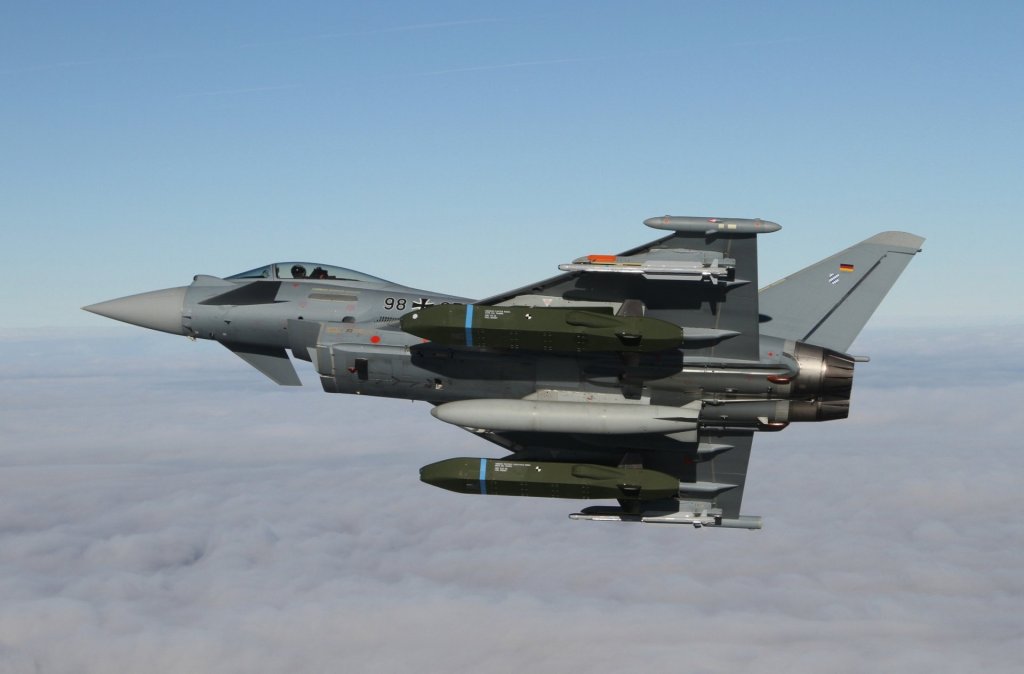
The first thing that’s obvious is that Ukraine doesn’t have anything that can carry the missile which is a bit longer and somewhat heavier than Storm Shadow. It may be too much for the wing mounts on an Su-24 Fencer and Ukraine has just a handful of these left in service. It doesn’t have any of the other aircraft listed either. If it doesn’t fit on the Fencer in pairs, I believe it’s too long and deep to mount underneath one. The question is can it be fitted as one unit to a Mirage-2000? It’s certainly too big for an F-16 or Mig-29. Yet we know that Sweden is on the cusp (allegedly) of delivering the Gripen – and that’s more than capable. The real issue is how far off the ground the landing gear carries the fuselage because you need the clearance. Gripen was designed for rough air strips and open roads and has a longer landing gear arrangement to cope.
So far Ukraine has overcome almost every obstacle put in front of it so there’s no reason to think it won’t do so again.
How Targeting Information Is Supplied to the Taurus Missile
Mission Planning and Target Programming
• Before launch, mission planners program the Taurus missile with detailed targeting information. This includes the precise location of the target, known air defense positions, and the planned flight path to the target.
• The missile is loaded with a digital 3D model of the target area, which it uses for navigation and terminal guidance.
Navigation and Guidance Systems
• Inertial Navigation System (INS): Provides stable mid-course guidance.
• Global Positioning System (GPS): Supplies precise geolocation data. The GPS system is hardened against jamming attempts.
• Terrain-Referenced Navigation (TRN): The missile scans the ground below and compares it with pre-stored digital terrain data, allowing it to fly at low altitudes and avoid radar detection.
• Image-Based Navigation (IBN): Uses onboard sensors to recognize visual landmarks (e.g., bridges, rivers, crossroads) and compare them to stored images for orientation and final approach.
• Infrared Seeker (Terminal Guidance): In the final phase, a high-resolution infrared camera matches the real-time image with the stored 3D target model to ensure pinpoint accuracy, even if GPS is denied.
Autonomous Targeting After Launch
• Once airborne, Taurus follows the pre-programmed route, autonomously adjusting its flight path using the above systems.
• If the missile cannot match the live image with the stored target model (for example, due to unexpected changes on the ground), it will default to backup navigation systems or, to avoid collateral damage, steer to a pre-designated crash point rather than risk an inaccurate strike.
ARGUMENTS AROUND USEABILITY
The German Defence Minister, Boris Pistorius, who is staying in his job under the new government, has argued against sending the missile, not out of fear or the hand wringing of Scholz, but because he has a real point. Namely he thinks it’s far too specific a weapon and its capabilities too specialised to be of use.
There is some merit in what he says, because Ukraine seems to have been more than capable of destroying C3 sites and depots, ammunition dumps and so on without much help or weapons like this.
The counter argument is there are plenty of other sites in western Russia and potentially occupied Ukraine that it could make a difference over. The lack of use of StormShadow and SCALP-EG lately is largely down to lack of missiles – what can be supplied has largely been so and used up.
THE POLITICS AROUND TAURUS
Germany originally ordered 600 missiles and these were duly delivered, but as with everything else relating to the German armed forces this century, the vast majority have been allowed to sink into disrepair. Only 145 are combat ready and it’s taken since 2022 to restore most of those. The rest are undergoing refurbishment with a life extension planned to 2045. So even if Germany gives Ukraine missiles, its unlikely to be overly generous with them simply because it cannot afford to give them all at once or it will have nothing to use if it needs them.
Olaf Scholz first publicly refused to supply Taurus missiles to Ukraine in response to Kyiv’s initial request in May 2023, and he has consistently reiterated this refusal since then. His main reasons, stated repeatedly in public and in Bundestag addresses, center on concerns that delivering Taurus missiles—which have a range of about 500 km—could escalate the conflict by enabling strikes deep within Russian territory, potentially drawing Germany directly into the war. Although he never explained how it might happen and Russia has never responded to the crossing of its alleged red lines over tanks, F-16s, HIMARS, ATACMS, and of course SCALP-EG and StormShadow.
In another Bundestag address, Scholz explained:
“That is a red line I do not want to cross.”
He emphasized that providing Taurus missiles would require German military personnel to assist in targeting, which he deemed unacceptable, adding:
“Caution is not a weakness, but a right owed to the citizens” of Germany.
On February 9, 2025, he reiterated his stance during a televised debate:
“I do not think it is right to deliver destructive weapons deep into the Russian hinterland. That is, I believe, exactly the kind of step not to make if you carry responsibility for Germany”.
Throughout 2023 and into 2025, Scholz has maintained this position, framing his refusal as a measure to avoid escalation and minimize the risk of Germany becoming a direct party to the conflict.
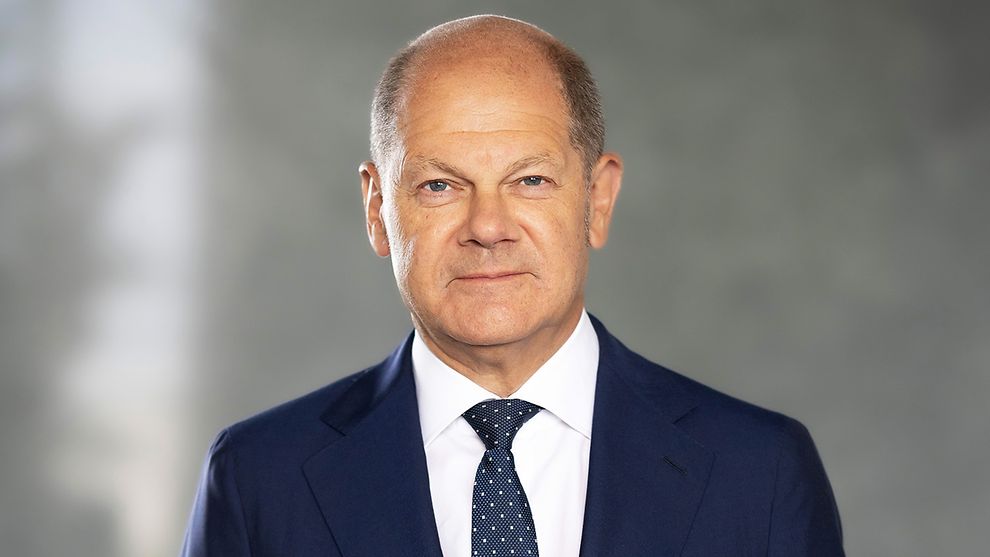
According to the public record there’s absolutely no need for German forces to be involved inside Ukraine in targeting the missiles, and if Spain and South Korea have the equipment to enable targeting of theirs, why would it be any different if Ukraine had that capability? The issue is where does Germany get its targeting information from and sadly that’s almost certainly from US sources – the very source that prevented the UK and France from allowing use of their missiles inside Russia during the early days of the Vovchansk offensive, where they could have stopped the Russians before they started – instead the Ukrainians had to retreat 5km before engaging them on their own territory.
This puts us right in the center of American intel provision for Ukraine – if they stop, it inhibits NATO allies too, so the need for an independent satellite system is vital. So far only France has that capacity, and has said it will use it to support Ukraine when needed.
Scholz seems to have a politically convenient deliberate misunderstanding of the way the missile works, and because the Bundestag doesn’t have the power to insist on supplying the weapons (even though it carried motions urging it be done), its the Federal Security Council (the Bundessicherheitsrat), chaired by the Chancellor that makes the decision, and Scholz was never letting that happen. He was under pressure from the Bundestag, other members of the Bundessicherheitsrat, and his coalition partners but refused to budge.
The German elections resulted in a new largest party (its next to impossible under German constitutional election procedures to ever have a real majority, a deliberate mechanism to stop parties like the Nazi’s ever emerging again – as the AfD has. The principle being as this time, that all of the others would rather coalesce to prevent it happening).
Sholz’s party was never going to be the largest after the elections – he was seen as universally weak and ineffective, so the next Chancellor takes office on May 6 – and Friedrich Merz is very different. He’s changed his position dramatically and gets the threat Russia poses and calls it as it is. He long said that he wants to supply the Taurus missile.
Now having made it clear he plans to do that, his parties, the CDU/CSU and the outgoing Social Democrats – Sholz’s party who have entered into the coalition to gain a majority, have to face a new problem. Russia on Thursday April 17 said it would regard the missiles as Germany involving itself directly in the war – playing right into the hands of Scholz. Others in the SPD support his view, though it’s not really a majority.
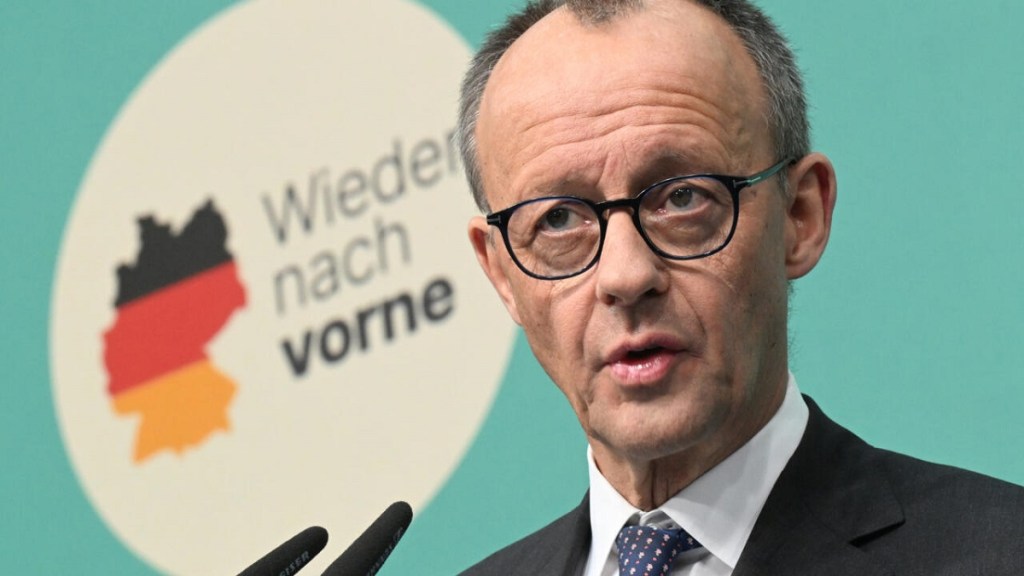
Merz asked Britain and France for backing to supply the missile – the British were an unequivocal ‘yes’ immediately. France was expected to respond in a similar fashion. All this it must be added, on the same day that the American delegation of Rubio/Whitkoff arrived in Paris bemused by Europe insisting on supporting Ukraine, and according to US sources, seemingly failing to understand why Europe just doesn’t give up and go with their plan. They had a meeting with the Ukrainians on peace proposals where it was made clear to them that they had no right to discuss the ceding of Ukrainian territory.
Would the Russian threat be considered as realistic? They haven’t done anything about anything they moaned about and set red lines over before – but even if Ukraine decided it needed to take down Kerch Bridge – a dozen Taurus would do it – there would be a retaliation of some kind, that’s for Ukraine to accept or decide against.
If we took the Russian argument as valid, then any country who uses weapons made by any other is now the responsibility of the manufacturer. Where would that put Russia? One of the world’s largest arms exporters until recently. It’s a stupid argument and they know it, but it’s fun for them to cause trouble with it. Germany must do what it sees fit to do. Send the missiles, and let’s find a target or two worth the time and trouble. If only Ukraine could hit their C3 and HQ in Rostov!
The Analyst
militaryanalyst.bsky.social

 The Military Analyst
I think Scholtz had cold feet because the most likley first target would be Putin himself. If he survived a Taurus strike he would be somewhat unhappy and if the strike was succesful it would be 50/50 whether we get a better or worse leader in Russia
LikeLike
Hi. Taurus is not a poerfull Missile. Its purpose is not a German deterance to hit Russian miss ile Silos etc.
The Taurus is Germanys Atomic Arsenal or better said Germanys Atomic retaliation potencial.
If attacked with nukes by Russia Germany will hit every NPP in Russia within range. (90% of russias populstion in the fallout area) Its like having nukes already in Russia we just need to set off. Us Germans are very praktical 😉
LikeLike