
For some older people the idea of a mutual defence pact between the British and the Germans seems almost surreal. In Russia it is seen as a grotesque alliance of aggressive forces proving that NATO is controlled by aggressive states. It never crosses their mind that they are the reason this came about in the first place.
Even some educated and usually sensible American commentators have equated the alliance to the ‘ultimate German dream’ and another step towards WW3.
Historically before both WW1&2, German Government leaders wanted, or would have preferred an alliance with Britain. But German militarism could never work with the liberalism of British sentiments (though they would not be seen as that today).
One commentator this last week actually alluded to the complex treaties of WW1 that ensured one way or another, everyone would end up at war at some point with the other side. Russia was allied to France, Britain semi-obligated to France but not formally allied. France, Germany and Britain guaranteed Belgian independence and neutrality, so when Germany, who was allied to Italy and Austria-Hungary, invaded Belgium to attack France, Britain was inevitably drawn in. It was Italy that changed to neutral, eventually joining the British & French in mid 1915 on condition it would get certain territories on the Adriatic coast – which in 1919 the Americans and French backed by the reluctant British refused to give it. The Americans declared war on Germany in April 1917 but left it until December to declare war on Austria.
The commentator’s argument that Europe was creating a new mess of interlocking treaties was frankly ludicrous. NATO already exists and there are a number of bilateral treaties – many of them spurred on by Putin’s invasion, that link Britain to several countries.
The May 2022 UK-Sweden & UK-Finland Security Guarantees, which still remain in effect despite their accession to NATO, covered:
Key Elements of the Security Guarantees
• Committed the UK to assist Sweden and Finland in the event they faced aggression, specifically referencing the context of increased Russian military threats.
• Were described as “solemn declarations” and “not a short-term stop gap,” intended to provide assurance regardless of the timeline of NATO accession.
• Specified that military assistance would be provided upon the request of the affected country, with the nature and scale of support depending on circumstances.
• The agreements also covered:
• Cooperation in cyber defence and intelligence sharing.
• Planning and coordination for operational activities, including in hybrid threat environments.
• Ongoing joint military exercises and increased interoperability.
The UK also signed the European Union: 2025 Security and Defence Partnership
• While not a bilateral treaty with a single nation, the UK and EU signed a broad security and defence partnership agreement in May 2025.
• This treaty strengthens operational, industrial, cyber, and hybrid defence cooperation between the UK and the EU, but not with any single European state.
There is also a pact with Poland along similar lines.
The Anglo-French Northwood Declaration I’ve discussed in this article previously: IMPACT OF THE NORTHWOOD DECLARATION on European Security
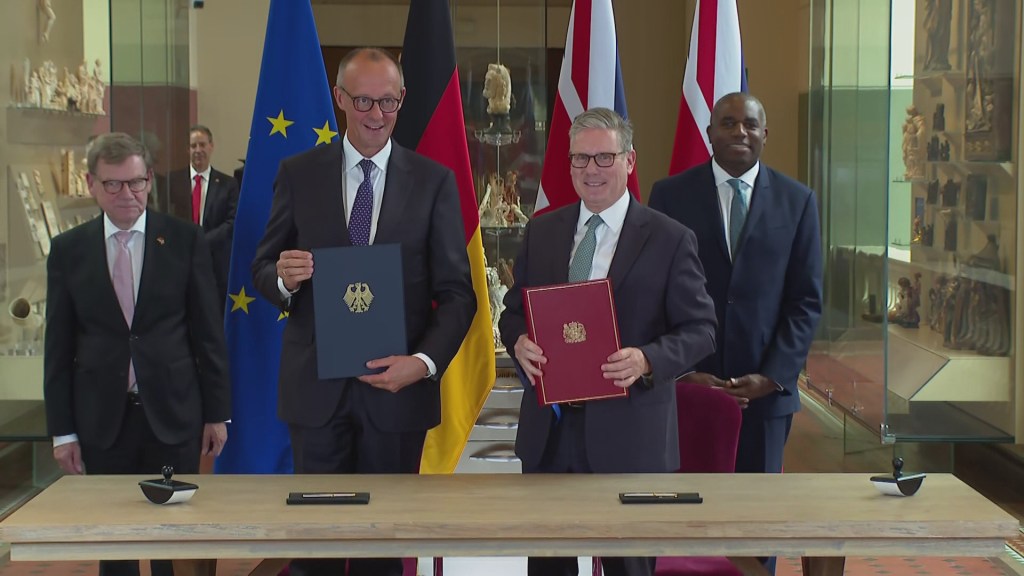
THE KENSINGTON FRIENDSHIP & BILATERAL COOPERATION TREATY, JULY 17 2025.
The Anglo-German defence pact, signed in London on 17 July 2025 and known as the Kensington Treaty, marks the most significant bilateral agreement between the UK and Germany since World War II. It represents a strategic response to escalating European security concerns, particularly regarding the threat from Russia and uncertainties around long-term US commitment to NATO. In effect the very same driving force behind the Northwood Declaration, which was an addition to the 2010 Lancaster House Treaties that cemented Anglo-French cooperation in defence, nuclear testing (simulation), and military cooperation in the event of war.
The Kensington Treaty covers mutual assistance provisions—including the potential for military support if either country faces an armed attack—defence industrial cooperation, military interoperability, and a commitment to regular strategic dialogue.
It also strengthens both countries’ commitment to NATO but establishes an additional framework for bilateral defence action, especially regarding current challenges in Europe.
Another key aspect was the general agreement for Germany to be consulted when issues around the Anglo-French nuclear deterrent posture were being discussed, implying involvement in any possible use. In short the UK and Germany will consult, coordinate, and exchange information regularly on nuclear deterrence strategy and policy.
Bearing in mind that Germany is also part of the NATO nuclear weapons sharing arrangements, which Britain is partly involved in now that weapons are back in the UK under US control, but will eventually fully participate in when the F-35A’s are delivered and certified in the coming years.
Germany may be a non-nuclear state but with the revitalization of its armed forces and the fact it is still the main base for many of NATO’s forces and commands, it is involved and has been guaranteed participation in, all nuclear policy and issues including at at strategic level with the UK and France, especially with American commitments being increasingly unreliable.
In fact this entire treaty is about defining a future path of defence cooperation because of Putin and Trump’s behavior, there’s no other way of saying it. Between those two they have made the world more dangerous and the major European military players aren’t ignoring the problem.

There is also one other major project to come out of this. Britain and Germany are looking at producing a joint long range strike weapon within the next few years. Long range discussions have been ongoing since May but both sides are deciding if this should be a ballistic missile with a range of up to 2,000km or a cruise missile. The UK, together with France, have already signaled that they plan on jointly replacing the Storm Shadow air-launched cruise missile, or SCALP-EG, in French service, through the Future Cruise/Anti-Ship Weapons (FC/ASW) program, led by MBDA. Both Germany and the UK are also part of the multinational European Long Range Strike Approach (ELSA) program that aims to develop a ground-launched cruise missile with a range of 1,000 to 2,000 kilometers. On top of that Germany & Ukraine are producing a long range weapon that’s set to revealed in the next few months.
While all this is good, it strikes me as too much duplication of effort, and that wastes valuable money and R&D resources. I do think that a two system answer is ideal, one long ranged and one short-medium, more than that stands to complicate matters.
Another issue that just isn’t being covered off enough is the development of tactical and strategic drones. Nobody seems to be grasping the nettle on what to build and how. Partly this is a problem with the war in Ukraine, where both sides, but especially Ukraine are developing drone types and tactics at such a phenomenal pace. In the US a Top Gun for FPV drone pilots is being planned next month. Yet at the same time the US-UK Project Vanaheim is unable to keep up with the pace. The introduction of new fiber optic drones wasn’t even on the menu at the last meeting and Vanaheim 3 wasn’t even where it needed to be. The Vanaheim 4 meeting is somehow expecting to come up with purchasing ideas for test drones.
Yet other than Ukraine, the UK and the US few others are taking part and the Ukrainians can’t get over how slow the process is going. It’s a question of urgency and there are too many competitors, not enough informed direction and the urgency isn’t there because the need still isn’t fully appreciated by those making decisions.
This lack of European defence talk on drones should have been addressed with France and Germany. Germany especially has manufacturing capacity for certain types of drone – loitering munitions especially, What Ukraine needs are viable interceptor drones and it will take all of Europe to make that happen.
More conventionally the Germans and the British will still manufacture components for Eurofighter for export sales, but not for domestic buys, as both shift to the F-35 on one hand (Germany makes the body shells for many) and the UK moves towards Tempest, which is genuinely looking to see service entry by 2035. There’s a real determination to make it happen.
Overall I absolutely approve of all of the bilateral treaties – mutual cooperation is essential. But don’t waste time and resources on these new missile programs – they’re needed soon, get on and make it happen.
Somewhere along the line a UK-Europe move on the industrialization of drone unit manufacturing and finding ways of keeping up with fast paced development will be essential.
When the war ends so will the rate of change reduce. But Europeans have to know that one type of drone might have a shelf life of six months so they can’t just have a staple drone that lasts ten years. They have to be able to scale up production almost overnight from pre-set designs that adapt almost daily.
Nothing of this was covered in any agreement and that concerns me deeply.
The Analyst
militaryanalyst@bsky.social

 The Military Analyst
Many thanks TA, an excellent overview of what is happening, and more importantly what isn’t. The slack response to the need for drone manufacturers is quite bizarre. Clearly Europe and the EU just don’t get it. It reminds me of when I joined a startup division within the American communications company I worked for. It was the best job I ever had. No rules, we made it up as we went along. Four of us looked after the world outside of the US. I worked alone in MEA plus the UN account. It lasted about 5 years, then the envy of company politics took over and the whole project died within months. I jumped just in time to an extremely boring role in the same company! I didn’t stay long.
LikeLiked by 2 people
I am guessing that the majority of parts for drones can be made by 3d printing. If this is the case then a huge batch of 3d printers should be available and with 3d printing it would be able to vary the output and designs to keep up with changes physically but I do not know about electronics and AI. I am probably being a bit simplistic.
LikeLiked by 4 people