
TRADE, TARIFFS & TENSION
The Chinese Government lies. Constantly. Its almost impossible to believe anything they say and they rarely keep to a deal unless its in their interests to do so, and if it is in their interests that means it almost certainly isn’t in yours.
Trading with China is done on Chinese terms. if you want to export into China you do it their way. If that means losing the rights to your trade secrets and intellectual property, that’s the price you pay. Operating services means obeying laws that go against the very fabric of what you stand for. Companies like Apple and Google have found that out all too readily. Apple simply swallowed its pride because of the amount of money they could make in the vast Chinese market.
Yet it’s much more complex than that. China has huge foreign currency reserves – especially in US dollars. Chinese banks buy US Sovereign Debt in the form of bonds, funding the US administration for a good return.

US governments have stupidly, resorted to tariffs. The incoming president has no idea how they even work. He thinks China is paying tax to the US to sell its goods here. What actually happens is the company importing the goods pays the tariff at the port of entry, to US Customs. They pass that cost on to you, the buyer of the product. It’s the consumer who pays, putting up inflation and simply making goods people want unaffordable. The idea of a tariff is to protect a domestic industry that could not otherwise compete. Those domestic industries more often than not barely exist anyway, because the manufacturing was deliberately outsourced to China.
The electric car industry is one America could make huge strides in, it could innovate and compete and be driven to do so because it faces stiff competition from companies like BYD in China, whose cars are more advanced, better built and cheaper. Rather than improve US manufacturing or give them an incentive to compete, 100% tariffs simply stop any competition from being imported. That doesn’t make for a better American product (or European one for that matter), it allows them to sit and stagnate and do nothing because that’s the most profitable and cheapest thing to do. Yes, Chinese state finance provides the means to boost these industries, but who let China get this rich in the first place? If America means to compete it must think and act long term.
The Chinese then retaliate and make life more difficult for American and European countries to sell there, so the tariffs in the US and Europe force the Chinese to absorb their own car production on the domestic market. They don’t use tariffs as much to deter imports, they merely make it a matter of patriotic duty to buy Chinese products and stigmatize being seen driving a European or American one. And they do that with incredible success. The same happened to Apple iPhones. It became patriotic to buy Huwawei, because the west was picking on Huawei for supplying compromised 5G communications equipment. iPhone sales plunged in China because of it. When the US placed high tariffs on Chinese goods, China had been buying billions of dollars of soy beans from the US as a partial show of trying to redress the balance. What did China do? It stopped overnight and changed its entire soy bean buy to Brazil, a massive logistics undertaking and shift in the market. It left American soy farmers high and dry and forced to find a new market, eventually in Europe, but not before many farmers had gone under.
Yet despite all that, from clothing to desk lamps and a plethora of other products, it’s next to impossible to buy anything without finding ‘Made in China’ on it. Even Japanese food sold in the west is largely made in China.
It’s the scale of the trade deficit between the US and China that’s horrifying. In October 2024 the Chinese made $33.5 billion surplus in their favor. Over the first ten months of 2024 it already stands at $291.38 billion in China’s favor.
This rarely changes, take 2022: In 2022, the U.S. trade deficit with China was $382.9 billion, marking an increase of 8.3% from the previous year. This deficit reflects the difference between U.S. imports from China, which totaled $536.8 billion, and exports to China, which were $153.8 billion. America mostly doesn’t make anything China wants or can’t produce for itself. One of the few exceptions is agricultural products.
Overall, the trade relationship between the two countries remains unbalanced, with China exporting significantly more to the U.S. than it imports, contributing to ongoing economic and political discussions about trade policies and tariffs. It will remain compromised unless the US rebuilds its own industries – which it cannot do cheaply, or as efficiently as the Chinese can.
Taiwan as an example, has been building a microchip plant in the US. It found the workers slow, poorly qualified and unmotivated to the point it actually requested permission to bring in Taiwanese workers from Taiwan – and that was just to build the factory. Competing, really competing, with China is going to require a huge change of mindset and industrial strategy. I don’t think the US is capable of it, and the new administration prefers to cast blame, rather than actually solve the problems. And the blame game is going to be the cause of a great deal of friction.

Another key element that China has and is very difficult to get around, is that it is in control of around 70% of the world’s rare earth elements, and 90% of the refining capacity for them. These materials are : Lanthanum (La), Cerium (Ce), Praseodymium (Pr), Neodymium (Nd), Samarium (Sm), Europium (Eu), Gadolinium (Gd), Terbium (Tb), Dysprosium (Dy), Holmium (Ho), Erbium (Er), Thulium (Tm), Ytterbium (Yb), Lutetium (Lu), Yttrium (Y), & Scandium (Sc).
There is barely any modern piece of technology from a nuclear warhead to a nuclear reactor, to a parts for an iPhone, advanced radars, missiles, microchips and specialized industrial equipment that doesn’t need one or more of these materials in some small measure. They cannot be made without them. And China has a chokehold on the supply. You can imagine where that puts the US defence industry, and they know it. Yet even so, it’s taken years for the US to allow The Cowboy State Mine (CSM) in Wyoming, operated by American Rare Earths, to get up and running. At least a refinery now exists; Phoenix Tailings has established the first rare earth metal facility in Massachusetts.
Everywhere you turn there are areas of potential trade conflict, resources conflict, geographical conflict, political conflict and simple idealogical conflict of the old school variety. The United States is trying to defend its position as chief economy and political-military power, against a dictatorship that loathes everything Americans stands for while craving everything that it is at an individual level.
Between them is the Pacific Ocean, three island chains and a handful of American bases.
CHINA’S COMMERCIAL-MILITARY WEB
China has so much money in foreign reserves that right now it has some $3.261 Trillion in Euros, USD, and other currencies. It has used the money to loan to poor governments or needy/desperate governments around the world. It gives them what they want and more, knowing they might not be able to pay it back. Then under the contracts it signed, when the default occurs it takes payment by taking full ownership of the project, system, facility or otherwise that its built or sold.

It refuses to use local labour, importing Chinese workers from home into Africa, South America, Asia, the Middle East. These projects rarely benefit anyone but the Chinese. They pay for it, they own it, they operate it and they keep the profits. The locals gain little.
They own everything from major automotive brands like Volvo in Sweden to British steel manufacturing, to the Greek port of Piraeus and the German port of Hamburg – which Olaf Shulz was mayor of and forced through the sale as Chancellor last year against multiple security concerns. The tentacles of Chinese commercial imperialism are everywhere. From hotels to airlines, even to sensitive government suppliers in many countries. That much money gives them huge power.
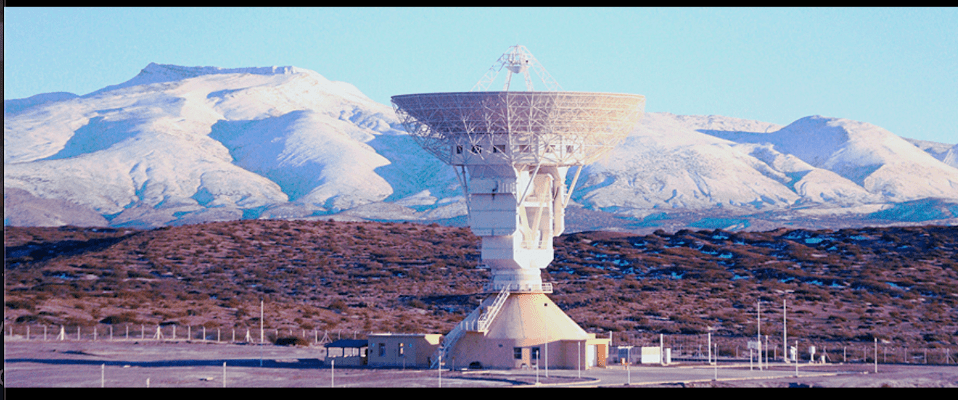
And they use it too, to take over strategic ports in the Indian Ocean, they built a tracking and spy station in Argentina located in the Neuquén province, 18 miles from the village of Bajada del Agrio in southwestern Argentina. This facility, known as the Espacio Lejano Station, occupies a 200-hectare compound and was established through an agreement between China and Argentina in 2014. The area is considered Chinese Sovereign Territory, an extraordinary concession. Argentina has no rights to enter the site and can use 10% of its capacity per year for its own use, which is 2 hours per day and in reality mostly redundant – and done remotely. The site is China’s until 2064.
China has naval bases in the Horn of Africa at Djibouti and port rights in several other African countries. It’s expected to have its first base inside the NATO operating area (above the Tropic of Capricorn) within a couple of years.
China is literally everywhere, often unseen and unappreciated by western audiences. It is a concerted commercial and military operation to ensure that Chinese interests and influence are heard and seen. That includes a vast disinformation network, infiltration of academia and universities, and concerted efforts to embed pro-Chinese influence in every government and legislature. The country is awash with foreign currency and it uses it to buy and peddle influence globally. Even to the point where western social media will often delete posts that are overtly contrary to Chinese interests. Tik Tok is a notorious Chinese information gathering tool and manipulation front. The recent Rumanian elections go to show how much that was used by Russian and Chinese agents to influence the way that operated. So much so that the Romanian Supreme Court had to overturn the result.
Control over Chinese citizens abroad by coercion, family pressure, or simple harassment and bullying – even to the use of illicit Chinese police stations in western democracies has been rife. They will push every limit, there is no red line they seem unwilling to cross. Add to that next level cyberwarfare against western institutions – the so called Typhoon Operations. ‘Lightning’ designed to break infrastructure, electricity grids and cause harm. ‘Flax’ a massive botnet project to link the internet of things and use them to take down websites using DDOS attacks. Four times in recent years this has been deployed. And then ‘Salt’, which is a never ending operation to obtain data – usually on people. This past week it’s been revealed that the Chinese obtained a US Federal List of people the US knows are working for China. So now China knows which of its operatives are compromised. They’ve stolen Federal pay role data, and so much else its almost too much to catalogue. And that’s without the military and defence espionage operations which are off the scale. China is know for example to have copied the C-17 Globemaster-III heavy lift cargo plane from stolen specifications, along with the B-2 bomber – that case involved the designer of the propulsion system handing over secrets and is now in court. The E-2 Hawkeye naval AEW aircraft, a new remarkably F-35 similar jet fighter just broke cover. When the USN recovered a Chinese torpedo used in a live fire drill some time ago, they found it was an exact copy of the USN’s own Mk48 Torpedo – they didn’t even know the Chinese had stolen the specs.
It seems almost impossible to believe that at some time these two powers will not lock horns. Neither can afford to upset the other and end up in conflict, yet they are working almost at every level against each other’s interests. The new American administration seems willing to focus on China to the exclusion of much else. The Chinese don’t like it when they’re held to account and face being told ‘no’. They will react badly to red lines because they believe their time has come. They have one real weakness in military terms and that they’re trying to rectify at lighting pace.
NUCLEAR WEAPONS
China exploded its first nuclear weapon in 1964 – the recipient of Soviet aid the Russians already regretted giving them before they even detonated the device at Lop Nor in the western desert. There is extraordinary video from the detonation that explains the achievement the CPC felt it was at the time.
As a nuclear cloud rises into the clear sky, Chinese horse cavalry – even the horses wear gas masks, race towards the black mushroom cloud as it rises. It’s utterly surreal.
Despite this China never went in for the nuclear arms race. It kept a very low nuclear profile for decades, rarely exceeding 200 warheads on quite basic IRBM’s and ICBM’s. They had in their opinion, enough to retaliate with. Even by 2015 it was estimated China had no more than 250 nuclear warheads. They have never believed nuclear war winnable. One thing you can at least admire them for.

However the number of warheads under Xi Jin Ping has doubled to around 500. China has started to deploy SSBN’s with at least 12 missiles. Larger 16 missile submarines are expected based on Russian technologies, and even 18 missiles have been seen on one design.
In addition china has started building a huge number of missile silos in the deserts.
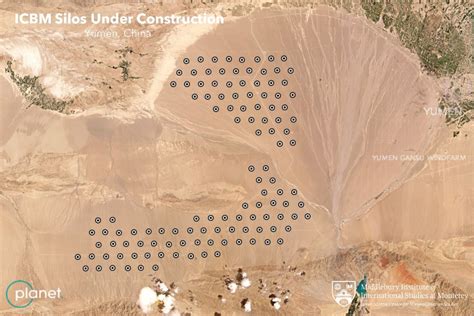
China is reportedly constructing a significant number of missile silos in its desert regions, indicating a substantial expansion of its nuclear capabilities:
• Yumen Site: In June 2021, satellite imagery revealed that China was building at least 119 underground silos for intercontinental ballistic missiles (ICBMs) near Yumen City in Gansu province. This site covers approximately 1,810 square kilometers and includes multiple command bunkers.
• Hami Site: A second silo field was identified near Hami in Eastern Xinjiang, about 380 kilometers northwest of the Yumen field. Construction at this site began in March 2021 and is nearing completion. The Hami site is expected to eventually house around 110 silos.
• Jilantai and Other Sites: Additional silos are under construction at Jilantai and possibly in other areas, bringing the total number of new silos under construction to approximately 250. This expansion exceeds the number of silo-based ICBMs operated by Russia and represents a significant increase in China’s silo-based nuclear capabilities.
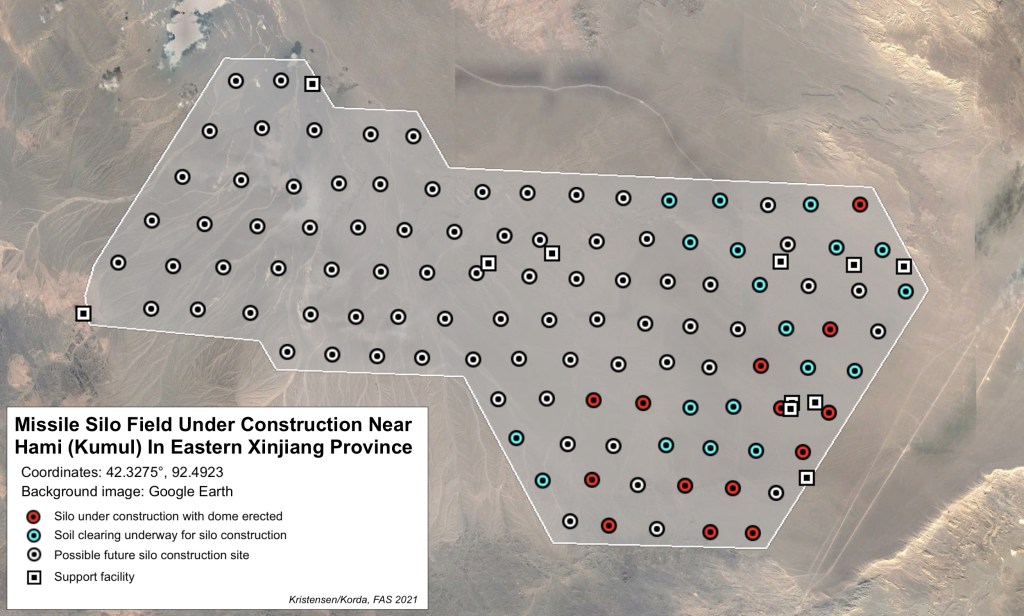
These developments suggest that China is rapidly expanding its nuclear arsenal, potentially increasing the number of warheads on its ICBMs significantly if these silos are fully utilized.

So the question is why? The answer is so that if it ever comes to a place where the US & China have to face off, the lack of strategic missiles that match those of the United States in quantity and quality, doesn’t leave China open to American nuclear blackmail.
Of course that puts America in the a position where it has China holding the biggest nuclear stick, Russia the second and itself the third. That’s just not a position to be in, which means the US will, after February 2026 when the Russia-US New Start treat runs out, be faced with having to build more missiles and silos. It cannot be in a position where it’s outnumbered two to one. Yet it’s already struggling just deploying the Sentinel-ICBM and refurbishing the existing silos. Yet another pointer to the appalling loss of capacity and capability in the American military-industrial complex. They can’t even build new silos with any urgency – yet they managed over 1100 in the 1960’s in record time. Yet again China demonstrates that its industrial capacity is vastly in excess of anything America can manage or even begin to match, without extraordinary effort and investment that simply isn’t forthcoming.
So where does this end? In war? In compromise? China doesn’t compromise. It will lie and make you think it has but it will just go about reaching the same goals a different way that’s not immediately apparent.
However clear military force and a visible powerful military deterrent can and does calm things down. If the Chinese see weakness, they will simply exploit it. Only strength and believable determination will keep them in check. They must know you mean what you say and believe you will do what you say you will.
And most of all they must know that the cost of doing anything militarily will outweigh any gains.
The Analyst
militaryanalyst.bsky.social

 The Military Analyst
Why in our democracies we let all manufacturing go. It’s a mistake from the last 20 years and we keep doing it. The only explanation I can find is greed.
LikeLiked by 1 person
Profit and it goes back far longer than 20 years sadly. However it’s not as cheap to make in China as it was. Vietnam is taking the challenge up on that front. We as consumers are unwilling to pay the prices of producing at home. We have lost the skills or the desire to produce it and learn the skills to do so.
LikeLike
The best source of often nuanced info on a wide variety of current national economic, political and military aspects, the interplay between which will determine the outcome of this attempt to transition world power realignment.
I find this all very rivetting stuff and would like to say thank you for sharing this knowledge in this, my first ever post having joined this App on your advice.
Regards
Gary
LikeLiked by 1 person
Thank you Gary, and welcome.
LikeLike
That is entirely true, especially in regard to the effect of tariffs. Tariffs are a simpleton’s response to trade imbalance.
The CCP has become a monster of our own making, with complexities hanging over from the Chinese Civil War complicating matters – particularly Taiwan and the escape of Chiang Kai-shek from the clutches of Mao. The US had allowed Taiwanese rule to transfer from Japan to KMT ruled China in ~1947. The CCP defeated the KMT to take mainland China in 1949. This 2 year period is the total time China has ruled over the whole of Taiwan…ineffective as its rule was. The CCP’s claim over Taiwan is actually a vendetta between two dead tyrants.
When Nixon and Kissinger capitalised on the rift between Mao and Brezhnev during the chaos of the so-called Cultural Revolution, he did so through the singular lens of Cold War geopolitics.
The US caught the Soviets off-guard, but it was a Pyrrhic victory. The CCP was gifted recognition as the legitimate ruler of the PRC; a permanent seat on the UN Security Council at the expense of the KMT’s RoC (Taiwan), and the progressive removal of trade barriers. Mao died only a few years after Nixon’s famous visit, in 1976. Chiang Kai-shek in 1975. The civil war in China should have ended with the death of these two tyrants, but it remains.
The thinking behind giving the CCP access to trade was that if they could prosper, they would surely choose to liberalise. Right. With the benefit of hindsight, we can see that the leopard failed to change its spots. The CCP allowed its people to gain some prosperity, provided they stayed in their lane. The CCP trousered most of the benefits.
However, China is anything but invulnerable. Its demographic profile is appallingly bad, with an aging population and a disillusioned youth. Decades of single child policy designed to protect itself from over-populating has left it with a generation of “Little Emporers” and “Little Princesses”, doted on by parents and more so grandparents starved of the typically large families revered by Chinese culture. The children become adults, and suddenly things are demanded of them rather than gifted to them. Harsh.
The single child policy has been abandoned, yet the birth rate has not recovered. Last year, 9 million births were recorded in China. With an average life expectancy of 76.6 years, that will support a population less than half the current 1.4 B. The demographic profile is the inverse of what a modern economy requires. The retirement age for Chinese is significantly below western standards. It’s a recipe for disaster.
Defeating Russia will do more to deter the CCP’s hawks than superpower weapons. However, western nations need to reflect on the geopolitical reality: the era of getting fat and happy on the back of the so-called “Peace Dividend” is over. We need to gear up militarily, and strengthen our entire way of thinking – from information systems to political processes. We also need to become more nimble. Dictators are rarely ever nimble – and if they are, it doesn’t last.
The CCP has more vulnerabilities than it has strengths. Let’s not forget it, but helping Ukraine to WIN rather than merely survive is key.
LikeLiked by 1 person