
I’d like to take a look at the war from an alternative perspective. We’re used to having what gamers call a ‘god view’ of the war. We look down onto maps of frontlines, in a war that for the first time has high resolution images good enough to see dead bodies on the ground and every tree line and broken tree. Technologically that’s amazing. Neither side is able to hide much from the other.
In recent months we’ve become concerned about how much ground Ukraine has lost. In and of itself that’s entirely reasonable. When it’s put into words using phrases such as “Ukraine lost an area the size of greater London in November alone”, you have some idea of what that means. London is huge. As a percentage of England it is. In Ukraine its not so much of a big deal. its not like you want to lose it, but its not the end of the world if you do. Far from it.
And perhaps the point is, that even with all of Russia’s advances – and they are relentless – if we take the Donbas/Luhansk border and the furthest extend of the Russian advance south of Pokrovsk as of yesterday. It was just short of 42km. It took them 2 years and 10 months to get that far.
One analysis states that Russia has lost just over 50 men per square kilometer it’s taken. That’s a shockingly high number. Was it really worth that much? To Putin it would seem that the answer is yes.
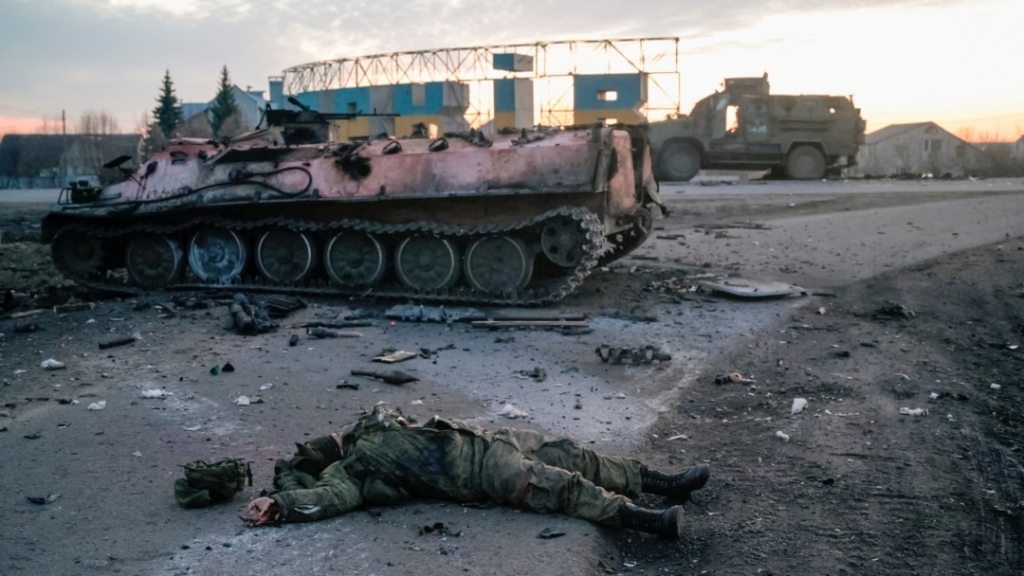
What do these gruesome stats tell us? 755,000 dead and mortally wounded. Almost everything from the Soviet era arsenal lost, from tanks to artillery. Men thrown relentlessly into battle because at the top of the Russian command chain, they accepted that they can’t win a war of mobility, but they think they can win one of attrition. Even if that means killing a million men to reach the desired goals.
The Ukrainians know they can’t get their land back by force. But they do know they can defend what they have with such ferocity and at such expense to the Russians, they can make the cost unbearable. Its unbearable alright, to the Russians who die, to their families and to the next wave of human assault meat that gets thrown against another Ukrainian machine gun position, as drones rain down, artillery shells explode and anti-personnel mines rip off another Russian leg.
However it appears to not bother Putin. He actually spoke to the very lucky ones who had a prosthetic leg replacement, asking them coldly, ‘so have you adapted to your new situation’? Almost as if they’d moved desks in an office reshuffle.
Well they won’t have a choice but to adapt, because the chances are they’ll end up back in the front lines. Nobody gets invalided out, they get sent back. If you’re under contract and injured with a viable repair, off to the front lines you go.
Putin has no connection to ordinary people, he has no idea what it’s like to fight on the front. Other than a command centre he’s been nowhere near it.
The decision to fight this war on the basis of incrementalist principles, knowing it would be deadly, knowing that manpower could be a problem if it didn’t go well, and it hasn’t, despite the advances, is another of Putin’s strategic mistakes.
He accepted the concept presented to him. He knew it would take a lot of men. Did he think it would take this many? Probably not, but as the old saying goes, ‘in for a penny in for a pound’ or should I say kopeck and rouble? Does anyone even remember the kopeck? 1/100th of a rouble? Probably not, because like so much in Russia, it’s a valueless anachronism and another symbol of cultural, physical and national decline.
The problem for Putin is he’s now set on a course, fixed on a strategy for the war he now can’t escape from.
And he’s peaked. I honestly think Russian manpower has peaked. The North Koreans partly prove it, the chronic labour shortage in Russia proves it, there’s nobody left to send to the front without impacting an economy bursting at the seams from inflationary pressures and fiscal issues, so profound the whole lot could explode and unravel any second.
Nobody can make anything any faster than they are because there’s nobody left to drag into the factories to produce it. And that means there’s nobody left to recruit without turning to forced mobilization. And that is something that might just get the people out on the streets. It would be an admission of failure, that the war was stuck, nowhere near being won and costing more than anyone ever imagined. It would mean highlighting the manpower problem and questions will be asked. So where are the 1.4 million you already recruited? Oh, so half of them are dead and you want us to join them?
The economy is on the brink of collapse, every day is a miracle that it hasn’t. One really low price for oil that sets it below the $60 line and Russia is done. It’s now a question of if they can keep oil and gas flowing long enough and the economy at 110% of capacity without blowing it up, that the army doesn’t grind to a stop. Can they get a deal out of Ukraine and end the war on Russian terms?
Ukraine knows the Russians are bleeding hard. Its defenders take down as many of them as they can. They fight an ingenious defensive war giving ground only when they must and taking out as much Russian manpower and equipment as they can find.
They know it matters. A few meters here for anther Russian tank and half a dozen infantry? It’s worth it. Because they know, that one more dead Russian is another one closer to ending the war and starting the long road to getting their land back, saving another civilian life, another drone raid on a major city, more cruise missiles into a hydro electric dam. Every meter counts, because every meter Russia takes is just another marker towards its eventual doom.
The end is coming for Putin and Russia as we know it. Like Syria has demonstrated yet again. You never know how it will happen, how it will come, how fast it can come out of nowhere. Just when you least expect it.
Germany in WW1 – which is Russia now, came shockingly close to winning the war in 1918. Operation Michael broke the frontlines and the Germans looked like they might capture Paris, it took everything they had left, they clawed to within meters of success, but it was just not quite enough. The home front was melting under the pressure of the war, the troops had had enough. In the space of three months the whole front collapsed, retreat after retreat and defeat, the Kaiser fled, the armistice was signed on November 11th and the German troops just got up out of their trenches and waked home. Just like that, the carnage was over, the fighting stopped. Nobody saw that coming like that either.
Russia can’t keep this gong much longer. Ukraine is slowly but surely winning the attrition war.
The Analyst
militaryanalyst.bsky.social
Slava Ukraine !

 The Military Analyst
To paraphrase Agent Smith from the Matrix:
“Do you hear that sound, Mr Putin? That’s the creeping sound of inevitability…”
LikeLiked by 2 people
Always felt that Ukraine would not win by brute force (re-taking territories via armed forces), but just by holding back Russia enough time for it to collapse on itself.
It only needs determined enough allies to support it until such time comes. Question is – which one will come first ? Russian collapse or allies war tiredness and incapability to understand the consequences of not doing enough – for long enough.
LikeLiked by 2 people
Just to correct the brief lesson on german WW1 history a little bit.
The Kaiser did not flee – he was in his great headquarters at Spa, when he more or less was resigned by Reichs Chancellor Max von Baden who proclaimed his resignation without the Kaiser ever resigning by himself.
So after that Max von Baden resigned and transfered the authority to Friedrich Ebert (SPD) out of fear of a sovjet style revolution, this led to the proclamation of the democratic republic, while only hours later a sovjet republic was also proclaimed.
Welcome to civil war…
LikeLiked by 1 person
From Emil Ludwig’s Kaiser Wilhelm-II:
THE FLIGHT
But would not the uniform speak-the uniform he had worn for fifty years? would not the spirit of his forebears cry out for the wildfire deed,
the hot-headed splendour, the old Hohenzollen knightliness? A thousand speeches in the past-now one speech in the living present! Ten words to his assembled officers:
“To the frontl To battle!” and with the Old-Prussian Hurrahl a human rampart would have closed around him in a minute. A prince in arms would have done honour to the dead, and saved the living.
… After all he had made up his mind to go. … Quite simply, quite unaffectedly. But when he came to the signature it occurred to him that the scene was historic; and with ceremonial stiffness he signed the artless page.
When his son came to see him next morning, he was gone. Nobody held the Emperor back-the saddest of all epilogues.
In the grey of dawn he and a few of the faithful had driven westward in motors.
There was no time to make any arrangements, nor did they dare to use the wires, already tapped in every quarter. And so it was virtually the first and last escapade of his life.
The frontier was not far away. The cars drew up.
The frontier-guard in his Dutch uniform refused to let German officers pass. His officer was sent for. For a moment he thought he must be dreaming; then he knew what to do: Telephone to The Hague. For the present he conducted the gentlemen to a little iron waiting-room.
But before those at The Hague-the Ministers and the Queen —could make up their minds, six hours went by.
At last! The officer, saluting, comes into the waiting-room. ” The gentlemen may pass.” With leaden heart the Emperor goes to his cars, he even forgets, to-day, to hide his withered arm under his cape. A soldier sits in front, escorting the distingwished prisoners. The engine throbs-the car drives on into the alien land from which there will be no home-coming.
Fainter, ever fainter. .
Soon the Emperor can scarcely hear the groaning of his land.
I’ve read four biographies of the Kaiser. At no point have I ever considered it less than he was forced to flee. It was that or his life in the opinion of almost everyone else. Ludwig even titled the chapter ‘The Flight’ – it’s certainly how he saw it. It’s a first edition printed in 1926. A somewhat more contemporary view than is common now.
LikeLiked by 1 person
I am about to embark on Harald Jähner’s Vertigo – a new history of the Weimar Republic, have you read it?
LikeLike
Well I think I have it in my library – need to take a sharp look, but I think I have it – which does not mean I already read it.
Concerning the Weimar Republic I always recommend Ursula Büttner: Weimar – die überforderte Republik (the overburdened republic) – not sure if this was published in english – but I would say this is more or less standard literature for the history of weimar – a good written one to.
Concerning WW1 – I would recommend Jörn Leonhard – History of WW1 and also some kind of standard – I think you know that for sure – Christopher Clarks Sleepwalkers
LikeLiked by 1 person
If you would like to read a book from the era, I highly recommend Bertrand Russell’s The Problem of China (1920). It includes a significant section on the history of Japan and the rise of the Genro; the adoption of Shinto as the “national religion”; the role of the Emperor; and then China itself.
Russell was a gifted British eccentric, with a phenomenal mind. He predicted the inevitability of war between Imperial Japan the the USA, and the inevitability of US victory. What’s missing is the rise of the CCP, which had not yet had its first meeting in Shanghai. However, the Kuo Min Tang had been in power for several years. I found it fascinating.
LikeLiked by 1 person
Thank you for your view, gave me something to think about. It might be a german view on the history, but I recon that the Kaiser left for the great headquarters (more or less pushed by his advisers – well you might call it flight – but I do not know if he has ever considered not coming back to Berlin). It was, well, a very unkaiserly leave in a hurry, not a lot of pomp and hoorays left. I agree with you on that – absolutely. I think he could not even imagine that he, the so “loved” Kaiser, would be stripped of like a pair of dirty and worn out boots even though he left or fled to Spa (advised to do so by his inner circle) to avoid beeing forced to resign. He could not imagine what happendend then. But I have never seen it as a flight, more a very hastily departure.
But I do not think that his life would have been in danger – there would have been enough troops on the Kaisers side to avoid him being endangered like the Tsar in Russia. I
But Max von Baden announced his resignation without the Kaiser ever resigning – and that was the end for the Kaiser. But what was done was done. Can you imagine Putin leaving Moscow for North Korea and than being granted asylum, residing somewhere in Pyönjang, till he dies? … Or Medwedew announcing his resignation…
And thank you for the book recommendation – never read Emil Ludwigs “WII” … Well, I will dig into that sooner or later.
And thinking about it – we are on the same side… And otherwise – i am with you comparing Russia to the late WW1 germany – thats quiet fitting.
LikeLiked by 2 people
Thank you for your insights again. I am wondering if Putin will try and sign up all those Syrian armies that are running away?
LikeLiked by 2 people
Iran might.
LikeLike
Is there a religious difference there Sunni/Shiite?
LikeLike
Could be as they are all mixed up in parts of Syria – and there’s the Alawites on the coast, a different sect.
LikeLike
I read this with interest. I have followed your long held view that the Kursk salient was a mistake in the past. Taking scarce experienced resources away from the eastern front, not being sustainable, strategically not of value, no it drawing away an ‘assets’ from the other areas as the FSB are in charge.
So does this article indicate that perhaps the reverse of the Russian WW2 strategy of drawing the Germans East in winter to exhaust them is exactly what Kursk and the withdrawal to the West is how the Ukraine forces are smashing the Russians. Kilometres in exchange for massive equipment and manpower sacrifice?
Is this as a result of a re-appraisal or just what was presented before. How say you on Kursk now?
LikeLiked by 1 person
In short. It was a rash and ill thought out means of raising morale and they didn’t really know what they were doing it for. They worked it out as it advanced.
The Russians did what they do and the Ukrainians were taken by surprise when the counter attacks started. The Russians then screwed up the counter attacks as only they could. Since then it’s been useful for Ukraine but it’s a lost game. Right now it has some value because of the way Russians behave. Overall I still think it was largely a mistake. They’ve managed to make the best of an error of judgment.
LikeLike