
Sometimes coming third is being the best. China and Russia have gained a huge advantage in the fielding of hypersonic weapons. China more so, because we know they have capable long ranged systems that meet the full design specifications of what it really means to be a hypersonic weapon. Russia has done little more than chop the top off an Iskander, called it Kinzhal and make a two stage aero-ballistic missile strapped to the underside of a Mig-31, whose specification is devoted to carrying just that one weapon. This type of weapon was developed in the 1960’s. Russia’s is nothing new, demonstrated by how often Patriot’s have shot them down.
The US has adopted a different type of strategy that could just as easily play well in Europe against Russia as it could in the Pacific against China. That strategy has informed its weapons development program and we’re now starting to see how that is coming together.
POST COLD WAR
The ATACMS systems and its developments were part of a Cold War era requirement to replace missiles like Honest John and give the US a longer ranged multi-function missile in Europe that wasn’t nuclear and sat beneath the Pershing-II which was. By the time manufacture began in 1986, and it was deployed in 1991, certainly before it could be deployed in any numbers, the Cold War was over. However the first and second Gulf Wars suggested such a missile might still have a place and the US continued to build newer and more capable versions until 2007. At that point no replacement was envisaged because there was a sizable stockpile. 4,000 were built of which around 3,400 were available before Ukraine started receiving longer range ones late this year.
However the US is very aware of the need for the ATACMS until new systems come on stream and are available in sufficient numbers, so has been reluctant to give Ukraine as many as it might like.
NEW ERA, NEW WEAPONS
The overall strategic situation has changed, with China now presenting as much of a military threat as Russia did in the past. While Russia was primarily a land combat scenario and still is, China is a totally different challenge, dominated by what American strategic thinkers call ‘The Tyranny of Distance’.
As such, speed and range matter more than ever. Range matters because the number of potential launch sites in the Pacific for a land based system is limited, and range increases the places to hide the launch system from a first strike attack. In Europe the same applies, and while Russia is far closer, its still a huge country and hitting valuable targets with conventional weapons is a major boost in effectiveness, and therefore a powerful deterrent in the first place.
Speed is crucial because of the distances involved, especially in the Pacific. A cruise missile that takes two hours to reach its target in Europe is one thing, but waiting five to six hours to reach its target in the Pacific – unless its target is land based infrastructure that can’t escape – is just not viable.
The answer is to increase the range, increase the speed and cut the time frame – and only true hypersonic weapons can do that.
TRUE HYPERSONIC WEAPONS ARE GAME CHANGERS
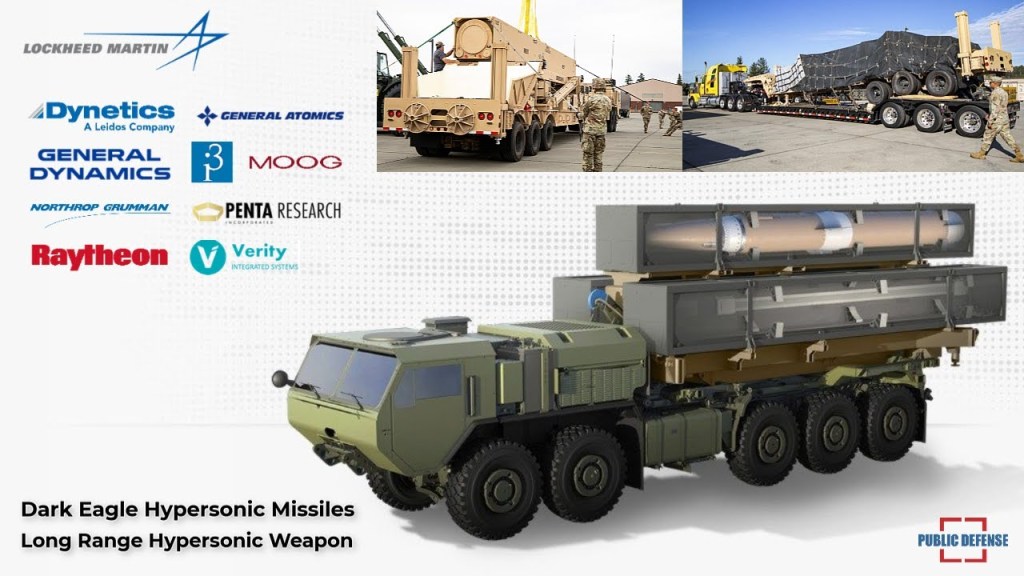
The latest US system, Dark Eagle, is an Intermediate-range, surface-to-surface boost-glide hypersonic weapon. Its acronym is LRHW – long range hypersonic weapons, not especially imaginative.

Developed by Lockheed-Martin and Northrop-Grumman, with Dynetics building the hypersonic glide vehicle, it reaches peak speeds of Mach-17 (12,937mph or 20,825kph) with terminal speeds of around Mach-5 (3,805mph or 6,124kph). At speeds like that there’s almost nothing currently capable of defending against such a fast object. It would be traveling at 1.057 miles(1.7 kilometers) per second, even at sea/ground level. That’s believed to make it faster and more dangerous than even the latest Chinese types.
Strictly there are two types of hypersonic weapons. The hypersonic cruise missile (HCM) and the hypersonic glide vehicle (HGV). HGV’s are what China deploys on the infamous Dong-Feng-17 mobile system, and these are the type the US prefers for time critical situations. They’re maneuverable and they’re almost impossible to intercept with current technologies. Dark Eagle is such a weapon.
Dark Eagles’s targets are things like mobile missile launchers, warships entering a strategic secure zone, command and control sites etc.
DARK EAGLE FITS AN OVERALL WEAPONS COMPLIMENT
Dark Eagle is designed to be the longer range element in the ground launched arsenal of weapons, with Typhoon, the mixed Tomahawk and Standard SM-6 system lying beneath that, giving longer ranges over longer time frames from the cruise missile and a mix of naval strike and missile defence options from the SM-6.
Below the Typhoon is the PrSM tactical missile, designed to replace what is essentially, ATACMS.
DEVELOPMENT & OBJECTIONS
The need for Dark Eagle was determined in 2019, with the overall strategy. It quickly ended up in the rapid development chain.
Like Typhoon and the old GLCM from the Cold War, these were to be deployed on TEL’s; Tractor erector Launchers, along with support vehicles.
The missile development was rapid because the base rocket was already developed by the Navy, but integration of the glide vehicle proved problematic and it was delayed for deployment until early 2025.
Unbelievably several areas of the US Government complain the weapons aren’t necessary, cost too much and provide nothing towards deterrence. I see that as jealousy and inside the Pentagon it’s entirely political. Greater numbers cuts costs and there’s no way they don’t have a deterrent effect.
Arguments that ordinary ballistic missiles could do the job are in my opinion ridiculous, they’re far too easily shot down, especially in China’s heavily defended coastal air space.
Another distraction argument is that the US hasn’t got the industrial base – well if it doesn’t develop the missile it isn’t going to develop the industrial base to produce it is it?
The biggest argument against developing it if you only look at China as the potential recipient of the missile’s wrath in war, is where to deploy it. Japan, the Okinawa base, South Korea, Guam, maybe the Philippines? My argument would be don’t just think about China. Such a system in Europe would be hugely valuable and seriously bolster western deterrence capabilities. Even 100 such missiles could potentially wreck the Russians C2 system in the immediate outbreak of a war, several hundred could cripple advance C2, air bases, comms hubs, logistics right when they’re needed most.
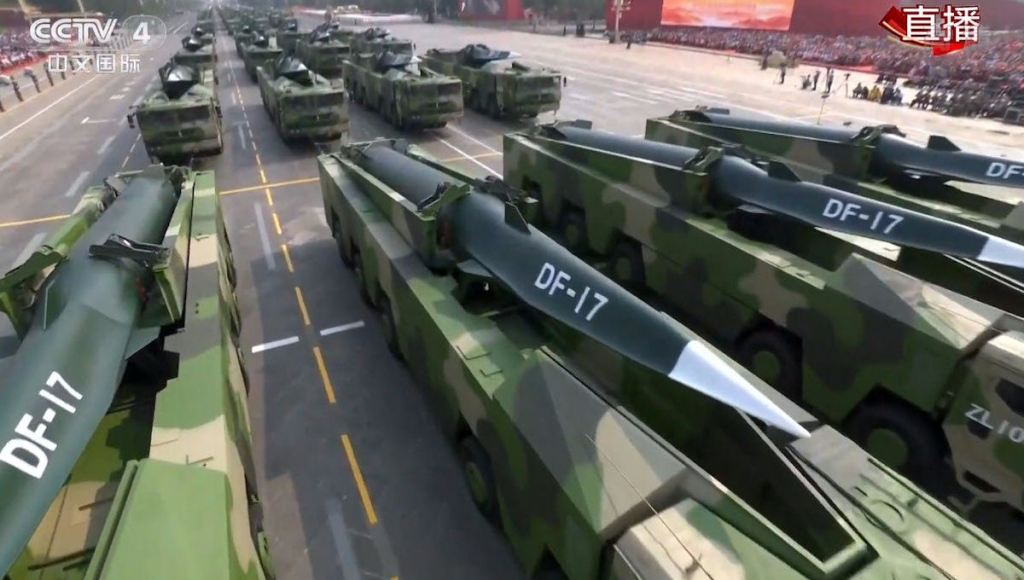
There’s always the risk you’ve picked the wrong weapon, but I don’t think this is it. If it wasn’t potentially useful China would never have bothered with its own. The Tyranny of Distance is an issue and particularly so in the Pacific. If America is going to have any capacity to deter China, you have to make it clear to them you too, can hit them hard and fast and make their lives difficult. That’s how deterrence works. No missiles, no deterrence. It’s pretty simple. Its about having it and never having to use it, but knowing that if you do have to, it will be effective.
I hope Dark Eagle, along with the air launched hypersonic coming too to the B-52 & B-21 will provide the deterrence that China – and Russia need to see. They cannot be allowed to have everything their own way, or war will indeed be inevitable. Imagine some of these in Ukrainian hands? Don’t think for a second this wouldn’t make the Russians think twice.
The Analyst.
MilitaryAnalyst.bsky.social

 The Military Analyst
Has anyone from the church of ‘rapid dragon’ contacted you? I’m sure there’s a way to stuff ‘em in the back of a C-17!
LikeLiked by 1 person
Has the new ‘Church of the Rapid Dragon’ contacted you yet? /s
Seriously though, I’m sure we can figure a way to throw them out the back of a C-5 or C-17 in a pinch!
LikeLiked by 1 person
Oddly enough yes!
LikeLiked by 1 person
Excellent.
LikeLiked by 1 person