
In December 2024 the Ukrainian military told Western media that Russia had started equipping its Geran (Shaheed-136) strike drones with artificial intelligence. The upgrade made these drones ‘smarter’ and potentially better able to evade Ukrainian air defences and identify targets such as energy infrastructure.
The Russian version of these drones, Geran, and simpler decoy models like the Gerbera, have become Russia’s most frequently used strike drones for daily attacks on Ukraine, their usage continues to rise. Russia has gone all-in on this drone type for strategic use, with nothing else even in the field.
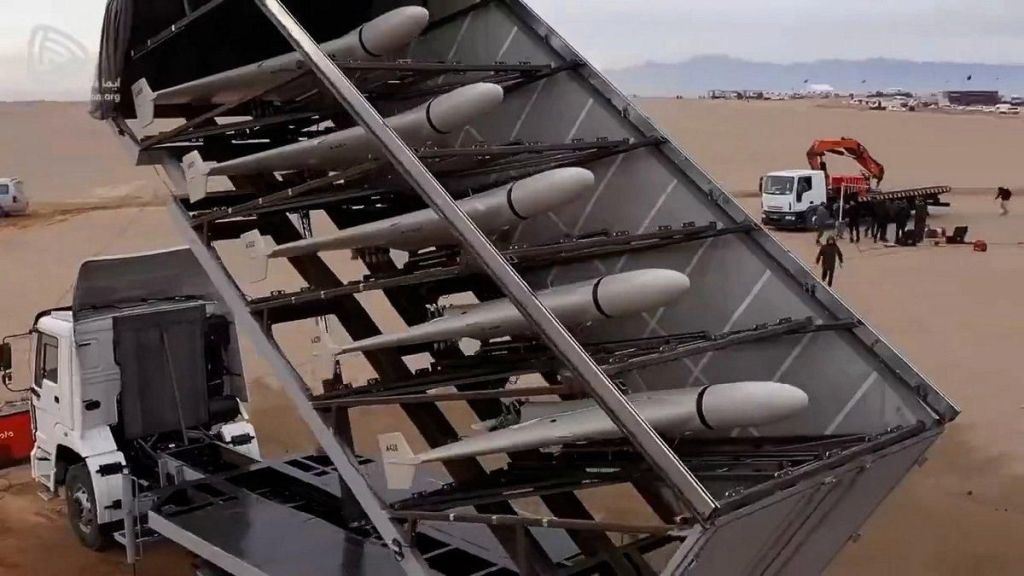
Ukrainian sources say that the technology currently used in these strategic attack drones is more conventional than it appears, failing to meet the criteria for full autonomy. However, even the current equipment is yet another sign that Russia is investing heavily in the concept of AI-powered swarms of drones that can overwhelm Ukraine’s defenses. Ukraine and its western allies need to find a solution before Russia reaches this goal.
Russia is apparently using two upgrades in the Geran.
Enhanced navigation is likely based on computer vision technologies rather than advanced AI. This involves pre-loaded terrain matching and means they don’t need GPS to find a target. Tercom as the Americans called it has been around since the early 1980’s, (it was what made the Ground Launched Cruise Missile so threatening), but has become cheaper and easier as technology has improved.
Digital Scene Matching Area Correlator (DSMAC), is a well-known guidance system that compares images from onboard camera to a pre-loaded terrain map in real time. It’s neither autonomous or especially advanced and certainly not AI. Only if one flagship drone was using the system to guide networked lesser drones to a target would it be interesting but inefficient and risky. Lose the flagship and the others are useless. Impractical and pointless.

It’s possible the same computer is being loaded with an AI model (or is it more accurately machine learning?), trained to recognize energy infrastructure. A step toward automated target recognition, yet far from a new idea.
Latest technology allows these models to potentially be trained on smaller datasets and quickly adapt to changing conditions such as new protective shelters built around Ukrainian power facilities, enabling onboard software not only to recognize the target but also to pinpoint the most vulnerable spot with high accuracy. Yet that still requires advanced knowledge of what these look like. That in turn requires reconnaissance and accurate imagery to train the ability to recognise a target.
To my mind this is not Ai by a long way. It’s getting there but it’s not there yet.
What is concerning is when autonomous navigation merges with automatic target recognition and the drone is authorized to engage the target without human supervision. Yet while that sounds like Ai, none of these Geran drones are manually controlled now, they reach their targets and they attack them, without human supervision anyway, so what’s the difference? Accuracy and increased certainty of hitting the target is the only payoff.

However by testing and installing these systems in the Geran – we know because the Ukrainians have told us they’re finding them in drone wreckage, Russia is actively pursuing and developing unmanned swarming capabilities.
However again, history shows us this is not a new angle for Russia to take. Even in the 1960’s Russia was far ahead of the West in using radar controlled anti-ship missiles, where one would sit high and guide as many as half a dozen others towards their target in a network.
In today’s war however to have networked drones you have to have several pre-requisites.
For swarming drones to work, mass production is needed, you have to have numbers to have a swarm.
The current Geran drone is made at a site in the Alabuga Special Economic Zone. According to a CNN report, this factory produced 2,738 Geran drones in 2023, and in 2024 it more than doubled its output to 5,760 units during the first nine months of the year.
Serial production has also begun for the Gerbera decoy, a simple plywood-and-foam drone that mimic real Gerans on radar but cost ten times less. Russia planned to build 10,000 Gerberas by the end of 2024, twice the planned Geran output.
The factory relies on imported components from China. Chinese firms supply 60% of drone parts via some 30 companies.
Evidence suggest that the Gerans are being equipped with the necessary components for future AI capabilities. A January 2024 leak revealed a new Geran variant labeled MS 236, featuring an electro-optical guidance head — an upgrade shown in March 2024 during Vladimir Putin’s visit to the Special Technology Center in St. Petersburg. More information came to light in December 2024 following Ukraine’s attack on the production facility in Alabuga. Defense Intelligence noted the factory was stocked with enough parts for 400 drones, including thermal imaging cameras and navigation systems.
Equipping drones with these sensors allow the drone to do mid-flight reorientation and not to rely solely on pre-loaded coordinates. While earlier versions of Geran still depended on an operator, integrating machine vision moved the drone to autonomous navigation and automated target recognition.
A third step is the way Russia is in the early stages of using both quantity and technological upgrades to unleash coordinated mass attacks, which would be a key tactic for AI enabled drone swarms. Early signs of this approach have already appeared with the Gerbera decoys, which reportedly use MESH modems, allowing them to share data and form a sort of a swarm. These modems can relay real-time information such as each drone’s position, operational status, and any detection of electronic countermeasures, enabling the swarm to re-route and remain effective.
Some Gerans equipped with electro-optical sensors can carry out target identification missions in real time and relay it back to Russia, paving the way for a subsequent wave of numerous drones to strike. By combining autonomous navigation, AI-enabled target detection system, and data sharing, Russia is moving closer to deploying large-scale, coordinated drone swarms that require minimal human input.

To make an autonomous swarm work, Russia needs to improve its artificial intelligence capabilities. Russia is doubling down on this area, relying on partner countries to evade sanctions and secure the technology. In March 2024, Russia and Iran agreed an understanding on AI development to enhance ‘technological and cultural dialogue’ as well as to conduct research on AI applications. Additionally, Russian institutions, such as Moscow State University, are work with Iranian universities to develop advanced AI algorithms for robotics, signaling that these international partnerships may soon channel AI breakthroughs into autonomous unmanned systems. What’s almost as concerning is that these developments are being shared with Iran and are giving them improved capabilities.
A further indication of Russia’s Ai push — even with Western sanctions — appeared in December 2024, when Putin announced the launch of an Ai alliance within BRICS. He unveiled the new “Ai Alliance Network,” initially 20 companies from Russia, Brazil, India, China, Iran, and the UAE, a part of a larger pool of 50 international businesses reportedly ready to join. Despite Western chip export bans, Russia’s Ai sector increased its spending on equipment by 40 percent in 2024, contributing to a 10.5 percent increase in technology output.
Finally, on December 30, Putin decreed the Russian Government and Sberbank, the Russian leading institution and investor in AI development, was to collaborate with China on artificial intelligence research. Prime Minister Mikhail Mishustin and Sberbank CEO Herman Gref must submit a road map for collaboration by April 30, 2025.
We face a Russia determined to find a way forward with Ai. One way or another.
The question is what are we going to do about it?
The United States must expand export controls and sanctions beyond directly involved Russian entities, encompassing the broader network of middlemen, shell companies, and covert operatives in third countries. Only the US has the clue to make this happen. Prioritize blocking Russia’s access to Ai-related expertise and knowledge by limiting academic and research connections with both state-owned and private Russian institutions, ensure more stringent visa reviews for individuals involved in sensitive fields. Getting the allies on board and to the same degree is equally as important.
Part of the problem for Ukraine is that it too is developing these capabilities though nobody wants to talk about them of course. Its latest drones are using the same types of optical sensors and terrain/target recognition. Russia no doubt knows this when it recovers Ukrainian drone parts.
The old adage that ‘military secrets are the most fleeting of all’, has never been truer. The problem with the high intensity technology war of which drones are the leading edge, is that the rate of change seems to be increasing in line with Moore’s law. Decades of research are being condensed down into weeks, the race to get through to targets and avoid counter measures has deeply intensified.
It doesn’t seem long ago that we were talking about Geran’s that were using the Ukrainian GSM network for guidance and how they were spoofing the signals to confuse the drone. That’s now fast becoming history as they move into new methods of what is largely EW-proof pathfinding. When the entire system is unitary and built into the drone, requiring no outside input other than passive optical to match terrain and target, it’s quickly becoming about detection and destruction. By building so many decoys, that too becomes increasingly difficult to counter, requiring refinements in the capabilities of detection systems to discern one type from another.
However there is a point where they can’t improve their navigation or their targeting. They will reach a zenith point because there’s only so much you can do, and that’s where the defence gains the upper hand. It will eventually only have to defend the target successfully no matter how many drones come at it. That means bigger and bigger (and increasingly more expensive) drone swarms, and an integrated defence of the target that itself can work out the most dangerous attack patterns and stop them.
It will be a battle of wills. But micro anti-drones are one solution, along with automated gun defences, managed most likely, by an Ai that learns as it goes with human input. That these days are coming to us seems almost inevitable. It’s the speed at which it’s happening – and the level of ongoing continuous adaptation that is giving both Russia and Ukraine a huge boost in the longer term picture. It’s almost not worth even trying for third parties, to catch up or develop anything until the war ends and the drive behind both sides pushing their technologies slows so that we can all catch up.
We as onlookers must watch, understand and constantly be ready with new updated designs, so that when things slow down a bit, we can put at least something in the field and work from there. If we try and settle too soon, all we’ll have left is outdated and easily defeated equipment. Drone warfare is here, it’s increasingly advanced, and we need to be ahead of the curve in understanding the technology, materials and operating theories, even if we haven’t produced large numbers. Industry needs to be prepared for a whole new approach to manufacturing. Yet wherever I look I see no real signs of this happening. We seem like deer caught in the headlights of technology and don’t know what to do next.
The Analyst

 The Military Analyst
Another excellent read. I found myself asking questions as I read and in the next sentence you answered my thoughts. I agree wholeheartedly with your point about “limiting academic and research connections with both state-owned and private Russian institutions, and ensuring more stringent visa reviews for individuals involved in sensitive fields.” We in the west are far too naive and gullible about sharing knowledge with our enemies who use it against us, the cooperation with the Wuhan Institute of Virology and the “Bat Lady” before the Covid outbreak comes to mind. Can we ever trust any Russian or Chinese researchers or scientists again, knowing what we now know from their behaviour in the current war? Or will money steer again, with the west wanting to cautiously reintroduce trade relations with Russia as fast as is diplomatically acceptable? I sincerely hope not.
LikeLiked by 1 person
Thank you, how close to each other are the drones in swarms? Is it possible to have a fire works explosive with hundreds of sticky type plastic balls that are very adhesive and on fire so they stick to the drones and burn the imitations and therefore get rid of some of the targets? This would be tricky as if these balls hit the ground in populated areas, but better than the real drone getting through. Feel free to tell me I am in fantasy land. Some of the fireworks can go very high and very large.
LikeLiked by 1 person
As usual the devil is in the details – the fusing of the ‘fireworks’ means that it is probably more cost effective to use a laser or Directed RF weapon to take out multiple targets in swift succession. The fireworks will still need to be guided in some way, or you could have a series of ‘barriers’ preset for a variety of altitudes, arranged around a target – again though, these are still finite an susceptible to saturation attacks. In future, my expectation is that we will see mobile High Energy Lasers and Directed RF defences with virtually unlimited magazines and overlapping, mutually supportive coverage, able to take out hundreds of units in a swarm. The attack vectors will then change, for instance to SOF and cyber pre-attacks to degrade or destroy the defences prior to shortly following swarms.
LikeLiked by 1 person
It’s all about practical application. Demonstrate it works!
LikeLike
Disturbing reading – mostly because all of the tech involved relies on advanced processing tech. So-called “AI” is really large model predictive data analytics. It relies on massively parallel processing – which is why NVidia is a leader in the field, because its graphics processing model relies on parallel processing behind a common interface across almost 20 years of designs. The technology involved is supposed to be controlled.
Drone “swarms” will always be vulnerable to EW & jamming, unless they have alternate signaling technique options. Basically, they need some autonomy, because there’s always a probability of signal loss – no matter how they interact. At that point, default action is either programmed in, or it’s simply left to chance and weather.
We should not underestimate what the Russians will do – or attempt; but let’s not assume the art of the possible equals the reality of the deliverable. This was the 2nd most powerful army in the world, and in three years of consistent incompetence, they’ve proven somewhat less than worthy of such respect – despite the damage they can inflict.
LikeLiked by 1 person
I appreciate your technology insight. The Russians have in my experience a capacity to be both fundamentally exceptional and at the same time exceptionally bad.
The Russian navy was using advanced networked missiles even as early as 1969. The NATO allies were totally unaware of this capability because they underestimated Soviet capabilities.
I don’t underestimate the complexity of what their aims are and even question if its true Ai or anything like it, but in this type of field we should not I think, underestimate what they might achieve.
Obtaining the technology is it seems, regrettably too easy through various sources, though no doubt expensive, despite the sanctions.
LikeLike