
For many people the fact that the F-16 is now arriving in increasing numbers – at least that’s the impression, suggests that Ukraine should by now be putting up some kind of resistance to Russian air operations over the country.
First off let’s look at what the Ukrainian Air Force has in service. I had to do a fair bit of research and there’s a lot of competing totals, so these may not be exact, but they ate a general estimate. None of it amounts to a great deal. The best you can say is that they make the very most of what little they have.
Mikoyan Gurevich MiG-29 Fulcrum
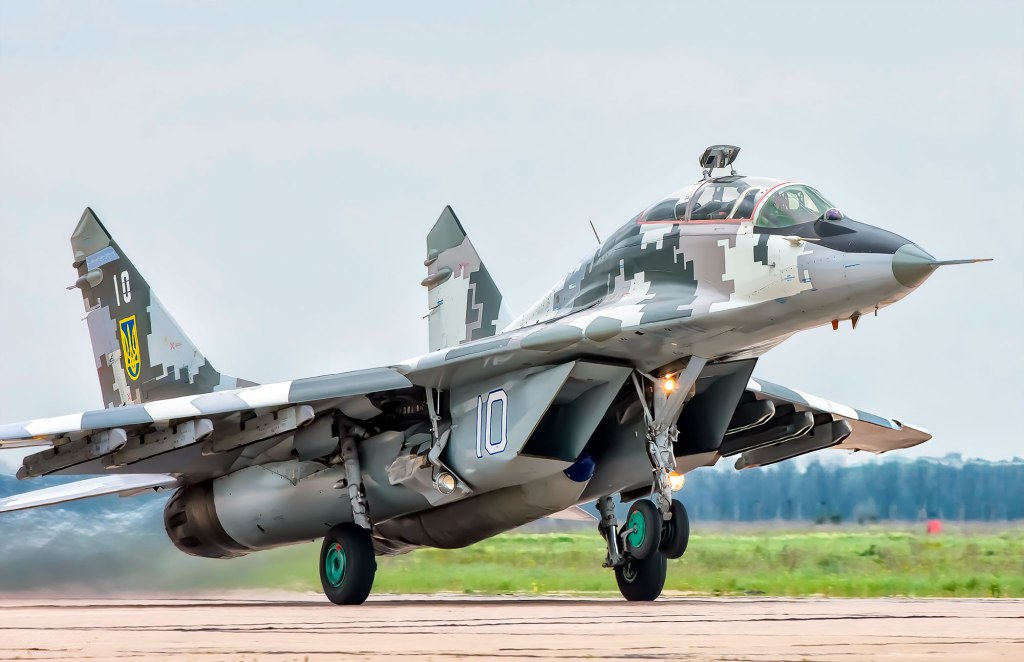
Like its peer the F-16, they never seem to be terribly outdated in appearance, even if technology wise they leave more than a bit to be truly desirable. Fast, but prone to spewing part burned aviation fuel in thick black smoke. The Ukrainian variants were especially outdated, but have been custom upgraded to carry more modern weapons and integrate newer systems. Their radars are weak by modern standards and you don’t want to get caught in a dogfight flying one. The best estimates are that between 30-35 are still in service, most those donated from Slovakia & Poland that were heavily upgraded to NATO standards. They’re generally vulnerable – modern Russian anti-air and detection systems can see them too easily, but they do occasionally make an attack run when they’re either desperately needed or the Ukrainians are confident about the combat environment. They seem to be equipped with HARM capabilities. They are in the end mostly 30-40 years old and normally would have been scrapped long ago.
Sukhoi Su-27 Flanker
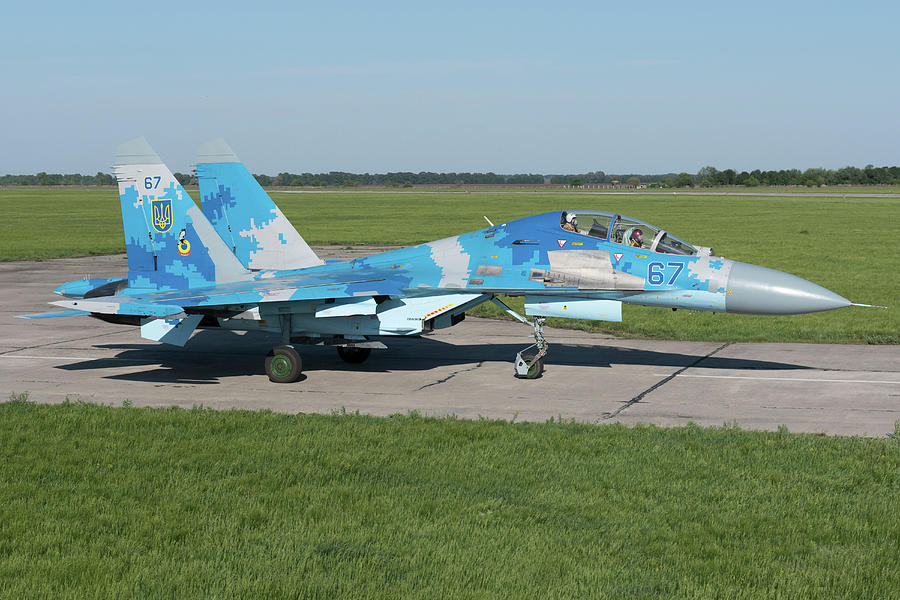
There are but a handful of these left in Ukrainian service. Designed as a counter to the long out of service F-14 Tomcat and the still being built F-15 Eagle, these are the epitome of an aircraft stretched to the maximum level of usefulness out of need. Mostly Su-27S and P versions, losses were replaced from units in storage and cannibalised parts used to keep the rest flying. No other donor air force had any and exact operational numbers are classified., but if there were a dozen I’d be pleasantly surprised. It seems they have been used as cover for other attack aircraft when its been deemed viable. There aren’t enough to be a viable force and they’re so dated they have minimal utility.
Sukhoi Su-24 Fencer
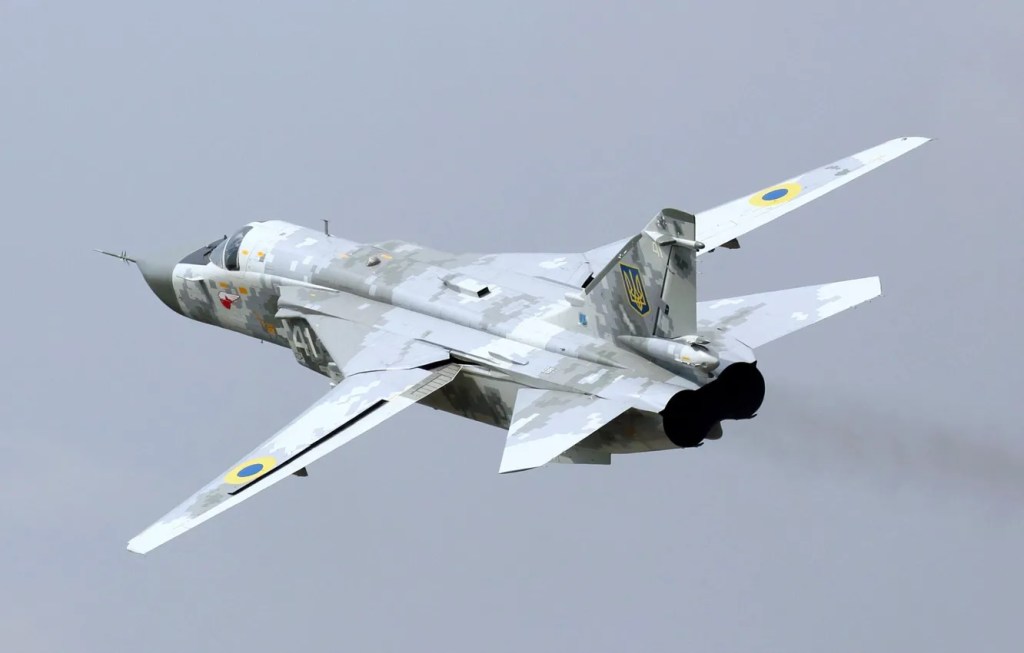
Of all of the Soviet era aircraft in service this is one that genuinely deserved its place as feared in the Cold War. Surprisingly long ranged, capable of carrying a heavy load, nuclear capable and built in significant numbers, The Fencer was the bane of allied air forces. Intended for deep strike, it was the Soviet equal of the Panavia Tornado-IDS (interdiction-strike)variant (still remarkably, in use with Germany and Italy in the nuclear strike role). Its purpose was to attack radars, runways and logistics deep inside NATO territory. The swing wing allowed lo-hi-lo or hi-lo-lo attack runs.
Ukraine had at least 21 of these at the start of 2022, but several were destroyed in the initial days of the war. At least 12 were operational, but in early 2024 the Russians made a concerted effort to ‘get’ them because they were the only type available (and still are) that can carry the StormShadow and Scalp-EG cruise missiles. At least six were destroyed or badly damaged in a deliberate strike at one of there bases in central Ukraine. Another three were hit mid year, leaving just three in service. However necessity is the mother of invention, and the Ukrainians seem to have rebuilt three from what was left leaving between four and six active. There were several months when StormShadow attacks were notable by their absence – it wasn’t lack of missiles, it was lack of aircraft and the risk of losing what was left. Its noticeable that the missile attacks resumed with up to 12 being fired recently at a target near Kursk – and that means at least six aircraft were in use as they carry two missiles each.
We have to admire the Ukrainians and anyone who has helped them get these aircraft back in the sky and doing their job. They may be few in number but they have been absolutely extraordinary in respect of the damage they’ve caused when their numbers have been so few.
It’s these strike missions that I believe the Su-27’s have been used to cover at times.
There’s one problem with the Su-24 and that’s its rarity. Even the Russians don’t use them in the frontline and they don’t have many left. The aircraft available to the Ukrainians don’t have the capability for the Storm Shadow. However the soon to be delivered French Mirage-2000-5 can carry a single missile. The promised but yet to materialize JAS-39 Gripen is also capable.
Sukhoi Su-25 Frogfoot
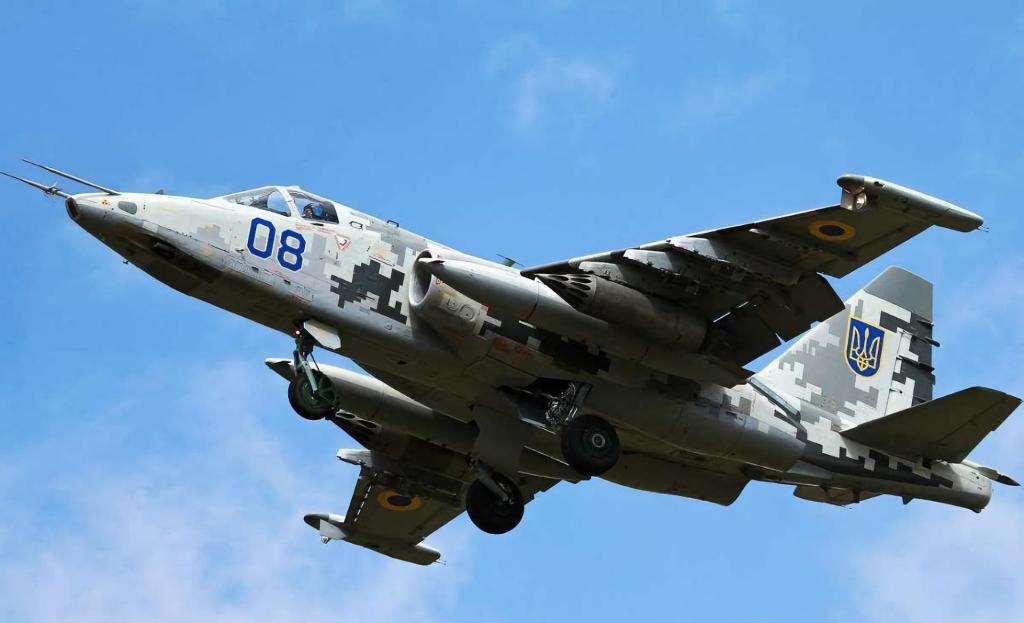
Possibly one of the Soviet Union’s most underrated aircraft. Often considered the Soviets answer to the A-10 Thunderbolt-II. It’s designed for ground attack missions and in theory as part of an armored spearhead, pushing its way through to an objective.
Oddly enough it actually works, despite its very short range which means it has to carry drop tanks as in the image. It has a dated jammer and has proven highly susceptible to MANPADS. Around 17 from around 35-40 are left in Ukrainian service. The Russians did use them extensively at the start of the war, but again, losses were high and they were considered something of a death trap. They’re very much the type of aircraft that requires experienced pilots adept at tactics and handling. New pilots not advised.
Again not many left, they can make only a limited contribution to the ground war and then only at high risk.
General Dynamics F-16 Fighting Falcon
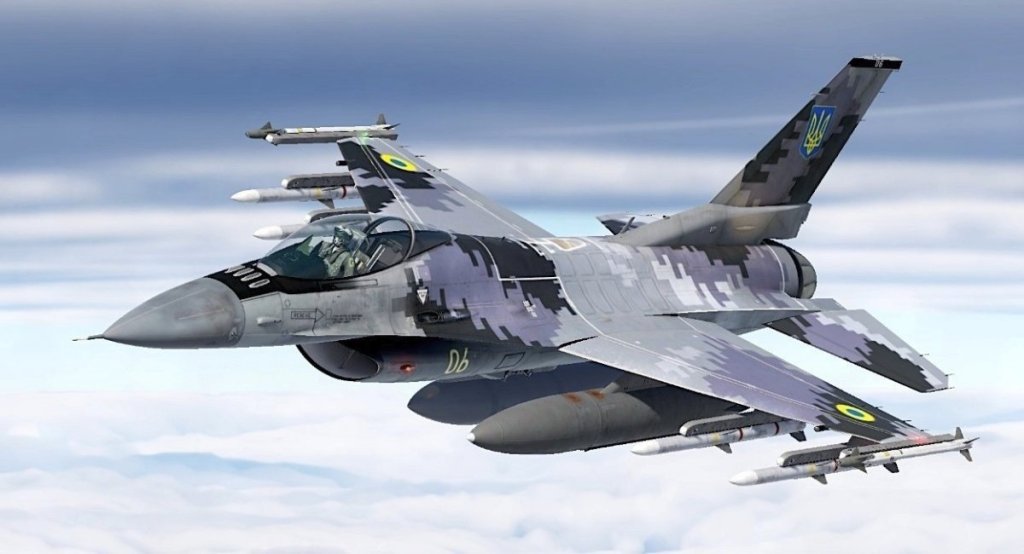
It took too long to agree to send them, and even then the US declined to send its own, leaving the Danes, Norwegians, Dutch and later the Belgians to deliver theirs. Many of them need extensive upgrades to make them combat ready and there’s a strong argument they were the last type of aircraft Ukraine really needed.
About twenty should have been in service by the end of 2024 but their locations and status are highly classified. One has been lost in combat shooting down Russian cruise missiles (it’s believed to have run into missile debris, which the Ukrainians say has happened to Mig-29’s and Su-27’s in the past).
An F-16 was recent credited with shooting down six cruise missiles in one engagement.
The F-16 is a complex piece of kit, expensive to operate and difficult to maintain, it’s not renowned for its ability to operate away from decent runways. At the end of 2024 the UK said it had trained 200 pilots to basic levels for F-16, and the French were doing well on jet trainers before passing them to the USAF to complete their F-16 training. However the training capacity in the US (which still operates front line F-16’s, mostly in Asia, the US itself and for the Air National Guard) is largely taken up with domestic and overseas customer training booked up years in advance, the F-16 is still in demand around the world. That leaves precious few spaces for the Ukrainians, although more capacity was promised it doesn’t seem to have materialized into much. Another 59 aircraft are due to be delivered and each one will need two pilots to ensure they can be used to maximum effect on rotation.
However it’s unlikely to be before mid to late 2026 that the remaining 59 will have been handed over in full, the Belgian aircraft especially need major refurbishment.
Dassault Mirage 2000-5F
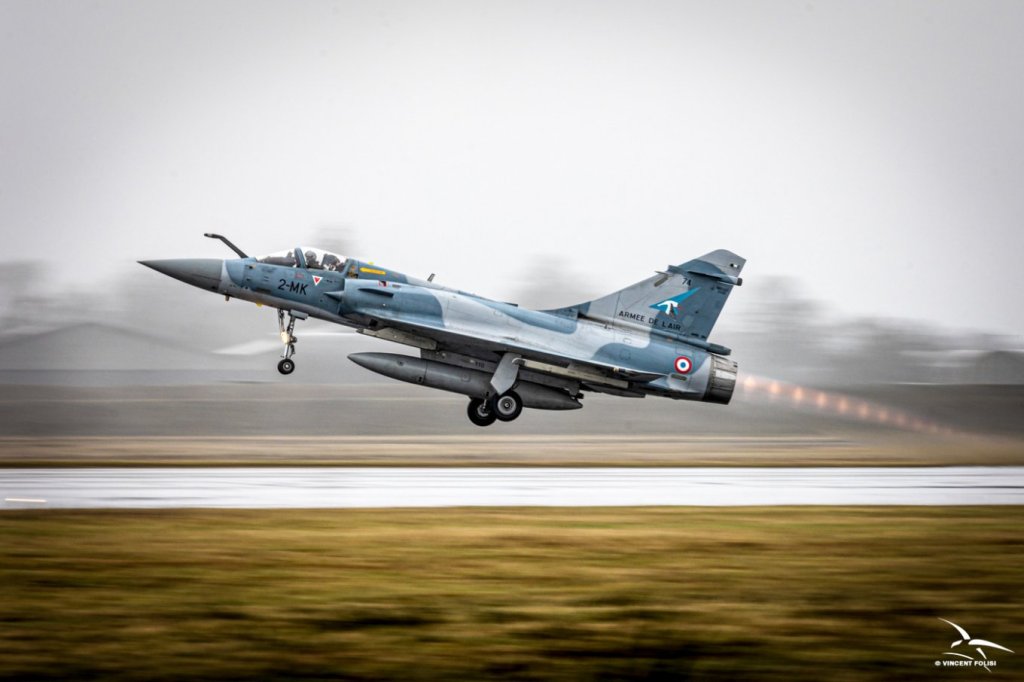
This aircraft has a very long history, right the way back to 1979. The French Air Force is due to retire all of the remaining in-service versions as it replaces them solely with the Rafaele to reduce costs and pilot training needs.
The type allocated to Ukraine (3 trainer versions are allegedly in country already), are the 2000-5F. It’s an air superiority version (originally the 2000-D strike version was suggested), with a strike capability. Arguably it’s actually better than the F-16 for a number of reasons. The F-16 versions being supplied are not very effective in the ground attack role – their radar is considered limited for such operations. It’s also not as capable of targeting multiple contacts. The 2000-5F however has a superior radar, and is far more capable of handling shorter range combat scenarios. No numbers have been established for delivery – at least not publicly anyway. However France took delivery of 37 of the aircraft. Taiwan and Qatar also took delivery of a dozen or so each – The Taiwanese versions were a sharp disappointment, with serious engine problems. Plans to upgrade them in recent years were considered unviable and too expensive.
France has said it will be upgrading the aircraft as much as possible, but as with the F-16’s they’re already dated – roughly equal to about 2010 technology.
USE
The question on everyone’s mind is what use are these aircraft, really? There are a number of ways of looking at this. Does Ukraine expect to achieve any level of air superiority over the frontline? Locally, at times certainly that might be viable. The real issue is keeping those glide bombs and their launch aircraft far enough away they can’t have so much impact. Yet Russia has its own ground launched S-300 and S-400’s, admittedly not in the numbers they once were, but they are still there. And they still have a couple of AWACS aircraft they can get close enough to protect their own air space. They certainly have enough fighters to manage doing so, despite the loss of bases.
There’s been no real air combat the entire war, Ukraine hasn’t risked it and the Russian pilots lacked training and Su-34 operations were crucified in 2022/23 using iron bombs. Replacement aircraft have not been built in large numbers either. The glide bombs are what has truly reinvigorated the use of Russia’s tactical Air Force.
One aircraft we haven’t mentioned and may help change the situation once in use, is the Swedish supplied AWACS. Couple that to F-16 and Mirage’s in selected operations and Ukraine might suddenly be able to gain a local operational dominance for a day or two that could potentially be game changing. But that would require lots of behind the scenes planning and careful integrated liaison with ground forces to maximize opportunities. The AWACS will be a high priority target for the Russians. We must also remember that the more aircraft Ukraine has the more easily the Russians will find them and they will target them with cruise, Kinzhal and Iskander missiles.
The best Ukraine can hope for is the denial of airspace. Longer ranged drones (maybe some of them even airlifted to give them greater range in future), may harass Russian air bases so effectively Russia is pushed further back from already stretched travel times. Ukraine too, is a big country when it comes to flying from west to east to get to the FEBA (forward edge of the battle area).
Personally I struggle with how these aircraft are going to transform the landscape. Perhaps that’s the problem. Despite their welcome arrival and their anti-missile cover against the endless onslaught Russia sends against the Ukrainian power grid and infrastructure, there’s still only around 100 ‘modern’ aircraft in full, when all are delivered. Unless they’re used in a concerted operation on a narrow part of the front, for a specific counter attack for example, they stand little chance of making any impact on the course of the war. Its hard to gain air superiority when there’s nobody challenging you for it because your own ground based air defences are so powerful. I’ve yet to hear a convincing argument these aircraft will make a huge difference. The glide bombers get further away as the bomb ranges increase, the missile carriers are never anywhere near in the first place. Russian air defences are too dangerous to probe deep inside the country when drones will do it for you.
So is the fuss worth it? I’m asking you to tell me why it is. Because I look at things from a ‘god view’ and all I see is cost and risk for little strategic or tactical gain. We have a habit of looking at our traditions and values, and that we know what air power can do. Israel is one place we can see how it works for them. Because they have no opposition to stop them and have achieved unprecedented air dominance – there are no counterparts worthy of the name – they’d have to fight the Saudis or Egyptians to come up against an Air Force that might challenge them. That is not the situation in Ukraine/Russia. They seem almost deadlocked in the skies, largely because ground based defences are so strong. Ukraine doesn’t have enough aircraft to waste, and frankly nor does Russia. If Ukraine could match the Russian glide bomb use and make their ground forces even more hard pressed, perhaps that could make a difference.
I’m sure you have your opinions – maybe even advice and knowledge. Please feel free to share it below.
The Analyst
militaryanalyst.bsky.social

 The Military Analyst
Probably a silly question, but where are the UA glide bombs? Why hasn’t the tactic been turned around onto Russia?
LikeLike
I have no idea other than that Ukraine never had any to use
LikeLike
It would be excellent if they could get A 10 Warthogs!!!
LikeLike