
The acceleration of the Chinese People’s Liberation Army Navy, to give it its official title, towards a genuine invasion capability has increased dramatically in the past few weeks and looks set to intensify in the coming months.
There are practical, economic and political, as well as geopolitical reasons why the acceleration towards a forcible occupation of Taiwan seems to now be inevitable.
ECONOMICS
Without boring you with the detailed statistics, because there is so much to cover, China’s economy is in very bad shape. It is suffering from another chronic respiratory virus outbreak (RSV), that has as many as 100,000,000 cases – largely affecting children and the elderly, running out of control, overwhelming hospitals and funeral services. There are many reasons for it but this isn’t the time to go in to it.
Fiscal problems plague the banking sector, which is choking on vast debts, owed by mega-corporations close to bankruptcy, and the huge Chinese regional administrations who tied their fortunes to the now almost completely collapsed property market. This has messed up the retail banking system and caused a crisis of confidence where consumers are not happy with their banks – and don’t even trust them. Banks stealing money from customer accounts to prop up balance sheets is not uncommon.
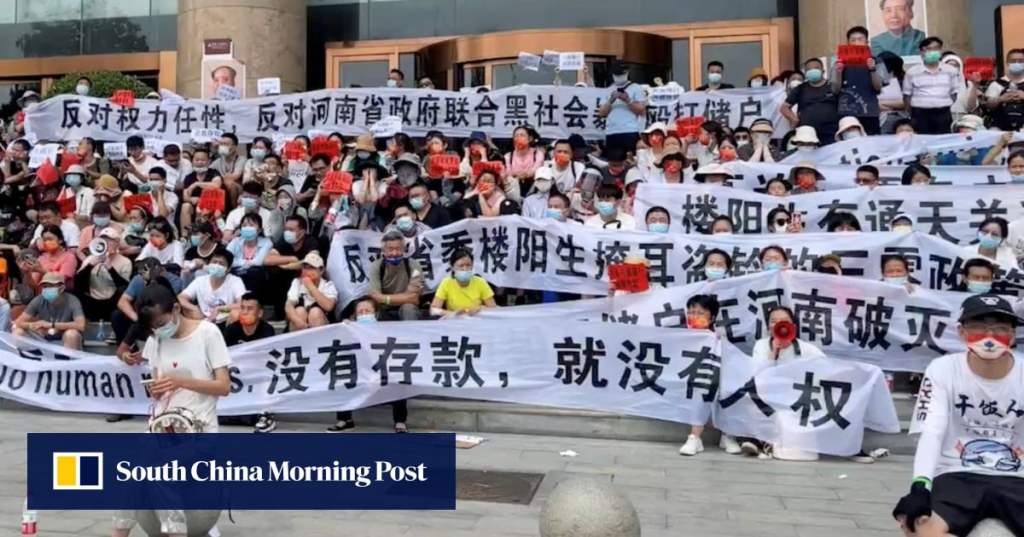
Youth unemployment (18-25)’s not in military service is said to be over 90 million. They have no jobs and no hope of finding any, the CCP is well aware this is a time bomb waiting to go off.
Productivity is low, inflation is teetering on the brink of deflation, and that is despite factory costs rising. Chinese companies cannot charge for the increased costs because nobody at home is buying their goods, meaning they have to cut prices and lose money. Profits have crashed, and with it new investment.
The overall state of the Chinese economy is shockingly poor and largely obfuscated by the CCP who don’t want anyone to know how bad things are. Chinese GDP figures are largely seen as mythological these days.
Even so China sits on the world’s largest currency reserves – some $3 trillion worth. It also has one of the worlds largest gold reserves at around $192 billion – it purchased over $50 billion worth in 2024 alone, always an indicator or preparation for economic problems ahead. The US has only $11 billion as a comparison.
It is not uncommon for governments to do exactly what China seems to be doing in these circumstances; ramping up military, especially naval production – it keeps people and industries working, distracting its population with issues guaranteed to support the CCP. There is no bigger issue than Taiwan. The public are completely in favor of reunification. It is seen as an existential right for China to be ‘whole’.
TAIWAN
Taiwan has never been ruled by the Chinese Communist Party. The Nationalist Republican government of China fled to the island in 1949, and the Republic of China – Taiwan’s official name lost its seat in the UN on the Security Council in 1971 when it was transferred to the Peoples Republic. The Beijing government considers Taiwan a breakaway province. Xi Jin Ping has sworn to reunite the two before the 100th Anniversary of the end of the Civil War in 2049. However for military reasons, the greatest window of opportunity is regarded as being 2026-27.
Militarily Taiwan is reasonably capable when judged as a medium-small country anywhere else (in Europe it would be a significant military power), and part of the deal when the US accepted mainland China based in Beijing as the ‘only’ China, was that although communist China didn’t like it one bit, the Taiwanese would be the beneficiary of what amount to an alliance with the United States and the recipient of American military aid. That aid and alliance is enshrined in the Taiwan Relations Act 1979 . The Republic of China is not mentioned, just the ‘Governing authorities of Taiwan’. In short the act says that the US recognizes no difference between Taiwan being a sovereign state or not being one, so therefore it is treated for all intents and purposes as if it is. No president can unilaterally terminate the agreement to offer defensive aid to Taiwan in sufficient quantity to defend itself. Many would argue the US has long failed to live up to that standard, which is partly why Taiwan is under so much threat now.
However, the new US administration Secretary of State, while Senator, Marco Rubio, was instrumental in getting Congress to underline and ensure the US would not abandon Taiwan in 2016, gaining a key vote on a resolution to underline American responsibilities.
For China and the US the position of Taiwan as an unrecognized Sovereign Nation that is de facto recognized as such by the US and not by the Chinese, has led to ever more complicated diplomatic and military spats. Who will forget three years ago when Speaker of the House Nancy Pelosi insisted on going to Taiwan despite threats she would be shot down by the Chinese. Over 15 million people used flight tracking app FR24 to watch the flight in case the Chinese, who were incandescent with rage over the visit, actually did something.
The issue is so sensitive for the Chinese that airlines and cruise lines who want to fly or sail to mainland China, if they also want to service Taiwan, must say ‘Taipei, Taiwan, China’ in marketing materials and on tickets. Those that tried to refuse doing so – which included United Airlines at one time, were told their flights to China were terminated until they gave in. Unsurprisingly they did.
China has spent that last twenty years particularly, undermining the handful of countries who still recognized Taiwan as the legal government of China, using fiscal and investment inducements to persuade them to cut ties and recognize the Beijing government. The only countries that still do have diplomatic relations are:
1.  Belize
2.  Guatemala
3.  Haiti
4.  Paraguay
5.  Saint Kitts and Nevis
6.  Saint Lucia
7.  Saint Vincent and the Grenadines
8.  Marshall Islands
9.  Nauru
10. Palau
11. Tuvalu
12. Vatican City (Holy See)
Six of those are Caribbean islands, the only ones that are of any size are Paraguay & Guatemala in geographic terms, and The Vatican in that it controls the global Catholic Church which the mainland Chinese are utterly opposed to. The most interesting and strategically important in the coming conflict in the Pacific, are the Marshall Islands, Nauru, Palau and Tuvalu. China does its utmost to turn these governments to its side, using everything from blackmail and subterfuge to investment offers and development aid. They’re desperate to prevent the Americans regaining a military foothold while wanting a foothold for themselves. Palau however is resistant as it is an associated US commonwealth state and always votes with the US.
Taiwan geographically, has on its west coast facing the Chinese mainland, the most suitable area to make a military landing. The capital, Taipei is in the far north. Most of the inhabited area is in the west, with the central area a unique semi-tropical forest and mountains. The first goal of any land invasion will be to arrive on the west coast road and use it to quickly pile armor and troops inland to occupy the country.
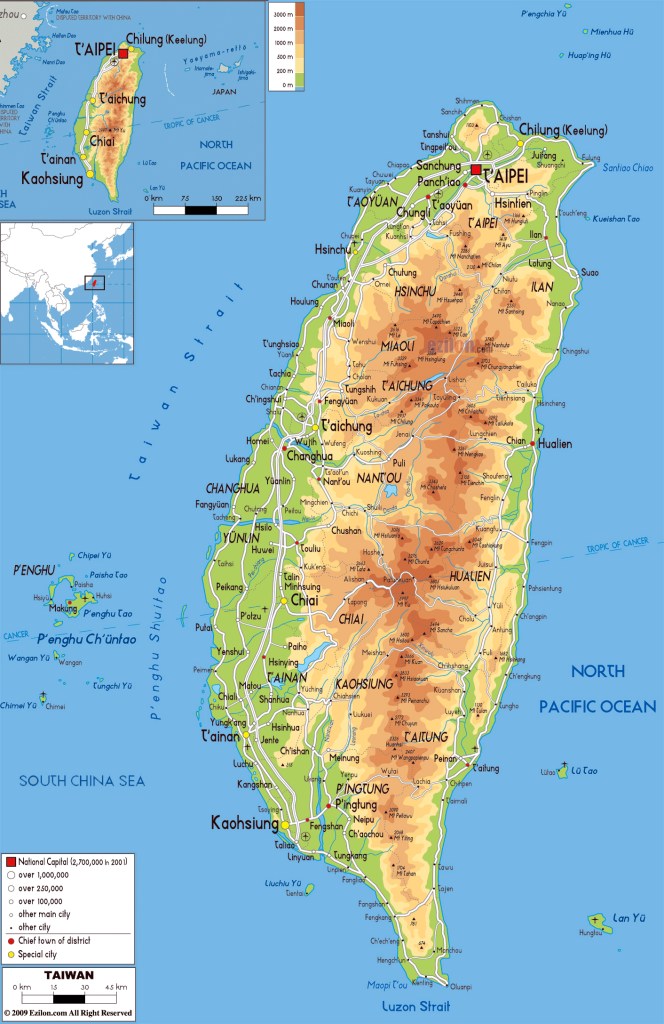
Taiwan’s defences are not minimal, but they may prove insufficient against a mass invasion and landing by communist forces.
The top line fighters are old Block-20 F-16, along with V/B/AM/BM & A versions. Newer aircraft are (66) scheduled for delivery but they’re generally not considered capable enough to fend off a modern Chinese attack, and delivery has been slow. China’s continuous probing and testing of Taiwan’s airspace has created maintenance and longevity issues. It’s acknowledged that this is one of the reasons the Chinese keep doing it, literally wearing out the Taiwanese Air Force . 141 are the modernized F-16V version.
The Mirage 2000-5D/EI fighters were considered unsatisfactory suffering engine problems from constant interceptions and general wear and tear. They are not being replaced.
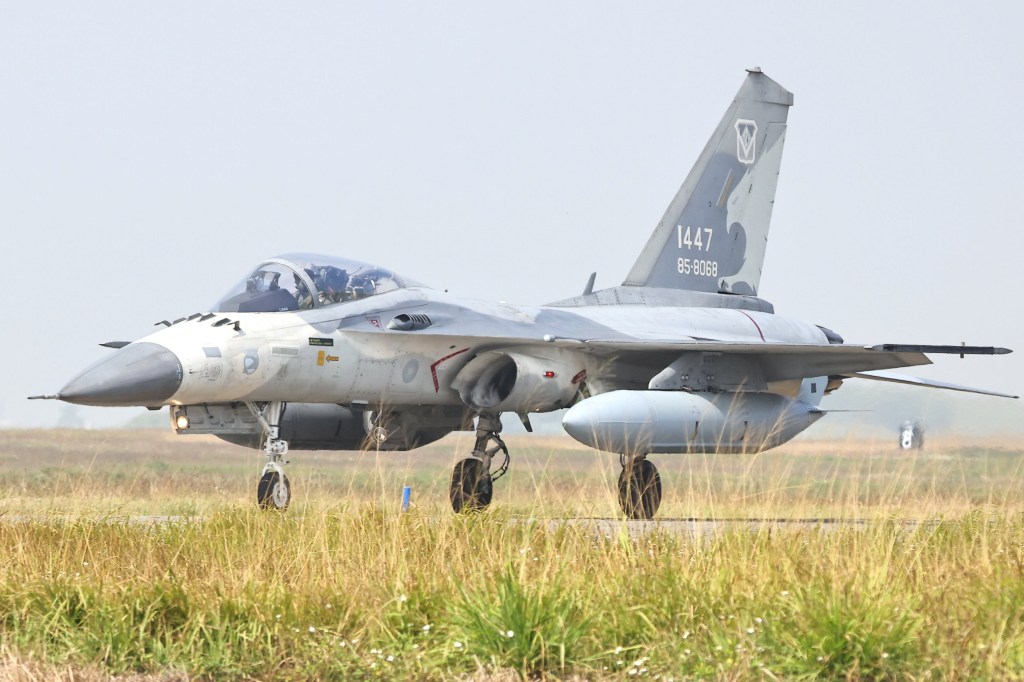
Taiwan still operates 129 of its domestically produced F-CK-1 Ching-Kuo fighter and a handful of F-5 Tiger-II E/F are still flying in reconnaissance roles.
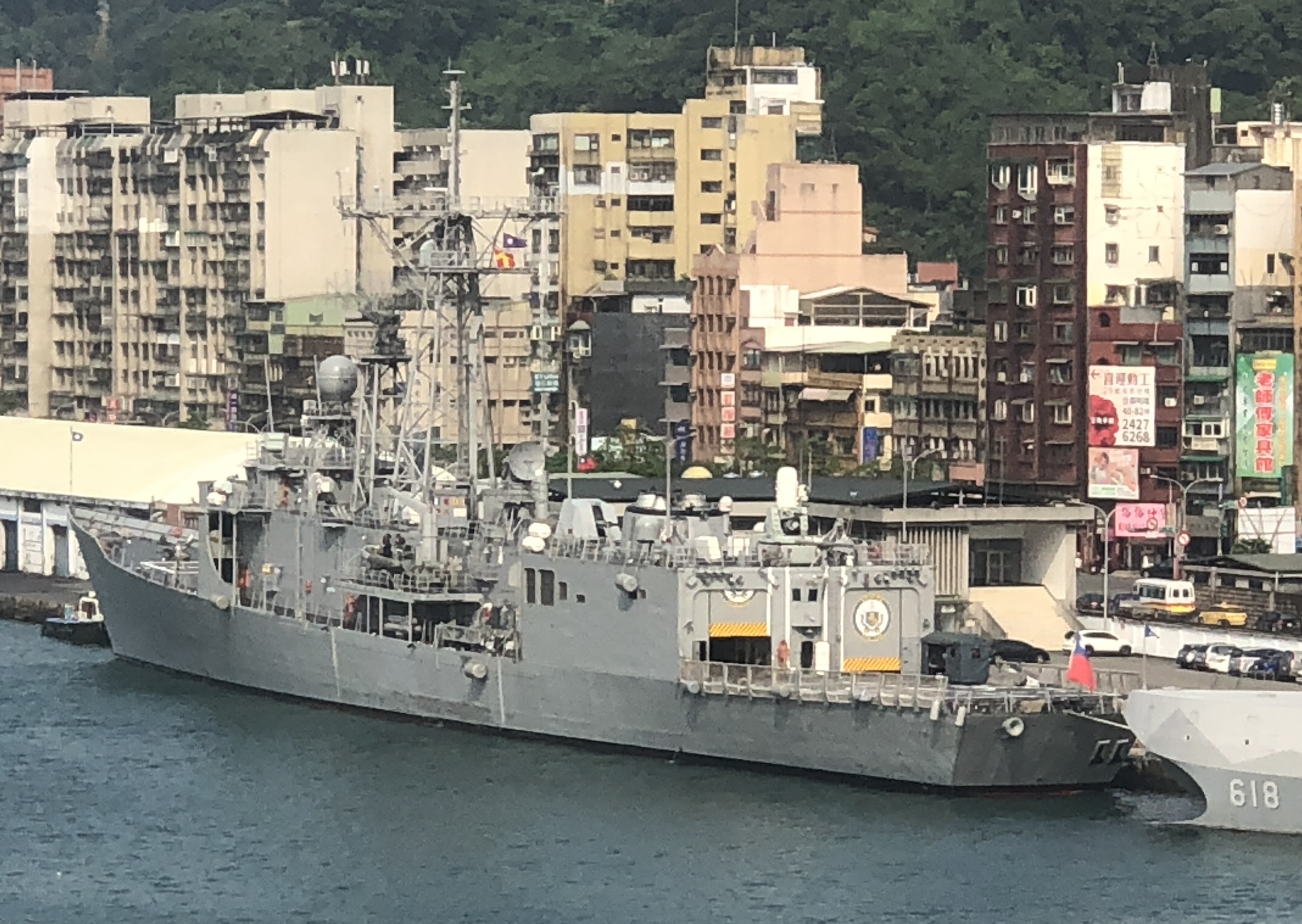
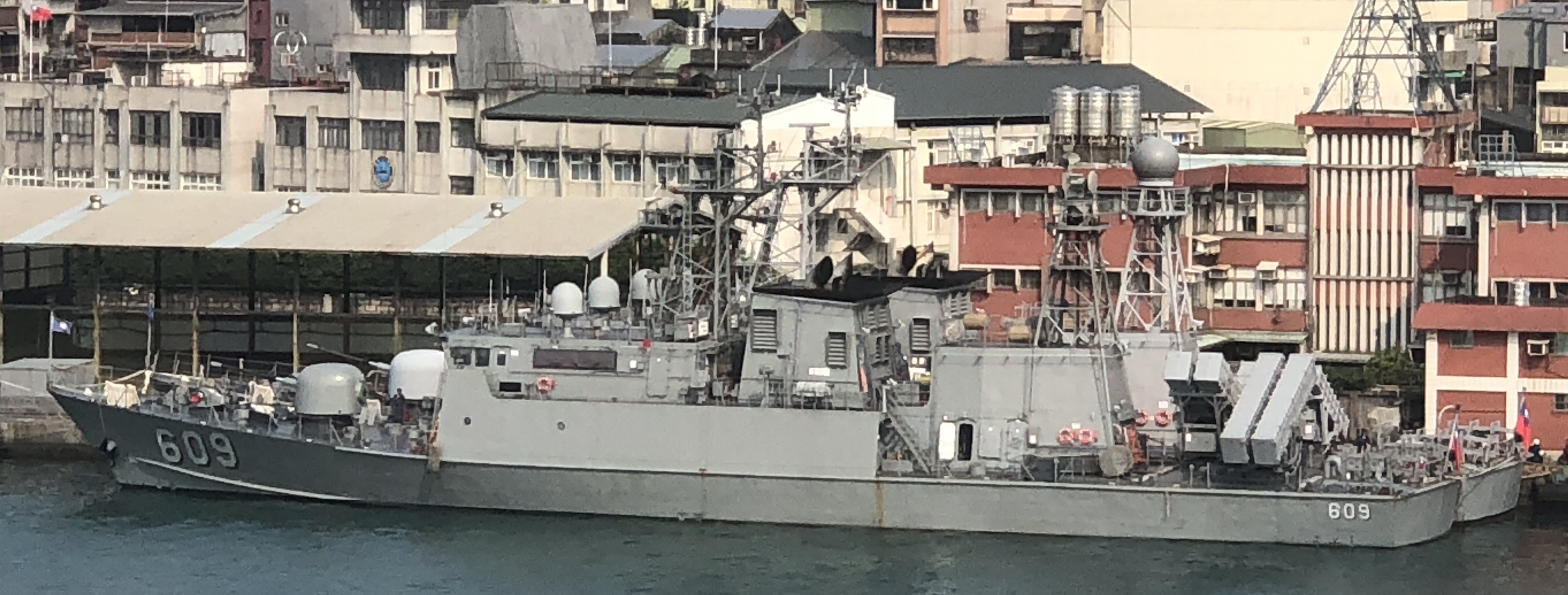
Taiwan’s navy is no real opposition for its Chinese opponents. I took these photos of three of the different classes in use in April 2019. To be frank, they might provide Taiwan with a tripwire force, but most of them are far below the standards of the massive Chinese fleet. They’re old and they’re outdated for the most part. Taiwan is often accused of under spending on its own defence. It expects somehow the US Navy and Air Force to come to its rescue. That might have been a viable concept even ten years ago, but now it has to be seen as unlikely.
Taiwan does have five good diesel and AIP submarines and has been given technical distance in building a new class, said to be incredibly stealthy and effective.
•   Destroyers: 4
•   Frigates: 22
•   Corvettes: 12
•   Missile Boats: 31
•   Submarines: 5

Taiwan’s Army
Personnel
• Active Personnel: Approximately 94,000 soldiers.
• Reservists: Estimated at around 1.5 million, with a total reserve force of about 1.657 million across all branches.
Organizational Structure
The ROCA is organized into several key formations:
• Army Corps: The army is divided into three corps.
• Brigades: It includes five infantry brigades, three mechanized infantry brigades, four armored brigades, three aviation brigades, and five artillery brigades.
• Defense Teams: Newly introduced units formed from deactivated brigades for area defense.
Equipment
The ROCA is equipped with:
• Approximately 1,100 tanks, including both U.S.-made and locally produced models.
• Artillery: Around 1,600 artillery pieces.
COASTAL DEFENCE MISSILE SYSTEMS

Taiwan has developed a robust coastal defense system to counter potential threats, primarily focusing on anti-ship missile batteries and mobile deployment strategies. Key components include:
- Harpoon Coastal Defense System (HCDS)
The HCDS integrates the Boeing RGM-84L-4 Harpoon Block II missiles, which are radar-guided and capable of targeting enemy ships, ports, and coastal defenses. This system includes:
Up to 100 mobile launcher/transporter units.
25 radar units for targeting and tracking.
A total of 400 surface-launched missiles as part of the U.S. Foreign Military Sales program.
These systems represent a critical element of Taiwan’s asymmetric combat strategy, offering mobility and flexibility in deployment. - Hsiung Feng Anti-Ship Missiles
Taiwan’s indigenous Hsiung Feng series includes:
Hsiung Feng I, II, and III, which are designed for anti-ship operations.
These systems are deployed in both stationary and mobile configurations by the Hai Feng Group, enhancing survivability against attacks. - Operational Security and Mobility
Taiwan emphasizes mobile deployment of its missile batteries to avoid detection by adversaries like China’s PLA. The Hai Feng Group frequently relocates its units to pre-surveyed sites to enhance survivability during heightened tensions.
These systems collectively form a multi-layered coastal defense network aimed at deterring maritime invasion and ensuring Taiwan’s strategic resilience.
AIR DEFENCES
Air defence will get its first NASAMS from the US this year.
It has ten operational Patriot PAC-3 batteries, with the PAC-3 MSE missile due to be delivered in 2025-26. They also have 200 PAC-2 GEM missiles and 380 PAC-3 CRI versions.
Tien Kung (Sky Bow), comes in the Sky Bow-II and III variants. The III has a range of 45km for mid-range defence. These recently replaced the MIM-23 HAWK batteries (which went to Ukraine), and the government is building 12 more Sky Bow-III sites around the island to improve its air defence capability, due to be finished by 2026.
There is much debate as to whether or not Taiwan can defend itself. One of its defence systems is the passive anti-landing and disembarkation ridges along the coast road. Few even comment on them. However they are an obstacle. They also created a response and that response is what sent everyone who watches these things into a new appreciation, that Communist China means business, sooner rather than later.
The Taiwan political scene is bizarrely complex with the opposition in Parliament that was the party of independence (the Kuomintang) now largely infiltrated by Pro-China factions. They managed to freeze defence spending only in December 2024 preventing the completion of a new submarine – and other programs, much to the frustration of the new president.
There has been endless speculation that the training for reservists is poor despite the money being spent. Some elements in Taiwan see the reunification with China almost as inevitable and many doubt there’s any point to resisting. Concern exists over quite how many would simply give in or cooperate with a Chinese occupation.
This feeling that not everyone in Taiwan cares one way or another doesn’t help allies stand with a democratic government. Chinese propaganda has seriously undermined public opinion.
WHY HARDLY ANYONE WAS TAKING THE THREAT SO SERIOUSLY, AND WHY THEY HAVE TO NOW:
China has a large fleet, most of its 370+ ships are for coastal operations. However its production of warships is the fastest in the word, building four for every one US ship delivered. Additionally the Chinese Navy is exceptionally advanced and very capable. The one thing it really did not have was the ability to move a significant invasion/occupation force 100 miles over open water. Estimates say that if its to fully occupy and control the island it may need as many as 500,000 just for that alone, never mind an attack force of at least an initial 250,000 rapidly reinforced upward to a million. For the Chinese this really isn’t a problem.
On January 10th 2025 HI Sutton, a naval analyst, revealed what had been seen under construction in Chinese shipyards.
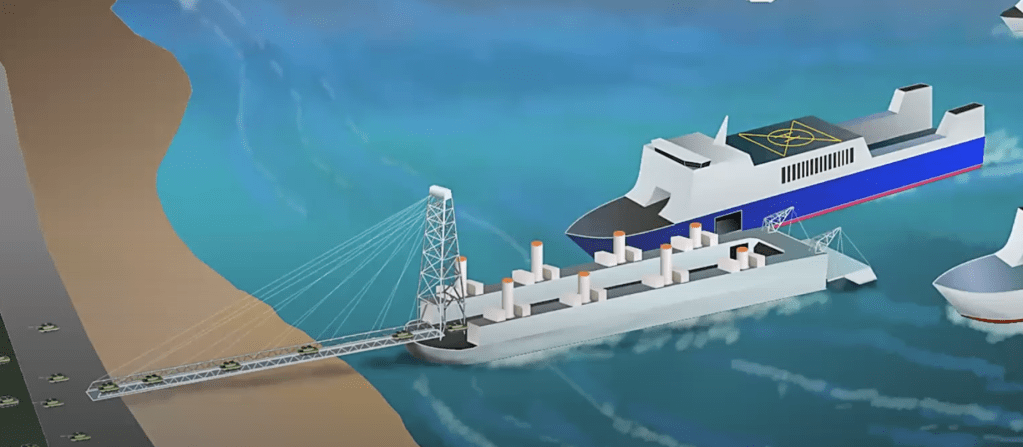
What you’re looking at is a floating roadway. It’s not designed to transport anything but the bridging equipment. It approaches the shore, lowers between 4 and 8 stabilizing legs (there are three sizes of these under construction), deploys the bridge and opens its tail gate.
What has to be understood is that Chinese RO-RO ferries are dual use, specifically designed to carry a five tank width ten or more tanks long. These can then sail up to the tailgate and vehicles, tanks men, whatever, drive on to the platform, over the bridge and directly on to the main roads in coastal eastern Taiwan. Suddenly, the possibility of a realistic invasion is here. China has the fleet and the air power to defend these – and they could well be critical, as the Mulberry harbors that were floated over the English Channel were to the D-Day operations in 1944.
These Chinese road landers are under construction right now, at least six of them, two very large, two large and two medium. they are relatively simple to build and are expected to easily be in service by late 2026.
CHINESE ASSAULT SHIP DEVELOPMENTS
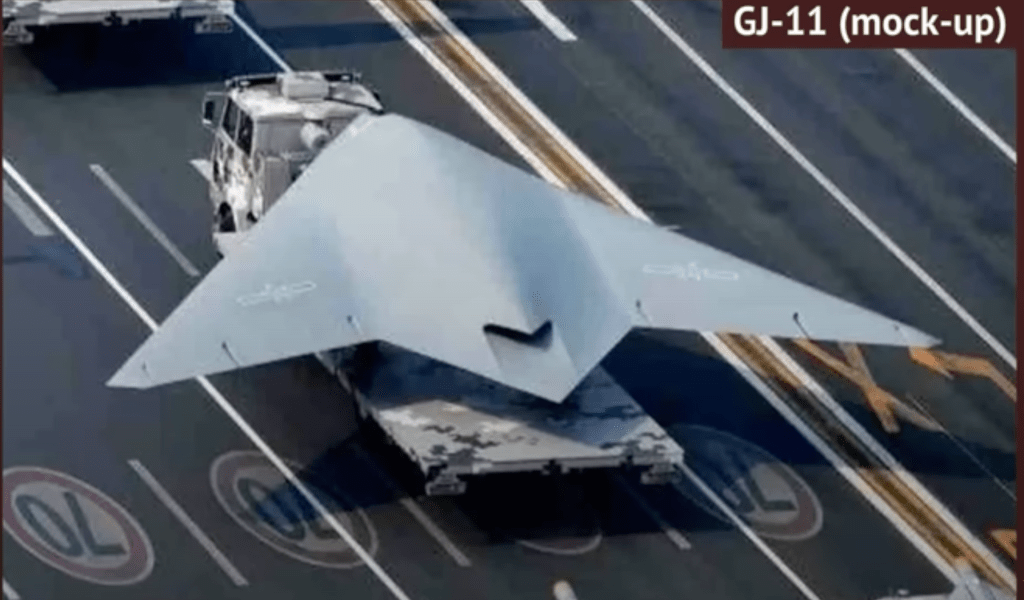
As if these were not enough of an alarm, China revealed what looks like a light aircraft carrier, the Type-076 Class built in Sichuan.

The carrier is no ordinary vessel and appears to be a world first. Heavily protected by as many as six anti-air missile batteries, three CIWS and what appears to be an anti-drone laser, the carrier is designed to operate as the world’s first naval air combat drone carrier. There is nothing else like it. Its equipment is likely to be based on the GJ-11 strike drone. Wether or not its designed to work in tandem with the Fujiang Class Carrier and her fighters, or as a separate system, its a pioneering and innovative concept likely to enter service by 2027.
And if only that were all. Because the latest marine assault ship is now in service.
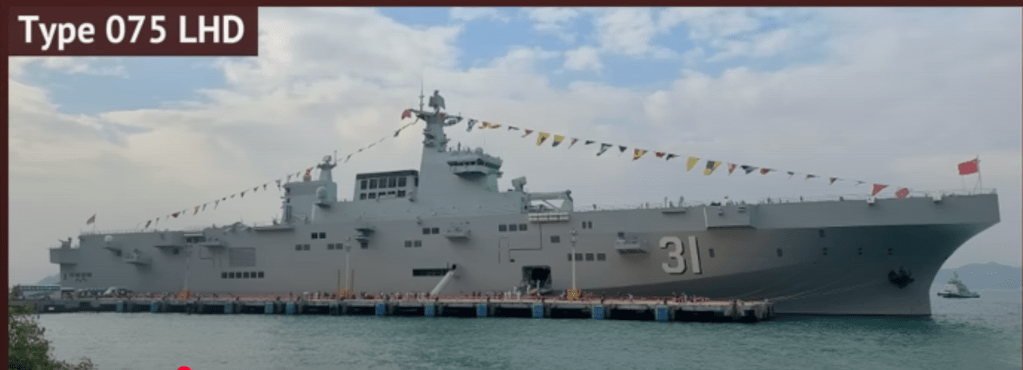
This is another ship designed to make Chinese island assault capabilities second to none. The Type-075 carries helicopters, a dock for landing ships and a comprehensive protection system. She’s roughly comparable to the US Wasp class. This is the fourth one to enter service.
China is preparing for not just a war over Taiwan, but for dealing with the multiple island nations in every one of the 1st, 2nd and 3rd Island Chains, if it has to.
CHINESE POLICY: STEAL IT OR NEUTRALISE IT

China is well aware that the Pacific island states have had long connections with the US, which occupied most of them after the fall of Japan in 1945. Most are now fully independent.
However the US didn’t treat the islands or the islanders especially well. From Bikini Atoll to Eniwetok and others, the Pacific Proving Grounds were the site of 67 major nuclear weapons tests – including the disastrous 1954 Castle Bravo test. Estimated at around 7-9 megatons it produced over 15 and spewed radiation across the whole of the Marshall Islands and far beyond. The US was never generous in its settlements and compensation and its legacy has never been properly forgiven.
The islands were left to themselves and the US showed little interest in any of them, especially after the Cold War ended. It retained a few islands for military purposes and still does. It became so disinterested in most of the Pacific Island nations it couldn’t even be bothered to install embassies in their capitals.
The islanders noticed. As China started calling in the last 15 years, quietly making inroads, the locals responded if not positively, certainly not negatively. The Biden administration was the first to finally notice it had a credibility problem in the region and started to make its presence felt again, offering development aid and rectifying some of its past mistakes. It was all a little bit late in the day.
China, having stolen most of the South China Sea and its islands, disputes Taiwan, and the Japanese controlled Ryuku islands that spread to the Japanese mainland from just north of Taiwan. Okinawa is the largest of those islands.
Aware of the key importance of the huge American military base on Okinawa, it has fostered opposition, stirred up resentment and goes out of its way to rile the population. Its favorite is to magnify any issue regarding the behavior of US troops on the Island, which belongs to Japan, but is highly Americanized. Successfully loud campaigns have been created demanding the Americans leave and seeking formal independence. Okinawa is the forward land based edge of American power. How it survives any massive initial strike seems almost impossible to believe.
Guam is another issue. Its such an important military site the Chinese obsess over it, just as the Americans have finally started to reinforce its defences and make it a more viable position – it is in effect the front line. The problem is that China has so many ballistic missiles and cruise missiles no matter what is there to defend it seems almost inevitably inadequate. Chinese firepower is way beyond anything that can be reasonably defended from.
This leaves the US, when it comes to Taiwan, with its Japanese bases, Okinawa and Guam. All of them could viably be knocked out of the conflict in hours. China has the firepower to achieve it, even the Americans know that. Yet they seem bemused as to how to defend from it and make their forward bases a viable deterrent.
That leaves the Americans with a problem. No airfields, no sorties. As a result they have started to look for additional air bases. Recent satellite photos show the WW2 air base at Tinian, from where the atomic bombs on Japan were flown, has suddenly started to be cleared and there is active construction going on, the result of a December 2023 decision by the USAF. Additionally the main airport is being upgraded for military use. This is part of the North Mariana islands, which are a US Commonwealth – meaning they have no say in Congress in Washington.
The Americans talk about strategic dispersion and making it harder to for the Chinese to target them. Yet they don’t seem to realize the quantity of missiles the Chinese have – and the speed they can produce them largely negates any attempts to effectively disperse on land based airfields.

The Americans have been looking around their former colonies and occupied territories looking for additional sites to refurbish – unsurprisingly most of the island nations don’t want any part of what could be a devastating conflict involving their biggest and most powerful neighbors.
The biggest US bases are in southern Japan, mostly around Yokohama where the fleet is based. Better defended but far from invincible.
The simple fact is China is reaching the point of having the unquestioned capability of dominating the sea and the skies around Taiwan, doing so much damage to US bases that are critical for any viable response, that even with three aircraft carriers and their associated battlegroups, the US would likely never be able to approach the island and land a response force of sufficient size to make a difference. Even with full on Japanese and S.Korean support, in the end its a numbers game and China can overwhelm the area it needs so heavily even if it lost three to one in aircraft, which is unlikely, it would still have enough to complete a successful invasion by 2027.
THE WINDOW OF VULNERABILITY
Naval officers, Congressional Committees, industry and analysts alike have all warned the Pentagon and several administrations that US shipbuilding programs, repair capabilities and programs are woefully inadequate.
Retirements of the large Ticonderoga class cruisers have been seen as financially necessary because they’re too expensive to modernize, while being militarily bad news because their 120 VLS missile launchers are too much of a loss to bare. Even a pair of Flight-III Arleigh Burke DDG’s barely makes up for one.
There aren’t enough submarines, there aren’t enough F-35 equipped carriers, there aren’t enough carriers ready at any one time, there aren’t enough assault ships, the Marine Corps is too small, support ships and auxiliaries too few. China will operate near its bases – American warships could barely be further from theirs if they tried. Everything the US needs to fight China has atrophied – and the 2027-28 point is the period at which the US Navy is expected to be its smallest and weakest in decades prior and to come. After that it slowly improves. Very slowly.
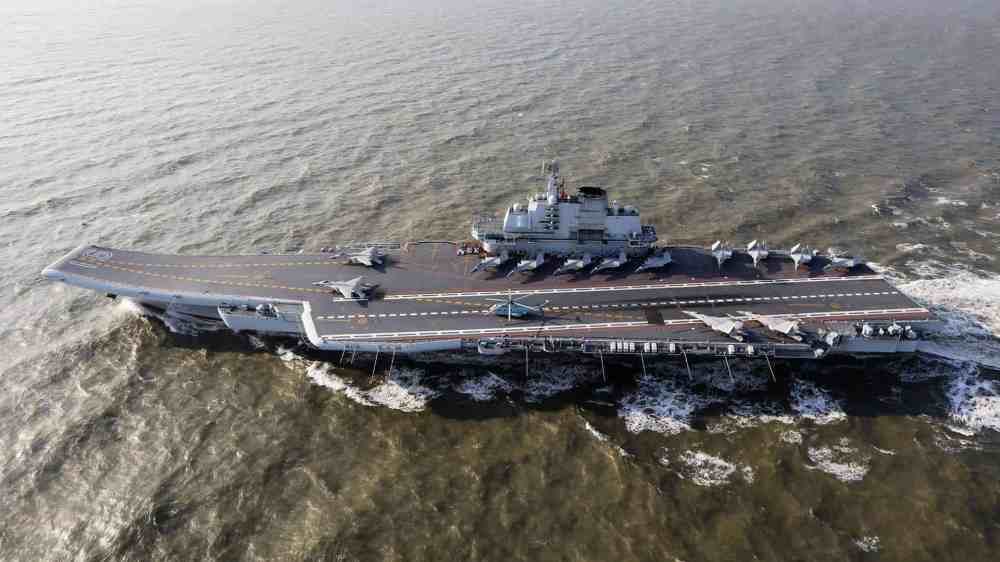
So just as China is at its zenith, the US is at its nadir. China is the only country on Earth that poses a military capability so great it could stop US carriers. The nuclear powered super carrier is a marvelously intimidating weapon when you’re up against an enemy that has no means of threatening it, let alone destroying it. However they could quickly become a liability and even a national humiliation and embarrassment if they were sunk in a failed effort to save Taiwan.
The Chinese have now built a navy and air force of such size that there is in my opinion, now no longer a viable path for the US to stop a Chinese occupation of Taiwan.
Imagine if Taiwan was 100 miles off of California, and the Chinese had to come across the Pacific with their nearest base in Hawaii. How with the entire USAF and Navy just a handful of miles from home, blockading the island and dominating the skies, would you expect China to win? You would not.
So where does this put the West when it comes to Taiwan? There is only one reality. Taiwan needs to move its industrial capacity out of country and back to the US. As a democracy we have to realise that failure to prepare itself, failure of us to build it up and our own forces until it’s far too late, has left us facing a Chinese attack we – the US primarily – simply cannot deter China from. China has a political agenda that is determined to get what it wants. We do far too little far too slowly and now it’s too late. If China decides a military solution is necessary then I don’t see how it can be stopped.
The only possibility is that the economic cost would be so devastating China would think twice. However it’s so fundamental to the party and to Xi personally that he leaves this legacy, that even that isn’t enough to make them reconsider.
I put myself in the position of both sides. If I was Xi, I would do it. In 2027 things will be at their best for China militarily. There’s almost no reason not to do it. The international community have half abandoned Taiwan already.
If I was the Americans there is the national humiliation of facing the fact its military is impotent in the case of Taiwan – it can face chronic losses and embarrassment fighting a losing war or it can do nothing but impose massive sanctions on China. Either way it stands to lose face and the implications for its influence and credibility are difficult to quantify as anything but very negative.
The only solution is to publicly let Taiwan go, admit its own government is failing it and say the US is not prepared to defend those who won’t help defend themselves. That’s in line with current administration thinking in general. Repeal the Taiwan Relations Act, (although that would be very difficult to do) and watch as Taiwan either wakes up and defends itself or is absorbed into China.
Then we wait as the US finally rebuilds its fleet and provides a real shield against Chinese expansion in the Pacific.
THE NUCLEAR OPTION
China has massively accelerated is nuclear strategic weapons program – precisely to negate American superiority over it. But its the Americans I worry about more.
Imagine the loss of two carriers and the effective defeat of the attempt to save Taiwan. The loss of those carriers makes me feel sick just thinking about it. It would be a clarifying, definitive moment of such importance. Not just the loss of men and material, but the foundation of American power is based, at sea and around the world, on its carrier battle groups. Show they can be defeated and it’s an earthquake in military doctrine and geopolitical terms nobody wants to contemplate. Americans would be stunned. This is the sort of scenario that those single SLCM-N they want to deploy on each SSN comes into play. Revenge will be called for. One SLCM-N into a Chinese naval base or fleet would do the job. What then?
CONCLUSION
None of these scenarios is good for America and the west. We have ourselves and the indecisive Taiwanese flip flopping their way toward China one minute and trying to escape it the next, to blame. Half asleep we have now stumbled into a near perfect storm that does not help the western cause at all.
However it ends it’s not going to be good for the west or democracy. The sooner we appreciate that fact the better.
How we deal with the consequences will matter far more.
There is though one way of stopping all of this. Defeat Russia in Ukraine or inspire its collapse. If we can prove we can save Ukraine and bring Russia down, China will not act. Its always been why this war matters so much beyond Europe. The Iranians are back in their box for a few short years, if Russia can be forced back into theirs China will not do anything like mount an invasion of Taiwan. It will do it politically and through social strategy. At least though a costly conflict that really would change the balance of the world order would not materialize.
The Analyst
militaryanalyst.bsky.social

 The Military Analyst
Russia just equipped Belarus with nuclear weapons, to not much outcry. Seems like all the US needs to do is provide nuclear weapons to Taiwan and that would be the end of china’s plans.
LikeLiked by 1 person
I think a fleet of ships with a massive amount of air and sea drones with batteries of air and sea defense is the way of future conflicts around islands. Also large planes with the similar capabilities is required. It is all about drones as AI becomes more prominent they will play larger roles. Soldiers will still be required but in a minor role. !0 or maybe 100 planes releasing 100s of drones each or different size drones from different planes maybe complimented with ships releasing their drones. Overwhelming numbers. These Ships should be a major part of a carrier group. Blow molded plastic drones could be manufactured in their millions with ease. Attach fuel , electronics , motor and stuff that goes bang.
LikeLiked by 2 people
The drones then become WMD’s, which I think is inevitable. I just can’t see anyone winning a drone arms race against China with its vast manufacturering capacity.
LikeLiked by 1 person