
The concept of a European unified military command has been around for a long time. It was high on the list of requests for an article and it seems to me to be the most relevant following on from Munich, though there were many others that deserve their own space – AUKUS especially.
World War-2 ended in Europe on May 8 1945, Germany lay in ruins and was divided up between the French, British, Americans and Russians, as was Austria. NATO came into being in 1949, following the Russian blockade of Berlin on its rail and road routes, which lead to the massive Berlin Air Lift. Russian aggression was now clear and a very present danger. NATO, as it still does, tied the US, Canada, Iceland, Norway, Denmark, France, Portugal and the UK, Turkey, Greece & Italy, along with the three BENELUX nations and the newly formed West Germany, into a military alliance. The core of that alliance is Article 5: An attack on one is an attack on all.

NATO followed on from the WEU – the 1948 Western Defence Union founded under the Treaty of Brussels which was quickly seen as being the basis for a wider permanent and long lasting alliance.
There were elements in France, which was already embarking on a nuclear weapons program, who were very uncertain that the United States would ever live up to this deal in Article 5.
This was the age of ‘Tripwire’, a policy by which the United States, unwilling to maintain a vast army in Europe like the Soviets, was willing to use all of its nuclear weapons (which in reality in 1949 it had 170 of), to stop a Soviet attack.
As the 1950’s progressed and the thermonuclear weapon joined the atomic, nuclear stockpiles surged and the Tripwire Policy – which was NATO’s stated doctrine, had teeth. However as the 1960’s progressed and the Soviet Union’s own nuclear stockpile increased, Tripwire started to look like a policy that lacked credibility as it relied on nuclear dominance, which the US by then did not have. That led to NATO’s flexible response doctrine which is still in force now, emphasizing conventional war and nuclear escalation.
In 1950 René Pleven, then President of the French Council of Ministers, proposed what became known as the ‘Pleven Plan,’ a concept designed to create a European Defence Community (EDC), to integrate military forces from European nations under a single political and military authority, excluding the US & Canada.
This initiative sought to prevent the rearmament of Germany (now the Federal Republic of West Germany from 1949), while strengthening collective defense against the Soviet Union during the Cold War. At that time the French were determined to never see another militarized Germany, and with good reason. France bore the brunt of the devastating 1870-71 Franco-Prussian War that saw a third of the country occupied and Paris under siege and lost them Alsace-Lorraine to the new German Empire. Then the First World War, where almost 20% of France was the battleground of the Western Front. And then the disaster of World War-2 where France was defeated in six weeks and occupied for four long hard years by the Nazis. France had good reason never to see Germany rise again. Frankly neither did the Russians who were vexed by the creation of the Federal Republic, eventually establishing the DDR (East Germany), five months later in response. At this point France was very much in the driving seat of European unity, the new West Germany yet to find its legs and rebuild. Britain stood aside from Europe economically and politically.
The Pleven concept was inspired by a recommendation from the Council of Europe in August 1950 and was further developed in a conference organized by France in February 1951. The Treaty establishing the EDC was signed in 1952 but failed to be ratified, primarily due to concerns over national sovereignty, ironically, particularly in France.
This failure marked the end of early efforts to create a unified European army, the national sovereignty issue never going away. Additionally the Americans saw it as pointless when NATO was doing the job – and they commanded NATO forces from Paris under the Supreme Commander Allied Forces Europe, SACEUR, and still do.
What did emerge however was the European Coal & Steel Community in April 1951, with Belgium, France, West Germany, Italy, Luxembourg, and the Netherlands as initial members. This eventually became the European Economic Community which Britain joined in 1973. Eventually this morphed in to the European Union, the modern organization we have today.

By the end of the 1950’s with France exhausting itself in colonial wars it inevitably lost in Vietnam, (but ended up with the Americans waging it until 1976). It was even more bitterly involved with Algeria in N. Africa. To many, French Algeria was as much part of France as Aquitaine or the Pas De Calais. A ruthless and bitter civil war raged there, France itself teetered on the brink of Civil War it was so divided on the issue. De Gaulle carried out what amounted to a coup by any other name toppling the Fourth Republic ‘by invitation’. Now President, General Charles de Gaulle, hero and liberator of France in WW2, ended it, granting Algeria independence. He created the Fifth French Republic – which still exists today, but it gives the President huge executive authority if he chooses to use it. He restored order in France itself and dominated politics until his death in 1968.
De Gaulle did not believe the American guarantee of NATO, famously saying “Would the United States be ready to trade New York for Paris?” He did not believe an American President could do this if it came to a nuclear stand off and one had to be chosen over the other. However he also believed that Germany and France together and in unison would prevent a militarism reemerging. And he was right, working with a revived democratic Germany was a wise and farsighted decision.
France detonated its first nuclear weapon in 1964. In 1966, De Gaulle still adamantly refused to believe the American nuclear umbrella was viable, and withdrew French military forces from NATO command (but did not actually leave NATO). This forced NATO to leave Paris and race to a newly constructed and pretty awful ‘temporary’ site in Mons, Belgium. They remained there until 2021 and the new HQ was finally opened just outside Brussels.
It’s necessary to go into this history because all of it is relevant to how difficult it has been to create a European defense commanded by Europeans. In effect the elephant in the room is NATO and the American command of allied forces. There has never not been a US SACEUR – though many wish that was changed. However there is always a European Secretary General. Yet this American dominance of the command structure was granted because America was the most powerful contributor by far – if that is no longer to be the case then this becomes an anachronism and its important it is changed. SACEUR is beholden to nobody in the end but the US President, and that now matters more than ever before. Technically he is subject to the Secretary General, but we have already seen instances in Bosnia where that system broke down and SACEUR took instruction from Washington over those of the Secretary General. Forcing the British Commander on the ground (Gen Sir Mike Jackson) to request his government play the Red Card – where national forces are withdrawn from NATO command for vital national purposes. SACEUR, General Wes Clarke played it to the hilt on instruction from the White House, but backed down when Jackson told him he wouldn’t fight the Russians over the use of an airport runway, “and start World War 3”. The point being here – SACEUR has already proven it cannot be trusted as a position independent of the US National Military Command, to hold European interests first.
NATO is older, better organized and already does the job a European Defence Union would want to do. Its command system, logistics, pipelines and planning would need to be duplicated or some agreement to use them found. The US is opposed to this because it has been one of the largest contributors over many decades and weakens its influence. Technically the US commands all European land forces, yet there are political and military weaknesses in that position.
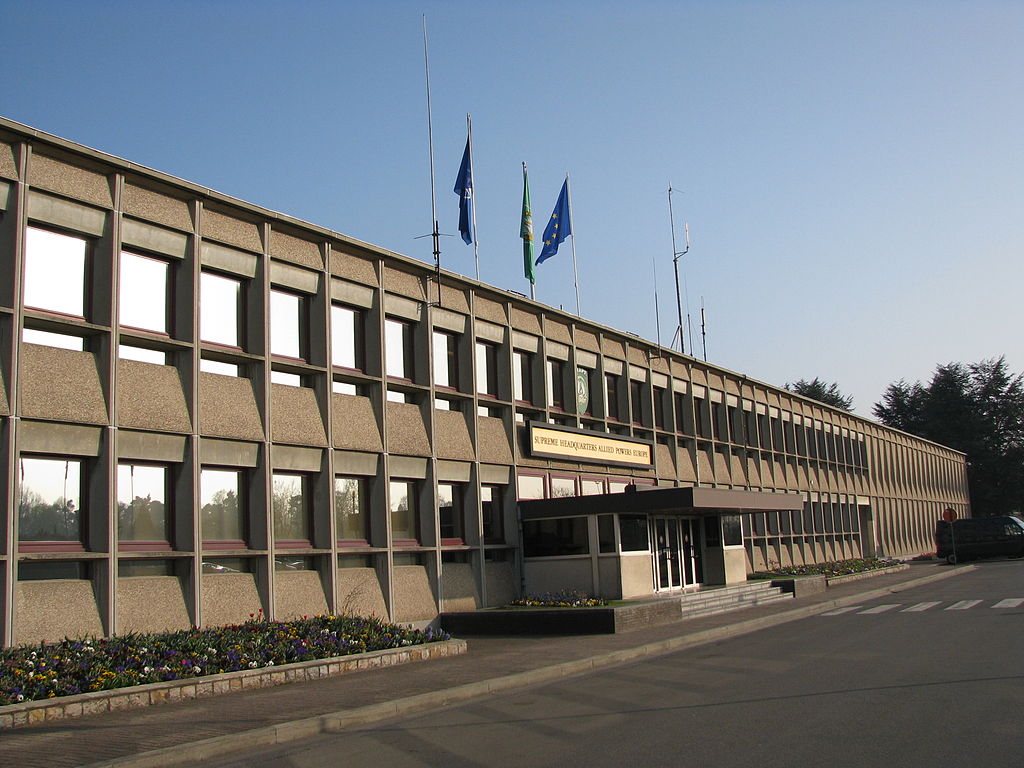
Ironically we are now in a situation where we don’t want NATO to be dissolved and the Americans to abandon it (which 47 can’t actually do), although ironically its structures, both political and military would help form the backbone of a new EDU.
The policy on an EU defence arm is mired in historical failure. It wasn’t until 1998 that the St.Malo declaration, between the UK & France laid down the groundwork for a European defence capability within the EU framework, leading to the development of the European Security and Defence Policy (ESDP) in 1999. In 2009 the Treaty of Lisbon renamed the ESDP to the Common Security and Defence Policy (CSDP), which continues to serve as the EU’s defense framework.
Common Security and Defence Policy (CSDP)
This is what we have right now inside the EU. Of course the ridiculous part of all this is the founding national government, the UK, has left the EU completely, a mistake that the vast majority of British now comprehend, but nobody wants to re-litigate after the divisions of 2016.
1.The CSDP deploys EU forces, contributed by member states, for operations such as peacekeeping, conflict prevention, and crisis management. The UK has no part in it.
2. Collective Self-Defense: It allows for collective defense among EU member states, though it primarily focuses on external crisis management. However this does give a basis for EU members coming to each other’s aid – but it doesn’t include an Article 5 type arrangement.
Article 42(7) of the Treaty on European Union (TEU), includes a mutual assistance clause. This clause obligates EU member states to provide aid and assistance to another member state that is the victim of armed aggression on its territory, but there are key differences compared to NATO’s collective defense framework:
A. No Automatic Response: Assistance under Article 42(7) is not automatic; it requires the attacked member state to formally request help. The nature and extent of the assistance are left to the discretion of individual member states, allowing flexibility in how they respond.
B. Respect for Neutrality: The clause takes into account the specific security and defense policies of member states, such as neutrality (e.g., Ireland, Austria, and Malta). These countries are not required to provide military aid if it conflicts with their domestic policies.
C. Coordination with NATO: For EU members that are also NATO allies, Article 42(7) is consistent with their NATO commitments. NATO remains the primary framework for collective defense for those states
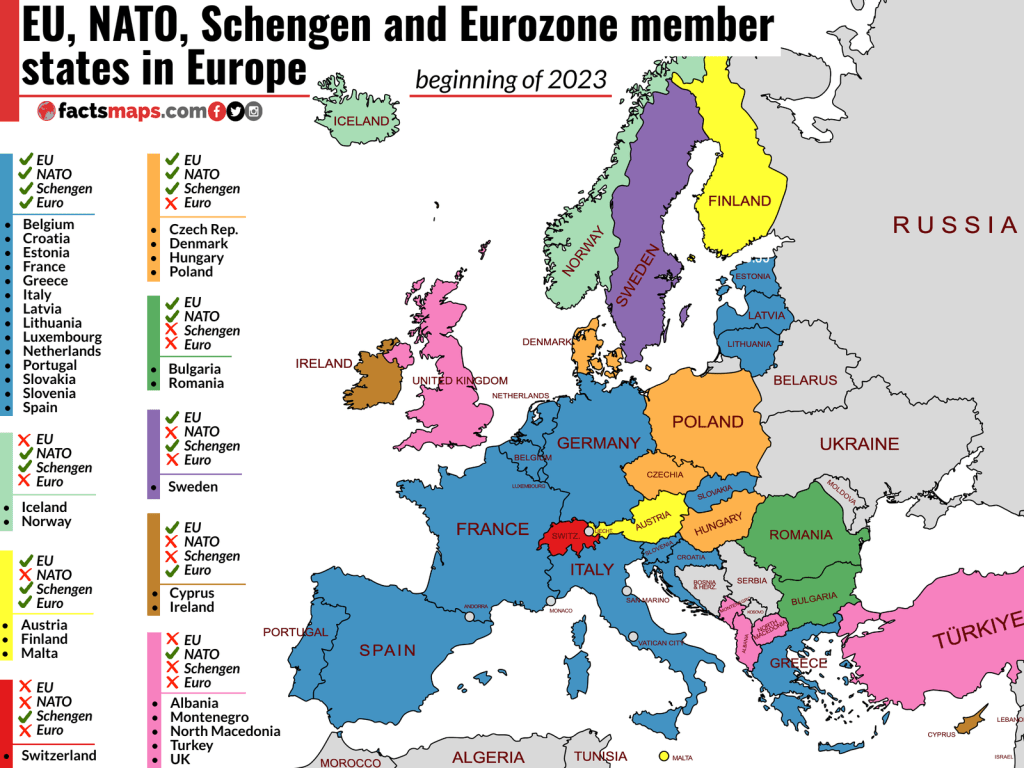
3. Permanent Structured Cooperation (PESCO): This initiative involves 26 of the 27 EU member states working toward deeper integration of their armed forces. Malta is constitutionally neutral so doesn’t take part.
4. Command and Control Structure: While the EU lacks a standing military force like NATO’s Allied Command, it has established structures such as the Military Planning and Conduct Capability (MPCC) office for strategic-level command. It’s based in the Kortenberg building in Brussels, Belgium, alongside other Common Security and Defence Policy (CSDP) bodies. Defined as a permanent command and control structure at the military strategic level, it was established in 2017 to oversee the operational planning and conduct of EU military missions.

The MPCC has overseen EUFOR Althea (but is under NATO command) in Bosnia-Herzegovina, the EUNAVFOR Somalia anti-piracy campaign, EUNAVFOR MED enforcing the arms embargo on Libya commanded by Greece and Italy, and Operation Aspides, launched in February 2024 in the Red Sea to counter the Houthis.
So, there is in essence now, a European military command capable of carrying out limited operations. And that’s the problem, they are very limited. There is no framework for turning this into a NATO level replacement for the EU, and the reason for that is again, NATO itself.
Europe has reached an inflection point. America under its right wing anti-everything except god, money and oil regime, wants and expects Europe to stand up militarily and deal with Ukraine and many other problems uniquely important to the continent. But it doesn’t want Europe to become the Fourth Power in the multi-polar world that seems to be developing.
It’s a position that cannot by its very nature make any logical sense, so it cannot stand. Europe has huge economic capacity. If it turns it to military means because it has to it will prove to be formidable. Russia and its behavior is forcing the issue, and America by its own, and its seeming willingness to disengage, is ensuring that it must. Yet the possibility America will return to ‘normality’ once 47 is gone and his allure fades in 4 years time, remains Europe’s (misguided) hope.
What happens next? The EU political arm under Ursula von der Leyen as President of the European Commission – effectively its head of state and treated as such (although she was a dreadful German defence minister and didn’t have a clue), has to rally the members. Germany will, post elections, be a determining factor. A powerful element could have been the UK which has Europe’s largest military budget, but now stands outside of it, though willing to cooperate. France is keen to push on – but Macron has just two years left in office and cannot stand again. Few look capable of stopping the right wing Marine Le Pen, who has more ties to Russia than 47 probably does.
There will always be the Orbans and the Ficos, who all too easily can slow the process down. The political will power has to be there. Countries like Spain and Portugal just don’t see the threat the same way as countries like Poland and Finland.
And there will always be NATO – standing there as a full scale military alliance that everyone is a member of and still ties Canada, the UK, the US into an obligation to defend everyone under Article 5.
47 Cannot unilaterally withdraw the US from NATO – congress passed the Congressional Approval Requirement: According to the National Defense Authorization Act (NDAA), specifically Section 1250A, the president cannot unilaterally withdraw the U.S. from NATO.
Any such decision requires approval by two-thirds of the Senate or authorization through an act of Congress. Then there’s the Prohibition on Funding for Withdrawal: The NDAA also prohibits the use of federal funds to facilitate a withdrawal from NATO without congressional consent, effectively blocking any executive action to exit the alliance.
It’s this that has stopped 47 from harping on about withdrawal this time round. However would he honor Article 5? Nothing says he has to, which brings us back to President De Gaulle and his question, modified for the current age, ‘would this president sacrifice Americans for Europe?’ Right now we know the answer. Therefore we must do more in Europe to be ready in case we are indeed required to stand alone.
So in effect we need a wider European defence posture operated by Europe through the EU – which almost certainly excludes the UK and Norway. Both important potential collaborators. Yet there stands NATO, which is still there and not going away.
One way would be to let the US go – and use the NATO infrastructure to build upon it. Automatically including the non-EU members. That though would mean a military problem develops – American missile bases, air bases, forward deployed troops all gone very quickly. Europe would have to be ready to replace NATO IN FULL from day one. Nuclear deterrent included – with just the French and British guaranteeing it.
The other way is that a European command operates totally separately – expensive and duplicated, but perhaps the only viable way forward, if you could change the TEU – which would require negotiations and ratification by all 27 members of the EU.
Nobody in Europe wants to undermine NATO credibility or diminish it. Replacing it seems unlikely. Quite where the Europeans can work out where such an organization sits and who runs it and funds it is hard to see. Coordinated action is more likely the result. But a separate organization I think would be unwise and legally impractical – unless America finally decided to leave NATO. That takes 66 votes in the senate – and that’s never going to happen. The current US administration is not permanent however much we fear it. It’s already heading towards the end in less than 4 years. Once it’s in incompetence is truly felt things will change – the first will come in November 2026.
Is there a place for an alternate European defence organization, yes. However until it can equal or surpass NATO, it’s unlikely to be anything more than a NATO-lite with fewer members and less teeth. If the US were to leave NATO, then that would inevitably be the organization to persist with. A revised NATO under European command and political control, could be a powerful force, especially if funded well. It’s also the only way to overcome the never ending issue of sovereignty, which have plagued the EU defence concepts since their earliest days.
It sounds simple to create a new ‘NATO 2’ for Europe, but it is not. Expand the authority of the MPCC command and its role, yes, but again, it is legally bound to be ‘in cooperation with NATO’.
I hope this has demystified the scenario a little. The fact is we’re largely stuck with NATO by default – I don’t think that is in itself a bad thing. NATO is a magnificent organization and yes it could do with some reforms. Could the role of the MPCC be expanded, of course it could. But it needs the NATO infrastructure and command system to operate effectively. That is the legacy of an institutionalized permanent military alliance that has been the backbone of western defence for 76 years. But it does not preclude, eventually, the Europeans creating something new, even if the legal and practical challenges are immense.
The Analyst
militaryanalyst.bsky.social

 The Military Analyst
The guy in the image is General Robert Brieger. (https://en.wikipedia.org/wiki/Robert_Brieger)
LikeLiked by 1 person
My mistake, thank you.
LikeLike
That was quite sobering reading. Undermining NATO socially and politically has been a key goal of the Russian led Soviet state and ex-KGB led Russian state since its inception.”
The “second coming” of 47, heavily fed by the disinformation machine, and amplified by the American invention of “social media” represents the culmination of their wildest dreams – if it can’t be countered.
Clearly, it must be countered, with strength. This article highlights the difficulty ahead.
LikeLiked by 1 person
I am not so sure the orange clown will go in 4 years. He did not want to go last time and this time he is tearing the government apart from the first days.
LikeLiked by 1 person
He might not want to go but the constitution cannot be changed on a whim, he doesn’t have the votes to do it in the House, in the Senate or 75% of the state houses.
LikeLike
Alnur Mussayev alleges the USSR recruited Donald Trump
This is a link from a comment on another Telegram channel I follow. It´s from X which I don´t subscribe to myself, and haven´t validated it, but seems feasible, even highly probable. If so, it certainly explains Trumps pro-Putin stance which became blatantly apparent during the last couple of days.
Inside Soviet recruitment: Kazakhstan’s former security chief claims Trump was a KGB assetPublished February 21, 2025 13:40Olesya BassarovaGeneral News Correspondento.bassarova@kursiv.kzdonald trumpkazakhstanrussiasecurity
LikeLike
The real Manchurian Candidate
LikeLike
It has been good to read this TA, how the outlook for NATO and indeed Europe has changed in less than a year. The idea of replacing NATO for a NATO 2 is no longer such an outlandish thing to consider. In fact it confirms what really needs to be done, even though it would be an incredibly difficult task. We just need to get Ukraine sorted first, only then can we move forward.
LikeLike