
There has never been a week like it, in fact I had to check myself and be sure it wasn’t actually two that had gone by. In the space of a week the President of the United States lambasted the leader of the free world, a man defending his country from direct Russian aggression. The external response from Ukraine’s allies was shock, and yet what appears to be sudden determination. It was less sudden than you might imagine.

Since the end of 45 as President in 2021 there’s been a quiet and then in 2024 a rapidly accelerated, backroom discussion on what to do if everything he claimed he might do in his first term was implemented – most notably the potential withdrawal from NATO. Therefore while they weren’t ready for how fast it happened with Zelensky and the rapidly accelerating realization of what had been coming for the past month was on them, they all knew what they needed to do because they’d been quietly preparing for it.
An extraordinary feature of this situation is how fast the politicians have accepted the realities and what needs doing. Whereas the officials and diplomats, schooled in years of semi-obeisance to the Americans in NATO and as the leaders of the free world, which had just about been resuscitated by Biden, despite his appallingly slow decision making, were shattered by the prospect of everything they knew turning upside down.

NATO leadership, both political and military is stunned – the Americans don’t know what their real position is now or what it will be. Do they even have their governments support? Mark Rutte, the new Secretary General is determined to keep the organisation intact, but is fast getting to the point where he’s wondering how it can operate without America, which has been so fundamental.
We have to understand how NATO works, because it’s been very successful, and I also believe that while losing the US is a huge problem, it’s absolutely not an insurmountable one. The question is do we want America involved in any way at all or go on our own as Europe+?
What is Europe+? The EU excluding Hungary, possibly excluding Slovakia, probably excluding Austria and definitely Malta and Ireland. The last three are militarily neutral and have been a long time. Hungary & Slovakia lean too much towards Russia. But Europe+ would include Turkey, the United Kingdom, Norway and probably Canada.
This may have to be a new organisation if it turns out to be impossible to extricate the Americans from NATO.
Why it being a NATO 2.0 would be a better proposition, is simply because NATO has all of the military and communications infrastructure, let alone a command structure that largely works. NATO has long needed some reform, because of the way it’s managed. The military Supreme Command has always been American as have been the land, air and naval commands, the Political command has always been European. Deputy Supreme Command – and deputies in most of the lower commands are almost always European. This was always based on the fact that America provided the largest single force contribution – which it no longer does on land. Turkey actually has the largest ground forces for example.
However the United States does contribute the largest Air Force based in Europe, operating from seven bases in the UK alone, including SIGINT and general intelligence, weapons storage and logistics. The question is would they be prepared to shut down places like RAF Molesworth which is USAFE’s main intelligence hub? Would they pull out of Menwith Hill a joint UK/USAFE SIGINT site, or Mildenhall where the Tanker fleet operates from, or Lakenheath where the 48th Fighter wing operates? The base at Welford used for support and logistics? Or Fairford for Strategic bomber forward deployment? This is just the UK. Presumably the combat bases would go but the joint intel facilities I doubt they’d be willing to loose.
Then there are facilities such as the important SOSUS network that runs from Greenland to Iceland and then Scotland. A series of frequently updated underwater sound detection systems used to track the comings and goings of the Russian submarine fleet.
What would happen to both the US and European BMEWS sites which work together to track ballistic missiles using over the horizon backscatter radars in Pittufik Space Force Base (Thule, Greenland) and RAF Fylingdales in Yorkshire? The network is key to NATO defence and the UK/USA early warning systems.

The United States has been integral to North Atlantic defence, and it will have to remain so for its own security if out of NATO. The US loosing access to bases in Greenland, Iceland, the UK, Spain, Italy, Greece, Turkey, Finland, Norway, Germany, Poland, Romania? All of these, especially those where the US Navy is involved would mean a huge retraction in US force projection and capability. Do they really want this? It would be a massive withdrawal from a hugely important part of the world, but it seems they well might do it. If they stand any hope of facing down China, they will need everything they have to stand a hope in hell.
But let’s not be mistaken, we would have to step up massively to fill that gap for our own security.
THE ISSUES THAT REALLY MATTER
- Air Defence
- Intelligence gathering
- Russian naval activity – especially their submarines
- Nuclear deterrence
- Combat capability on the ground and in the air
- Combat sustainability – how long can we stay in the fight?
- Cyber attack and defence, Command and communications
- If we cannot defend our air space from a cruise missile or long range drone attack, we have an instant problem. For the Western parts of Europe they are just as vulnerable to Russian missile strikes as the East – Russian submarines are generally equipped with cruise missiles capable of land attack. This is where western navies – UK & France particularly are going to need more than the four SSN’s they can probably have at sea at any one time in an emergency. Russia has a much larger submarine force than we do. We need more anti- submarine ships and long range planes as well as SSN’s. We need more anti-missile capable defense systems, to protect key infrastructure both civil and military. At the moment the UK has NOTHING AT ALL to fulfill that role. Even those countries that do have something, don’t have much.
- Intelligence gathering and processing needs to be done on an integrated EU+ basis – far beyond how it’s managed now. The gathering capability is increasing constantly, I believe we can cover that in time. knowing what the Russians are doing is vital to our security.
- Russian naval activity in peacetime is not going to stop being a problem, we have to work to counter it, understand it, deter it and if it comes to conflict, prevail. Western navies are capable – and far larger on the surface, but deep sea submarine operations in the Atlantic is another matter. Only France and the UK have the means and they don’t have enough of it. Smaller navies like the Dutch will be needed to hold the line in the North Sea and Channel with their capable coastal submarines.
- Nuclear deterrence. Everyone accepts this will be vital. The UK and France can provide a strategic level deterrence with their SSBN’s – and those will be high on Russia’s kill list in the event of conflict. However at a tactical level the Europeans other than France have nothing. The UK and France will have to come up with theater capable nuclear weapons, because Russian doctrines will tell you the Russians will use them if they think it will benefit them long term – and that means having a reliable counter weight to stop them considering it. They have over 2,000 battlefield nuclear weapons – without the US and counting only France, who have about 40, that’s the sum total of Europe’s nuclear tactical weapons. It’s not enough to persuade the Russians to back off.
- I believe we as a whole can counter a Russian attack with our combined land and air forces, especially by the time Russia could strike. I don’t think this is as big an issue longer term.
- This is the real issue – Combat sustainability. This matters for the simple fact it affects every service land, sea and air. Having enough missiles shells, drones, torpedoes, mines, bombs and whatever else we need is a huge deal. One of the major reasons that sustainability is vital is that it prevents any premature need on our part to resort to nuclear weapons first in defence. If the Russians believe we can sustain the conflict they will be deterred from starting it. The last thing they want is a lengthy war. Interoperability and manufacturing standards are vital.
- Cyber, Command and Control, Communications. We have to have a unified system, not several. We need quality cyber soldiers because Russia loves that space for open warfare.. and it’s available 24/7. We need secure command and control communications across the entire organisation.
These are just the basics, but Europe is more than capable of providing them because generally speaking it is already. The political and financial will is there now. Its how America wants to operate – in or out of Europe as a believable NATO ally, or it goes. Because the one thing we don’t need is an ally that says its in and then its out when the chips are down and we can’t make things work without them.
Personally I think we should encourage an American withdrawal over the next four years as we build up our forces, and they move theirs to the Pacific. We can do this, there are problems to solve – Britain especially with its reliance on American tech, intel, and nuclear missiles has a problem on its hands
THE UK’S NUCLEAR PROBLEM IS EUROPE’S AS WELL NOW
The UK purchased 58 Trident-II missiles and used 8 of them in test fires. Allowing for two SSBN’s to be live missile carrying, at any one time in the future, that leaves just 26 – and each submarine is going to need to fire at least 1 and probably 2 to reach IOC, reducing that by 8. The missile is no longer manufactured even though it can be refurbished in the US. The UK stores its spares at Kings Bay Georgia, with the US spares while the operational missiles are either at sea or at Faslane in Scotland where the subs are based. They are expected to remain operational until as late as 2050/55. The US and UK have cooperated on a new warhead for the missiles, the W-93.
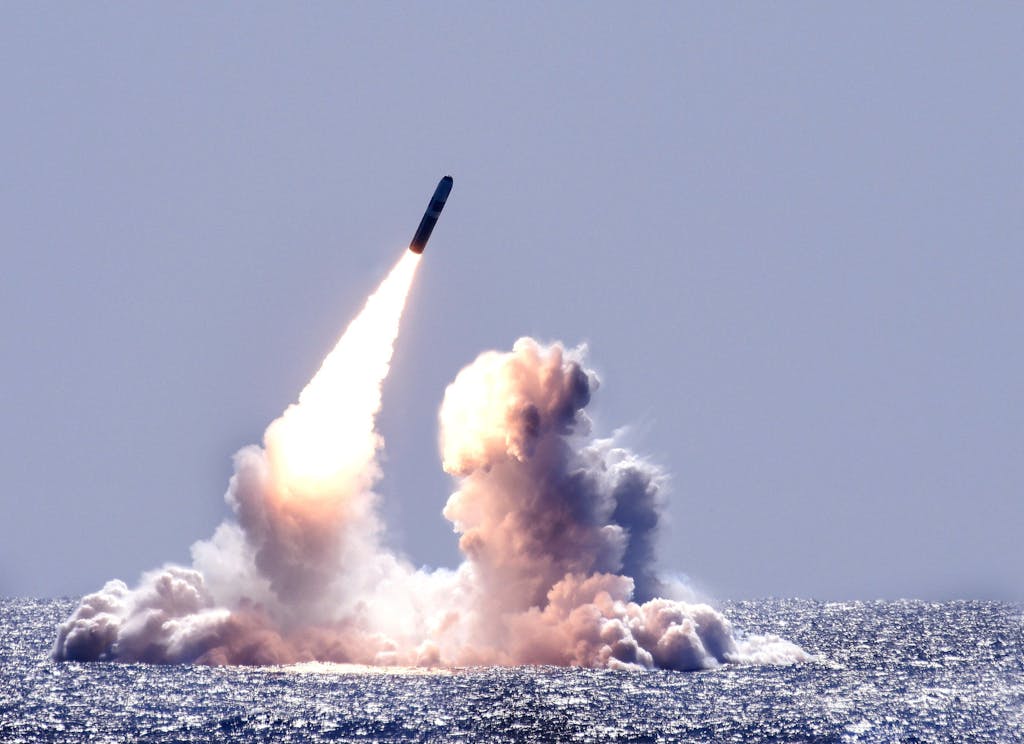
There have been tensions in the whole program. Twice a UK SSBN test fire has failed (2017 & 2023). The UK Government wanted to be open and honest about the problem, to preserve the deterrents viability – because its since been revealed through leaks that the missiles weren’t faulty – it was the test equipment the Americans installed that failed. The Americans blocked the British from admitting the truth. Its issues like this that make it hard to ensure the nuclear relationship works – especially with an administration that can so fecklessly change its mind on a whim. The fact is the UK is tied to the US at least on the deterrent issue for decades to come. If it falls apart so do the UK options and replacing them with French missiles – if that were even possible – would be expensive and deeply problematic.
Ultimately the UK & France both need to contribute to strategic nuclear defence, so it does matter what happens to the UK and its systems for all of Europe. Once in the UK, installed in the Submarines the US has no control over the missiles, they’re entirely a British operation, what we do with them is up to us.
INSTITUTIONAL REFORMS
An updated Euro-centric NATO needs to determine a process of merit based promotions to give the organisation the best possible SACEUR. The Americans tend to use the role to put troublesome generals who question everything out of the way before they retire, and it’s been that way since the end of the Cold War. It’s considered a plum job but as most of the time nothing ever happened, lesser men were picked for it, which led to issues when trouble did occur in the Balkans in the late 1990’s. Most people would have considered then SACEUR Wes Clarke the wrong man for the job, and it heavily emphasized to Europeans that SACEUR was answering more to Washington than Brussels SHAPE (Supreme Headquarters Allied Powers Europe). These days have to be put behind us.
Likewise if the US withdraws its forces from the Mediterranean, if an Israel problem flares up and they want to redeploy that could be done in partnership with a reformed NATO – or they go it alone which they could but would be considerably more difficult.
The political side of things – especially the Atlantic Council would need an overhaul, as would some of the clauses on membership and voting. Unanimous voting is ridiculous, it needs to be a binding majority of at least 60%. Clauses to enable the ejection of an allied member like Hungary which has become a serious security problem and blockage to NATO policy need to be made available.
The underlying principle however must be that Article 5 – the all for one and one for all keystone of NATO is its principle strength.
The elephant in the room of course is that America requires Congress to approve a withdrawal from NATO and the funds to make that possible. Right now this is very unlikely to happen. However, if the administration decided to do a France from 1966-1996 and withdraw from the military command of NATO, while remaining in the Atlantic Council, and withdrew its military forces from Europe over time to the Pacific, it retains much of the basic cooperation but leaves the Europeans and Canadians almost entirely responsible for their own direct defence.
I honestly think that a new separate organisation for European defence is too duplicative and wasteful when we have the best system in operation already.
Does it need reform, yes, but we can make reform happen if we desire it strongly enough. Ukraine is a top priority.
Individual nations like Germany have made a huge change in perception, Friederich Merz, is a technocrat, a by the book economic conservative, whose methods to turn Germany around would have harsh in some ways but entirely necessary changes and Germans know it. Its in the economic doldrums due to poor planning, lack of investment in the future and a failure to keep up with the digital revolution across the board.

Yet, this fiscal conservative sees instantly that the world has changed and his pragmatic nature is able to simply wipe away everything he thought he would do and replace it with something else that in the long term will partly drive the same result.
He’s calling for $200 billion in additional German defence spending alone, never mind the additional stimulus form the EU. He’s calling for the reconstruction of the German armed forces to the levels they were at in the Cold War – and at the same level of readiness.
This is a huge undertaking. Germany’s armed forces are a laughing stock they’ve been allowed to get so bad. Yet the $100 billion boost Olaf Schultz allocated has been largely spent, much of it on new US equipment. New communications, a tranche of F-35’s to replace the ageing Tornado fleet and much besides. It will all arrive in time, but it’s just the start. If you start from behind you have to catch up first.
New thinking is required – for example an interesting proposal by Italy’s Giorgia Meloni was to extend Article 5 to Ukraine without actually making it a member of NATO because Russia will never agree to that happening for a peace deal. Ukraine can unofficially take part in NATO much as Sweden & Finland did before actually joining, it’s already doing that anyway. These are the types of ideas and proposals we need but Hungary and Slovakia would make it impossible which is why the organisation needs reform.
Getting the US out of NATO and restructuring it is an immense problem – but no more so than building a new organization from scratch.
There is a vast amount to resolve, some serious negotiations and planning need to get underway. But for once the political will is there. We know we have a problem and we have to deal with it. Let’s rise to the occasion and make this happen!
The Analyst
militaryanalyst.bsky.social

 The Military Analyst
A useful summary of the issues that will drive the choices that NATO members have collectively got to make. The real difficulty is I suspect, “collectively”. It takes time to digest, process and change direction even in a single democracy.
LikeLiked by 2 people
Also, while Ukraine is obviously the key issue now, most analysis of Ukraine assumes it’s simply about Russian territorial ambitions qualified by their long held belief in needing a ring of buffer states to protect them from the outside world.
Actually it isn’t. The weaponisation of grain, and now the wrangling over mineral extraction, both demonstrate that economic resources is the fundamental driver, but, and this is critically important to understand, those resources in a world where catastrophic environmental disaster is now reality. Russia knows that global climate breakdown actually suits its interests very nicely thank you. Melting tundra opens up unbelievably vast new agricultural
LikeLiked by 1 person
… and mineral resources, a whole new scope of ready military, trade and comms routes inside the arctic circle, and at the same time economic chaos in western countries unable and unwilling to adjust to the need to adapt to climate breakdown. Plus the social instability of having to tackle the impact of unprecedented waves of human migration as poorer regions break down environmentally, then politically. Russia has a long way to go to catch up with China, and probably never will, but China has been quietly sequestering global resources for 6 decades or longer, with the massively effective “firepower” of tied development programmes. And China is obviously playing Russia along to make the most of getting its stake on Siberia registered irreversibly.
Sooo …. the big issue for NATO and NATO aligned democracies, is what will need to be done to survive with liberal democracy still vaguely functioning, when Russia in particular has every reason to accelerate environmental destruction? What are the military and strategic threats in that context?
LikeLiked by 1 person
Too complex for this reply! But accelerating climate change even faster than the break neck pace it’s already happening at is not going to help Russia. It’s in danger of being totally unable to manage vast areas of Siberia – storms, altered weather patterns, vast fires, that’s just the beginning.
LikeLiked by 1 person
It’s also accelerating methane emissions at a scary pace – and methane is 23 times worse than Co2 for warming.
I was talking to a geologist the other day and he’s adamant the whole real Rare Earths thing is totally overblown. They just aren’t as prevalent as some sources are making out – his estimate was Ukraine has almost nothing of the ‘key 17’.
LikeLiked by 1 person
If your geologist friend is right, then I’m sure that Kyiv knows that too, and would negotiate accordingly. But the rare earths issue was just an example, and other mineral resources are just as significant, not least old fashioned coal.
Regarding the impact of climate breakdown on Russia itself, I can’t disagree with you that it would generate as much catastrophic consequences as elsewhere, but my case is that the Russian kleptocratic leadership will only be counting the gains including the pain inflicted on others, not the welfare of its serfs and minions. Stalin would certainly have seen the advantages and Putin would love to be revered like Stalin.
LikeLiked by 2 people
Great article, v thought provoking, + some of the comments. One small thing: Gen Breedlove ex SACEUR pointed out that SACEUR always had to be an American because any decision to hit the nuclear button involved a US nuke, which of course would change if USA withdraws.
LikeLiked by 1 person
That was part of the reason, but it’s always been a point of order that ‘we’re the biggest and we get to run things’. There was never an argument over it. SACEUR never had the ability to operate nukes without NCA approval from the President unless there was no NCA left.
LikeLiked by 1 person
Lets not forget Ukraine when talking nukes. Ukraine is acutely aware this war would never have started if they weren’t forced to give up their nukes. Of course they will deny it, & it must be super hush hush, but if Ukraine in not re-developing their nuke capability then they are simply not doing their job.
LikeLiked by 2 people
I heard someone say the other day, ‘of course we haven’t got our nukes yet, but…’ then he stopped and changed tack.
LikeLiked by 1 person
Interesting analysis – thanks! My only question is, where does all this leave Canada?
LikeLiked by 1 person
I think that’s up to Canada. A revised NATO without America would welcome it to stay. I think we’d all be better off with Canada as a member.
LikeLike
Why I was asking:
https://en.defence-ua.com/analysis/canada_is_worried_all_its_f_35_can_be_disabled_with_a_push_of_a_button_in_washington_how_realistic_it_is-13760.html
It seems Canada has reason to be just as nervous as the Europeans …
LikeLiked by 1 person
Severomorsk, the home of Russia´s Northern fleet, is only approx.. 250 km from the Norwegian port of Kirkenes on the Kola peninsula. It has over 30 surface warships and 30+ active submarines with unrestricted access to the Barents Sea, the Norwegian Sea and the North Atlantic, making Britain, Ireland, France, Spain and Portugal very vulnerable from the sea. Britain and France are now doing their part in rearming NATO, while Spain and Portugal are lagging behind in contributing as they feel that the war in Ukraine is so far away in the east of Europe that they are not so much in danger of being attacked by land. France is now spending 2.04% of its GDP on Nato, Portugal 1.55% and Spain 1.28%. Fine. Have they not ever thought about their coastal cities and ports being attacked by Russian submarines with their Kalibr land attack cruise missiles? The French naval base at Cherbourg in the Channel, Brest Arsenal, La Rochelle; Spain´s A Coruna and Vigo on the northern and western coasts, Portugal´s Porto, and Lisbon. All are wide open to attack from the Atlantic and being on the western periphery far from Ukraine won´t save them from submarine-launched missiles.
And then there´s Ireland, the soft underbelly of Europe. Still militarily neutral since the end of WWII , it relies on Britain to protect Irish airspace. In 2024, Ireland joined NATO’s Individually Tailored Partnership Programme (ITPP) to increase its capabilities at countering potential threats to undersea infrastructure (transatlantic telecommunications, internet cables). It might be time for the “neutral” countries (Ireland, Austria, Malta and Cyprus) to rethink and decide whose side they are on, because you can only be neutral if you are strong enough to defend yourself. Do they expect that other NATO countries will come galloping to their rescue (Article 5 and all that?) Perhaps Trump had a point after all.
We saw Finland and Sweden hurriedly join NATO after years of being against joining when it came to the crunch. It seems it is never urgent until they are directly threatened. – Finland having performed a balancing act since WWII with USSR/Russia sharing a long land border, and Sweden, finally realising that after over 200 years of having been spared the costs of war, that it could no longer stand alone in the face of Russian aggression in the Baltic. The Russian exclave of Kaliningrad is only 300 km from the Swedish naval base at Karlskrona, easily within reach of any cruise missile. (Sweden´s neutrality during WWII whereby it permitted Nazi troop transport by train through the country to occupied Norway and Finland has still not been totally forgiven by those old enough to remember).
Perhaps the cheapskates and freeloaders will finally wake up when the blowlamp is at their backsides.
LikeLike