
The war in Ukraine is entering a new phase and a slightly unexpected one.
TACTICAL DRONES
There appears to be no question now that Ukraine has achieved tactical superiority on the battlefield in drones, and this appears to be increasing and improving. Russian military commentators opinions of their own drone quantities and especially the qualities, are at best mediocre.
This is perhaps understandable if we look at the origins of the Ukrainian effort. They knew at the start drones would be important, and the only way of producing enough and consistently was through a nationwide effort, because drones lent themselves to be fully or partially assembled at home by volunteers. This created a highly skilled network of people that could not easily be disrupted by Russian attacks and ensured a rapidly rising supply level. As time went on these volunteers have produced less in the way of finished drones, but more in the way of components ready to be assembled and sent to the field from assembly and distribution points. Ukraine is aiming for a million or more drones this year, never mind the drones supplied from allied countries, although they tend to be more specialised.
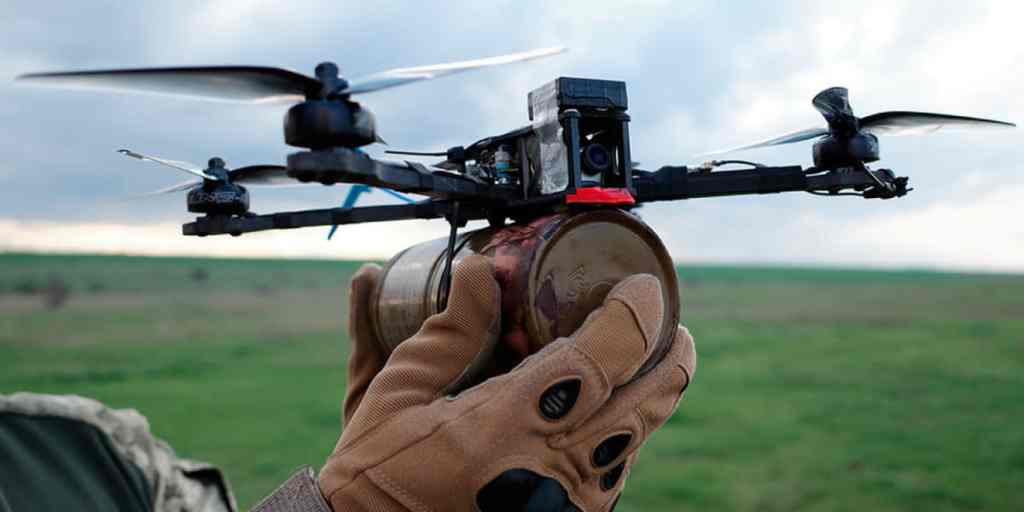
Ukraine has consistently improved its drones – and a lot of that is down to the fact that so many people have been able to say, ‘we’re doing this, but if we did this, it could be x times better’. The system allows for quick on the fly improvements applied in bulk at relatively high speed field deployment.
Russia of course didn’t ever have this patriotic motivation to contribute to the defence of the homeland, so its drone industry had no opportunity to grow in the same way. Drones such as the Lancett series are almost a different class of weapon. Its the day to day, shell carrying, fragmentation carrying grenade dropping types that kill hundreds of personnel each day (the Russians and Ukrainians assess that 75% of Russian casualties are drone related), that Ukraine has achieved a huge tactical advantage in.
It’s not just their terminal capacity but the range that they achieve. Over the past weeks it’s become clear that the operational range has been extended from 20km to 40km – so some 35km behind the front. This has had a dire impact on Russian logistics, and even more of a chronic impact on Russian artillery which has been relentlessly hammered for two years – even the longest range pieces of which there are few in service now, face elimination. Ukraine’s war on artillery has been devastating, reducing Russian dominance from 10:1 to around 1.8:1 -a remarkable achievement. Its also had a crushing effect on Russian supply trucks and logistics.

Ukraine is also operating western tactical anti-drone systems and increasingly effective electronic warfare drones that have frequently rendered Russian drone operations useless, which the Russians themselves complain about.
Russia hasn’t been totally hopeless on the drone front and they are especially good with recon and spotting drones far behind the lines, although these too have come under increasing pressure as detection and counter-drone operations have been stepped up. The anti-drone drone, sometimes manually operated and sometimes automated, are growing in effectiveness.

Russia did have a significant breakthrough in the Kursk campaign due to night vision equipped fiber-optic drones that couldn’t be jammed. These were able to locate Ukrainian positions at night, they tracked their logistics support to their storage points and then used artillery and drones to hammer their supplies – the Ukrainians were so shocked they assumed American connivance in supplying intel to the Russians, but that wasn’t the case. The Russians had trained up a specialist regiment to operate the drones for this operation.
However, the old axiom that ‘military secrets are the most fleeting of all’, remains appropriate to this day. The latest Ukrainian countermeasures to these fiber-optic drones (which they also use in areas of high EW), is an optical detector that can isolate the light in the cable and track the drone controller down.
Overall, Ukraine has a high level of superiority in the tactical field, both in overall implementation, technology, speed of construction and quality. It actually appears to be increasing as Russia’s remains stagnant. This could be decisive.
STRATEGIC DRONES
Ukraine has had to start from scratch with this section of the drone war, but its advancements after three years have been vast. Its ability to target sites deep inside Russia and the damage it has managed to inflict on key parts of the Russian economy is staggering. In terms of production and the scale of production, the current Ukrainian moratorium on use because of whatever this ceasefire is, are enabling them to stockpile what I hope is a devastating blow against Russia when they break the ceasefire as the Russians undoubtedly will – and have.
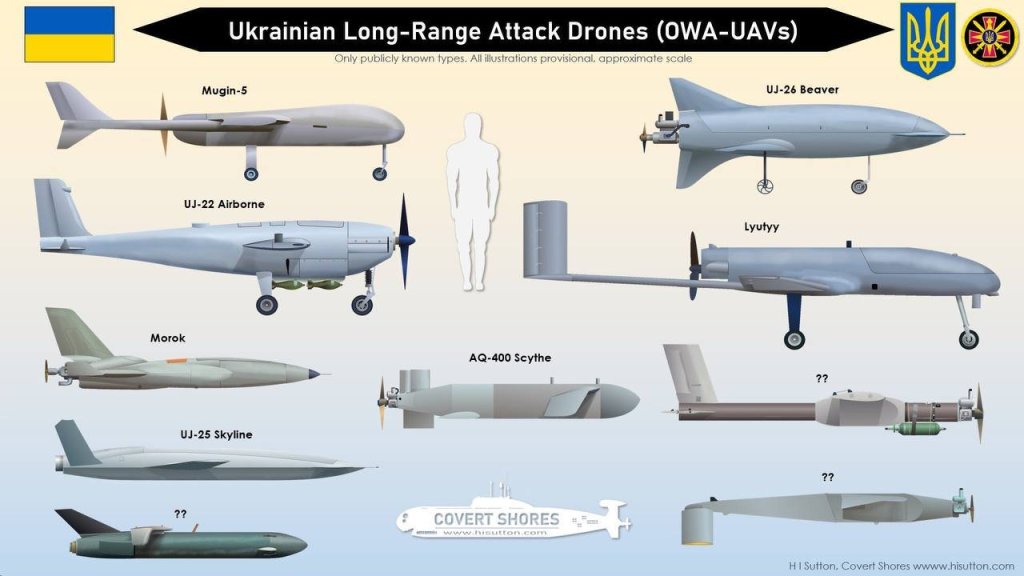
Its not just the variations in type of drones, its their crossing the line into what almost counts as cruise missiles in some ways. It still stuns me that what amounts to a light aircraft packed with explosives was able to cross hundreds of kilometers into Russia and hit anything, yet they repeatedly did so. That alone tells you so very much about Russia.
The Ukrainians have got this incredible development of domestically produced strike drones down to a fine art and the advantage is they have only just begun. Because the strike drone war is about to reach new levels if the war carries on. These won’t be dozens of attacks per day, but hundreds. In fact we have already reached that stage of the war and it may well prove to be almost impossible to overcome without some radical new ideas.
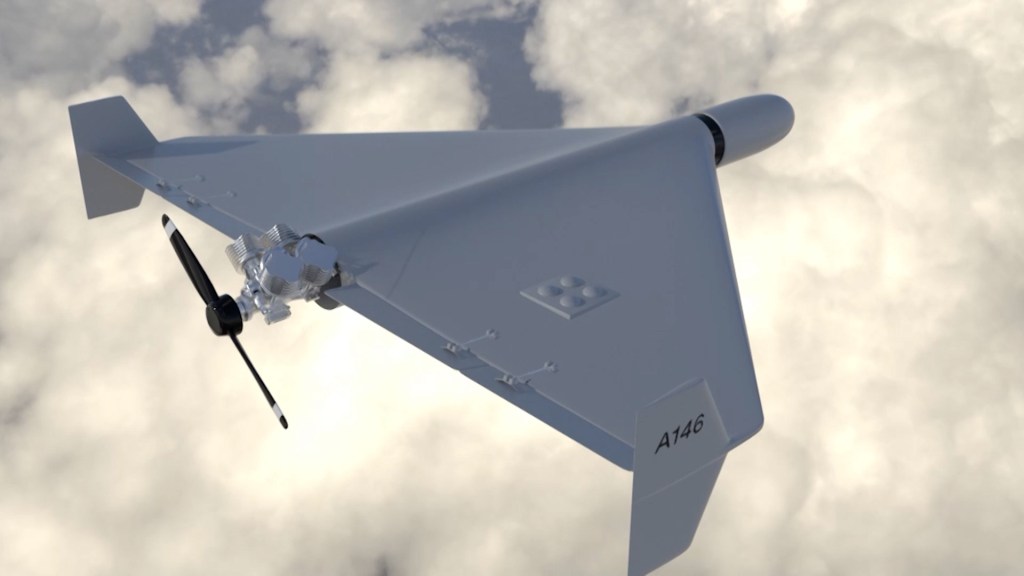
Russia has been using the Shaheed almost from the outset, firstly importing drones from Iran, which were low flying, slow and over time easy enough to jam or shoot down. They were slow and noisy.
The one thing the Russian excel at is making something old and remaking it into something capable of being far worse than its original designers intended. Extending the life of old designs and evolving them has been a mark of Russian military progress for decades – The Mig-25, morphing over fifty years into the Mig-31K, then continuous use of the 65 year old Tu-95’s or the the re-invention of the 1970’s SS-18 ICBM as the Satan in the 2020’s. T-72 – which really does date back to 1972, upgraded again and again, into the T-80, the T-90.
This is what they have done with the Shaheed-136, the drone they call Geran. It has now developed into a far quieter, higher flying (2000m) more resilient version with not the original 30Kg warhead but a 90Kg warhead. Not only that, it has developed networking capabilities (always something the Russians have excelled from the 1960’s), and group of them now loiter above their targets until sufficient arrive and then dive bomb the locality, currently one at a time. They’re harder to shoot down and harder to jam and spoof. They seem to have stopped using the mobile network masts as navigation as the Ukrainians were able to spoof them off target.
If this news was not bad enough, there are now three 24/7 production lines producing these drones at a rate of 200 per day. Until the 31st March this year not one day had gone by without an attack and the numbers in use have risen dramatically to around 200 per day – a sharp increase began late last year. The Russians are on target to produce and use as many as 500 per day by the end of this year, a number that is almost impossible to defend from at an economically viable rate. Interceptions have also fallen as a percentage from highs of 90%+ to the mid 60’s.
It’s what Russia targets that’s so deadly, anything from shops and petrol stations to hospitals and schools, and of course the electricity grid and hotels and apartment blocks – its a terror campaign.
Both participants in this war have very different strategies. Russia is obsessed with electrical infrastructure and ‘life maintaining’ and cultural targets. This is designed to undermine the morale and psychology of the population; they did this Syria, to huge effect and it did in the end work, but left the country in ruins and the Russians largely expelled and their puppet leader gone.
Ukraine hits military factories, oil refineries and gas/oil infrastructure to damage Russia’s carbon based economy and its working. Personally I believe they should strike hard at Russian electrical infrastructure, which one of my followers on BlueSky with knowledge of these things tells me, is far from being particularly resilient. Something needs to be done to reach the population at large and make them feel that this war has come home to them.
NAVAL DRONES
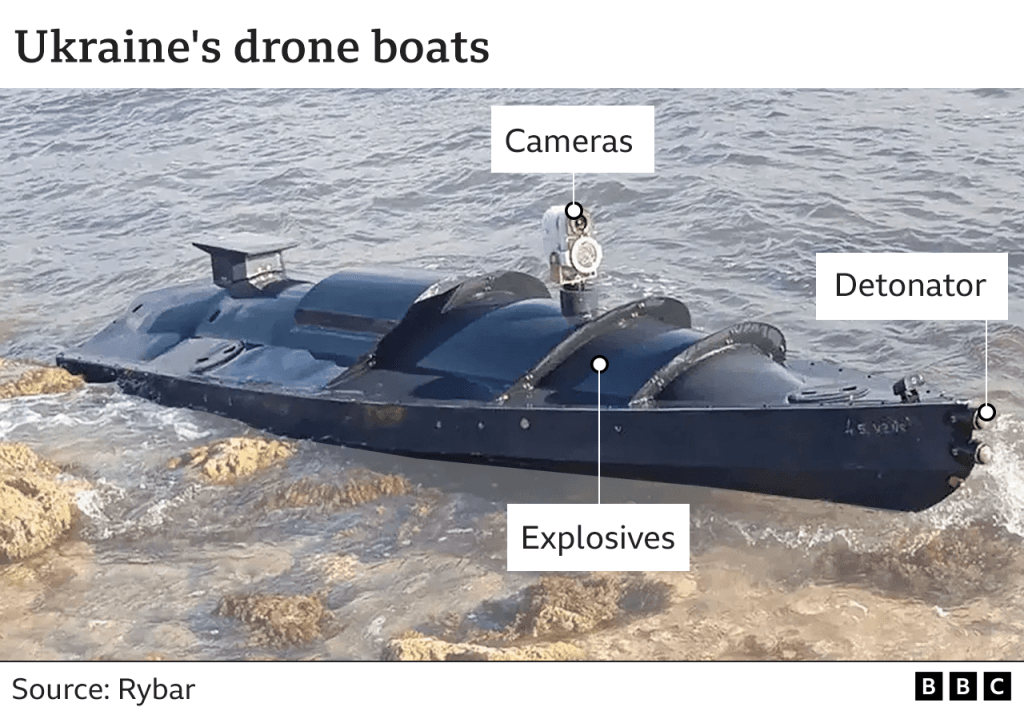
I haven’t gone on about this extensively because this is a war Ukraine has won. It’s a revolutionary victory and tells us a huge amount about war in confined maritime spaces in the future. Eventually though, those drones will be ocean going and as dangerous if not more so, but that’s down the road a little. It’s not belittling the naval drones, because they continue to develop, especially the gun and missile mounted versions that have shot down Russian aircraft and helicopters – who expected that three years ago? Russia’s navy has been humiliated and defeated in the Black Sea, and that will be the case until this war ends.
CONCLUSION
Technology is driving this along with production capacity. On the battlefield I am sure Ukraine is winning the drone war and Russia is well behind. They just don’t have the background and motivation – and frankly the labour force even if they had the factories – to out-compete Ukraine. The Ukrainians are more innovative and more driven, never mind creative and inventive. This is one of their key advantages.
Strategic drones the Ukrainians can match the Russians for the scale of their attacks – but the strategy will never be to hit hospitals and shops, schools and petrol stations. And rightly so. But I think it’s time to take the gloves off when it comes to electrical generation and distribution.
Neither side has a realistically viable defence against increasingly sophisticated strategic drones. It’s becoming expensive to use anti-air missiles and production cannot keep up. Systems like Gepard tanks and ground based guns don’t have the numbers or range at 2,000m to be as effective as they were at 500m or lower. Besides which the numbers are outpacing the available defence.
There’s no doubt that some kind of cheap ‘track and attack’ automated anti-drone system is the only way forward – I’m sure we’ll see one eventually.
The strategic war is like judging apples against oranges. Both sides are capable and both sides have the potential for a deeply destructive campaign, but in very different ways. The drone war is only midway through its span, there’s far more to come.
The Analyst
militaryanalyst.bsky.social

 The Military Analyst
In the early post war period before anti aircraft missiles became popular, Russia had a fairly significant radar guided anti aircraft gun network. With large calibre air burst munitions you do not need to be that close to bring down the target, especially a lightly built drone. What Ukraine needs are radar guided are truck mounted large calibre anti aicraft guns. At 2000m even the old WWII 88mm AchAch or British QF 3.7 inch would do the job although if the Russians respond by flying higher then something bigger will be needed
LikeLiked by 1 person
Lasers will be the future for point defence. Then, when the technology is more mature, directed high power RF to disrupt swarms that lasers are not fast enough for.
LikeLiked by 1 person
Its dissipation and power consumption/output that still remains illusive
LikeLike
Hello,
The big hurdle with any use of light based weapon system, is the need of perfect condition to be effective enough to balance power consumption. Imagine you’re dealing with a swarm of drones flying inside a thick fog, then you’re powerless. To be effective in any condition we’ll need to broaden the spectrum and means of emission, they use a method in brain surgery called gamma bistouri, you shoot hundreds of tiny and harmless gamma ray beams from a ring shaped emitter around the head, all crossing precisely where the tumor is located. Now we’re talking thousands of stations capable of beaming at pin point accuracy from gamma rays to visible light and beyond to radio, because gamma rays are even more sensitive to scatter than lasers and won’t travel very far, because more powerful means higher frequency and easier disruption, a sheet of lead will stop gamma but radio will get through 2 meters of concrete, sadly when gamma or UV are of nanometer precision thanks to their short wavelength, radio isn’t. For future battle in space I bet laser and all kind of energy based weapon system will work just fine thanks to the hard vaccum, I can’t see any disruptive capabilities in atmosphere for energy weapons. Autonomous or ai assisted, tiny, nimble and fast drones will probably become dominant in air defense as they are now for attack and the outcome of engagement will depend on who’s developing and producing better.
As always thank you very much for your invaluable insight on this decisive conflict for our future as a species, because there’s not only the risk for democracy, but as everyone is focusing on defense against this rising evil, we are losing time and ressources to heal our planet and its wounded ecosystem
LikeLiked by 1 person
As usual, excellent reading; well reasoned.
LikeLiked by 1 person
if they are networked then there are radios talking. That signature should be detectable, at the least. You should then be able to disrupt it.
LikeLiked by 1 person
‘Should’ being the operative word!
LikeLike
After a bit of thought, I say, “could” 😉
It is most likely a broad aperture low frequency transmission in order for the drones to find each other and link in. I doubt if they have the tech or funds to then switch to some sort of phased array high frequency point to point channel.
So, I would expect it to be a sub 10GHz (maybe even 2-3GHz) transmission to be detected by incoming drones, trying to find each other. They are 2km high and clear sight, so it doesn’t have to be a high power transmission but I would speculate it to be at least 2W.
Although this might be hard to detect from the ground, a loitering drone or aircraft would be able to see it fairly easily. UKR would need picket drones over key target areas during attack hours but this is well within their capability.
But, this is just my amateur speculation. I could be underestimating their ability.
LikeLiked by 1 person
The Russians have been using networked missiles since the 1960’s I suspect they have some expertise unfortunately.
LikeLike
that actually gives me more hope! They tend to stick with proven methods.
it also has to be down-scaled to fit in drones so constrainted by power, size, weight, and cost).
LikeLiked by 1 person