
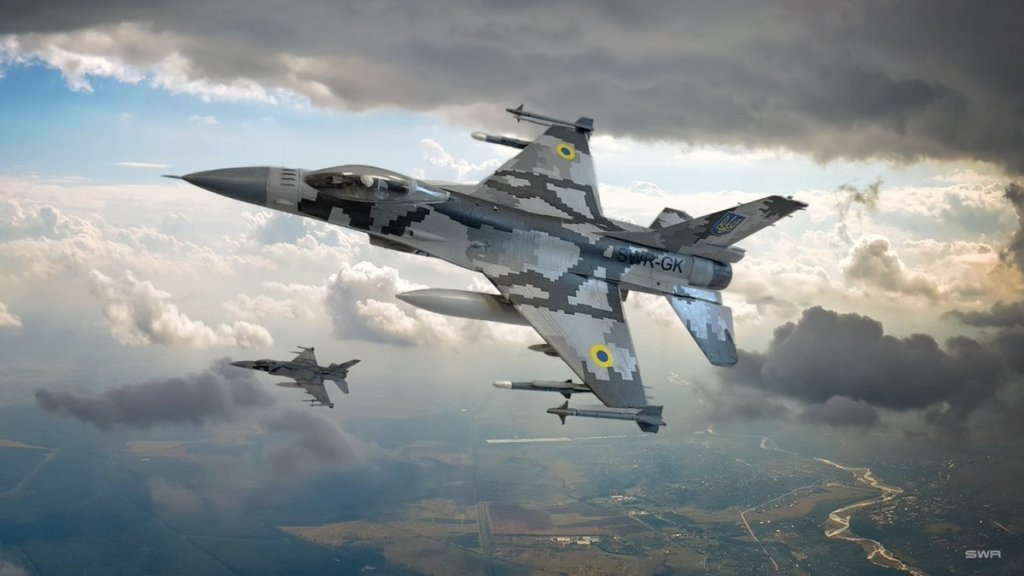
This past weekend we sadly saw the loss of the first over the battlefield F-16 and pilot. Yet the fact it happened speaks of a growing confidence Ukraine has found in preparing to risk these valuable assets for the purpose they were built and trained: air strike of enemy units. It’s war and it’s going to happen. What’s surprising is that its taken so long, and for the most part that’s because Ukraine has largely destroyed, but as this incident underlines, not eradicated, much of Russia’s air defence on the front. This pilot appears to have been unlucky – caught by an S-400, and a MANPAD – some report there was a third missile involved.
Yet the point is Ukraine’s Air Force is now starting to make a difference in key places. The question is will the Russians identify where that’s likely to be and risk the deployment of either their own fighters or anti-air batteries? Which then raises the risk of the Ukrainians finding them and destroying them, something they have proven remarkably adept at doing.
On the ground the Ukrainians are using their first Corps command, based around the 3rd Battalion in the Svatove area on the western side of the Sherevets River. The Russians have a foothold here and the Ukrainians have, as appears to be their wider strategy, decided that where they can stand a good chance of pushing the Russians back to key lines, that’s what they will try to do. We’ve been seeing this from Pokrovsk to Toretsk and Lyman region. They don’t expect to make major breakthroughs, but if they can use their preponderance of drones to reconnoiter Russian movements and destroy them before they can reinforce these relatively isolated pockets, that’s what they will do.
The initial battle for the west bank of the Sherevets, has gone well. Ukraine’s aim is to prevent the Russians massing enough men and supplies to make a breakthrough. The Russians, who so far have displayed a remarkable lack of armor, seemingly having no tanks, IFV’s or even APC’s, have been using bicycles, mopeds and ATV’s to get as close to dismounting as possible. They have also been taught to only travel in pairs and a good 10m apart so that it gives them a better chance of surviving a single drone killing two or more men. It’s also a deliberate act to make the Ukrainians use more drones to kill troops.
The lull in fighting over the past couple of months is largely over and the Ukrainians accept the Russian spring offensive is under way, but it seems to be intended to build up slowly rater than unleash some huge force all at once, although I suspect they will try this somewhere along the line when they feel ready enough. Ukraine is aiming to preempt any Russian attack, by taking out the initial troops as they advance, cripple their logistics and weaken their ability to make an impact.
Ukraine has had a lot of time to prepare the ground, lay mine fields, establish defence lines and prepare to take the Russians on whichever way they chose to come. So far it’s been taking a high toll on Russian troops. When you know, as Ukraine does, where the crossing points of rivers are, when you can see makeshift pontoons being put up and can take them out as fast as they’re laid down. When you know the route the enemy must take and you know from experience what his soldiers without backup from armor or much artillery will do to advance, you can be ready.

Ukraine’s forces in the Sherevets fight are making sure no reinforcements get across the river so that they can swoop in and retake the West Bank. That will deny the Russians a way of moving west in a key area. They had their opportunity but the winter offensive petered out, exhausted and drained from months of effort.
So the process is to deny the Russians the ability to do what they like to do, which is in essence to feed enough men into a target area, regardless of how many losses they take, then when that eventually reaches what they see as a critical mass, force them forwards to push the Ukrainians out.
The issue for the Russians now is their clear lack of armor. They’re clearly saving what they have for when they might actually need it. But even then what they have is pretty thin on the round and often used in miserably bad ways. The armoured column getting ambushed at the front and the whole force then stopping to either disembark its troops or scrabble about trying to escape, is still their preferred operating procedure. They really don’t seem to learn and how they get away with these years old tactics without reprimands is extraordinary.
Meanwhile Ukraine is trying out new ideas and new approaches to both attack and defence. It’s ensuring the concept of the steel porcupine stays strong. Its military production is rising with western help, with new APC’s, IFV’s, towed and self propelled howitzers, increasingly domestically produced. Allies are spending another $25 billion in aid and production programs to keep the flow going and improving. Norway alone recently agreed to fund an entire new battalion, and they’re not the only ones.
Ukraine has improved is recruitment and its AWOL rate and its training has been increased to six weeks basic. Its depth of supply and ammunition seems to be significant enough to hold off the Russians for another year at least. It’s already trying to engage the Americans in offering to pay for $50 billion in US equipment. Ukraine, despite its many problems, despite the endless civilian casualties and the indiscriminate attacks is not prepared to give in, is increasingly capable of defending itself and making the Russians pay dearly for their efforts. And it’s working, even though along most of the line, Russia still makes small advances. the cost of these advances is still unsustainably high.
ANOTHER ECONOMISTS VIEW OF RUSSIA
I just spent the weekend with an economist friend who strips every last detail of data on what comes out of Russia and he was adamant, that no matter what Putin does now, he believes an economic fail point will come this year, peace or war. Putin has wrecked Russia’s economy and there is no possible way back. He also believes in the economic shattering model, and that the whole country will break apart in racial/religious independence movements and Governors seizing their regions and making independent states. It’s always possible, much of it will depend on circumstances at the time. I kind of hope he’s right, but with so many nuclear weapons all over Russia its going to be a dangerous end if that’s how it goes down.
His conviction rested on what he claims is a key aspect of the Russian economy that’s been overlooked in the West. The non-military industrial economy. Apparently, even according to Russian figures and not just observation, it has almost ceased to exist. In fact the last Russia domestic television maker finally closed down about two weeks ago. That, I am told, is about as final and significant as it gets because the one thing Russians have been buying with their high pay and military bonuses is big screen TV’s. They’re a status symbol. Imports were hard to get, so domestic was well sought after. The fact that this industry has ceased is a mix of everything that’s bad in the economy. From super-high interest rates, high inflation, component shortages caused bu sanctions, excessive worker pay they couldn’t afford anymore competing against the military industry, and underhand pressure from the state to drive it out of business to release workers for the military industry. This has been what’s happened to almost every non-food industry in Russia. There’s no civilian industry to turn to when the military one shuts down producing at the frenetic but still insufficient pace its working at.
END GAME?
We did discuss at length what the Russian army in Ukraine might do if the economic collapse came and the army finally had enough when the generals and the officers and the soldiers aren’t being paid, the food and fuel becomes a problem. Would Ukraine be in a position to sweep in to its occupied lands as the Russians walked off? Could it be that easy? There are too many variables but stranger things have happened. In WW1 the Germans did exactly that. Within a couple of weeks the entire German army had vanished and walked home. The French, unable to find the transport and organize such a rapid return to normality were stuck in their trenches for up to ten weeks before being demobilized. Russia’s own breakup in 1991 was relatively peaceful although fairly complex. In the end central authority collapsed and those that wanted to went their own way. The bizarre reality was that the much feared GSFG – Group of Soviet Forces in Germany were left stuck there even as the DDR dissolved and the Soviet Union ceased to exist. Putin himself, then a KGB Colonel was stuck in Dresden unable to find anyone to issue orders from Moscow. Their world fell apart around them.
I’m not so sure it would be so peaceful this time. However when you remember how fast everyone fled Moscow during the Prighozin coup attempt, and how little was done to save Putin – even the generals sat about and did very little – maybe the loyalty when push comes to shove, just isn’t there. That’s the trouble when you live by the sword, you usually die by it. When the fear is gone how fast do the knives come out?
The Analyst
militaryanalyst.bsky.social

 The Military Analyst
I hope the assessment is correct. We have for months speculated that the RuZZians are scraping the bottom of the barrel and are about to collapse their economy.
Right so, it might happen, and we hope rather sooner than later.
Then the NK support lines opened and more recently Chinese in uniforms were apprehended. Does this not mean that new channels are opening whenever we think or hope they have reached a dead-end.
I hope I am wrong, and I am by no means qualified to judge the situation or even predict an outcome, but we have to see the reality and as long as there is little or no uprising in the ranks of the RuZZians, the casualties will occur and continue but the end game has not yet begun.
It needs THAT push to create an avalanche effect, be this on the battlefield or in the economy. Both are well prepared for the collapse, just how can we expect this to happen?
47 has well played into the hands of his master and given him the extra breadth and leeway by sabotaging the NATO efforts and undermining the concept of power for the allies.
Europe, now on their own, still have to find the foothold to be able to create that umbrella of security and decisiveness for that little extra push.
German Taurus might just help especially to extend the interdiction zone and suppress supplies from reaching their destination.
Slava Ukraini
LikeLiked by 1 person
Ukraine’s will and resolve remains strong and aligned. The US chaos has likely strengthened Ukrainian resolve. Europe’s fitful backing is still substantial and robust – albeit not as equivocal as we’d all hope. Russia’s will and resolve is not. When you have a substantial portion of your drone combat resources dedicated to enforcing military will upon your own troops, you have a problem. Live by the sword indeed.
But politics and military assessments are often how wars begin and evolve. Economics often end them, because politics and military means resolve in economic ways.
The strange thing about economic collapse is that the rumours are many – both about the impending doom, and the fallacy of such predictions. Signs emerge as markers to measure with hindsight. And then suddenly, out of nowhere, a minor failure triggers the shattering of everything underpinning the economic fabric. At that point, it’s survival of the fittest, and chaos is only a breath away.
We never know when it’s going to happen. I spent some time looking for off-ramp options for Russia around a year or so ago before Ukraine launched deep drone strikes on oil refineries. Even then, the options for Russia were few – and mostly built from energy supply. The damage is much deeper now. It’s societal. What are they going to do with the soldiers returning even more angry and hateful than they were when they were Shanghaied into service.
The It’s a problem that needs to come to pass. Set the knives loose in Moscow.
LikeLiked by 1 person
“The soldiers that return” well “yes” , if they return.
Many 100’thousands are pushing sunflowers in Eastern Ukraine and that might be part of Putler’s plan, so two problems solved even before they occur.
LikeLike
Thank you, I think live by the window, die by the window is more appropriate.
LikeLiked by 1 person