
One of the many lessons from the war in Ukraine has been the need for strategic long range weapons. Russia and Ukraine are now employing a mix of ballistic missiles, cruise missiles, hypersonic weapons, modified naval strike missiles and long range drones. These are being used to hit infrastructure, from power stations to air bases and military facilities. Russia uses them against purely civilian targets too.
As the US tries to work out its position in NATO going forward – barred from leaving without a Congressional vote that’s unlikely to be positive, or even use federal money to draw down forces for the same reason, the link with NATO remains intact. Indeed the new SACEUR has already been selected and awaits confirmation. But is America’s nuclear triad fit for purpose?
SENTINEL UPDATE
At the top of America’s long range missiles is its aging ICBM force of Minuteman-III’s, these are to be superseded finally by the new Sentinel system. The missile is pretty much on time and target but a huge blow to the program – already seriously over budget, driven almost entirely by the issue of silo refurbishment, was confirmed only this week. The Air Force is basically saying that virtually none of the existing silos are viable for Sentinel. They’re too old, the cost of fixing them is too high. Far too many of the 400 needed are far beyond viability. The cost of re-cabling the silos over thousands of miles on private land is too much.
The cost of building 400 new silos is no mean challenge either – but the fact is the US did it the 1960’s and it should be able to do it again. China has managed just such a feat in the past three years. The proposal is to use existing Federal land, spread the missiles around the Midwest without encountering private land owners and property easement issues. Then introducing the new missiles as the old ones are taken out has to be managed in a different way. The question is will Congress pay for it? The ten year projection for all of America’s nuclear weapons is $954 billion – before new silos were a consideration.
EUROPE+ GOES ITS OWN WAY
France and Britain are already well along the path of renewing their strategic nuclear forces – the only nuclear weapons that a go-it-alone Europe+ defence arrangement is going to have. Britain’s 3rd Gen SSBN, the Dreadnought is well under way, France is embarking on its own program of 3rd Gen SSBN too.
Yet the issue for Europe+ – which the US has largely addressed for itself – is that it has no means of reaching deep into Russia with a non-nuclear weapons package. That has a danger of its own in that it may force the allied powers to make use of nuclear weapons sooner than they would like, or respond with them against a devastating conventional attack. That is not a welcome a prospect.
With the UK admitting that it ran an exercise where Russia attacked it in the same way it did Ukraine, and the consequences were said to be ‘an unspeakable mess’, its become quite clear that a counter strike option is needed both as a deterrent and for operational reasons.
France does have missiles it can fire from aircraft, but they’re mostly assigned to the tactical nuclear role. Even if they were conventional, they’re relatively short ranged at 300km – even the next versions will only reach 600km. It needs something longer ranged, in the 500-2,500km range.
It’s not just the cruise missiles either, be they launched from land or air. Statistically the short-medium ranged ballistic missile remains the most difficult to shoot down and has the quickest reaction time to get in flight and time on target wise, little is better. The Russians have proven this many times using recon drones to scout out a target and having an Iskander missile land on it and take it out in under three minutes. Several HIMARS and part of Patriot were taken out this way that I can recall off the top of my head, and much more besides.
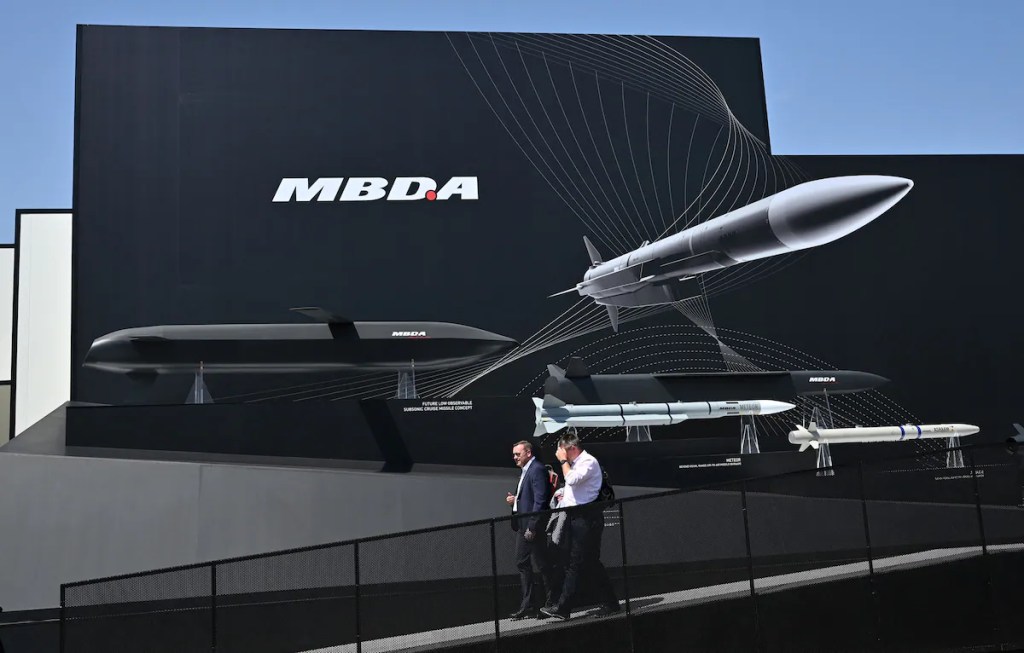
The result has been a rapidly assessed long range strike project: the European Long-range Strike Approach (ELSA), which identified 13 key pillars of development and before June is out the six nations taking part will have decided who is doing what. Unquestionably the French will take a lead role, because they have more experience in this type of weapons platform, especially the rocket motors and bodies. Ariane is expected to build the ballistic missile motors for example. The ELSA programs will use what termed ‘best athlete’ as the approach to divvy up who does what, each country leaning in to their area of expertise.
One French company, Turgis-Gaillard, has produced a new ground launched missile vehicle system that they claim should be able to fire any French or other allied weapons, offering up a quick vehicle solution for any new system. It will be on display at the upcoming Paris Air Show and is likely to attract a lot of attention.
The program to develop long range weapons is also being done outside of the EU financing structure – partly because that would slow things down and the need for speed is acute. Four nations signed up originally but now the UK and Norway are also taking part, along with Germany, France, Poland and Italy.
The point of the whole project is that everyone can bring something to the table and everyone knows that this is no time for arguing over the politics of who does what – its about who is best at which element, once a specification is agreed the contracts can be put out to tender and the manufacturers line up to produce the needed components.
I’ve written about this today because it’s exactly the type of program, Europe+ has to get behind. Working together, isolating a requirement, finding a solution, getting it built. It proves the intent is there, the will power is there and the nations who can make it work are willing to get it done. That is something we have not seen with any urgency attached to it in many a long decade. It proves that the Europe+ concept is viable, and it can work. Now all they have to do is deliver. And I honestly believe they will.
The Analyst
militaryanalyst.bsky.social

 The Military Analyst
I think we need a combo of a limited number of ELSA-type ordnance and masses of slower but more effective/destructive drone swarms. If our defensive posture is against Russia then putting 5000 cheaper drones, orchestrated to overwhelm, in the air every night will exhaust their defensive arsenal very quickly and lead the way to the modern equivalent of the ‘Thousand Bomber Raids’. Russia’s great weakness will continue to be its economy whilst it remains an oligarchy/kleptocracy – the lack of high tech materials and manufacturing capacity within that country means that mass will quickly overwhelm and there is no counter-strategy to it. Ukraine is already starting to demonstrate the strain the Russia is being put under with just a couple of hundred drones being launched per night.
For me, the ELSA-type weapons are more about signalling and detente. We will take years to manufacture sufficient of them to concern the Russians, and even if we can produce enough to slowly overwhelm their cruise/ballistic missile defences, their conventional warheads make them expensive in terms of (literal) bang for buck.
LikeLiked by 1 person
i know a country that has developed that 3000km conventional capability. How come they are not involved in ELSA? Let’s not let the European part limit the development too much. Pretty sure someone from ELSA will be discretely leaning into UKR anyway.
LikeLike