
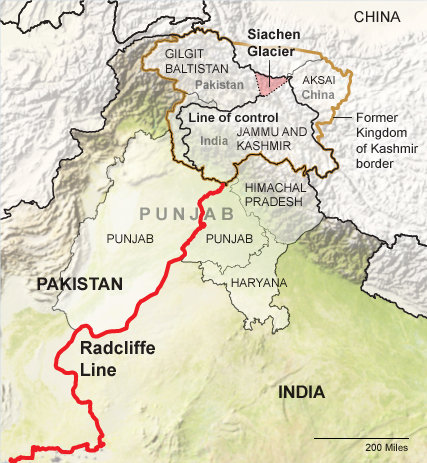
The latest spat between India and Pakistan, currently in the midst of a tense ceasefire was caused by a terrorist attack on Phalagam in the Indian controlled zone of the disputed Jammu & Kashmir province. 27 people were deliberately chosen and shot – all tourists – by Muslim terrorists. They made the Muslim potential victims recite verses from the Koran – if you could not you were shot. 26 were Hindus and 1 was Christian.
India then launched an attack on a number of sites across Pakistan, under the title Operation Sindoor, which took place on May 7. Its purpose to destroy ‘terrorist training camps’.
Operation Sindoor utilized some interesting weaponry. The Rafale fighters which India acquired from October 2019 and had a total of 36 in the Air Force, with 26 of the naval variant at sea on their carrier, used French SCALP-EG missiles Hammer glide bombs. BrahMos attack missiles were also used.
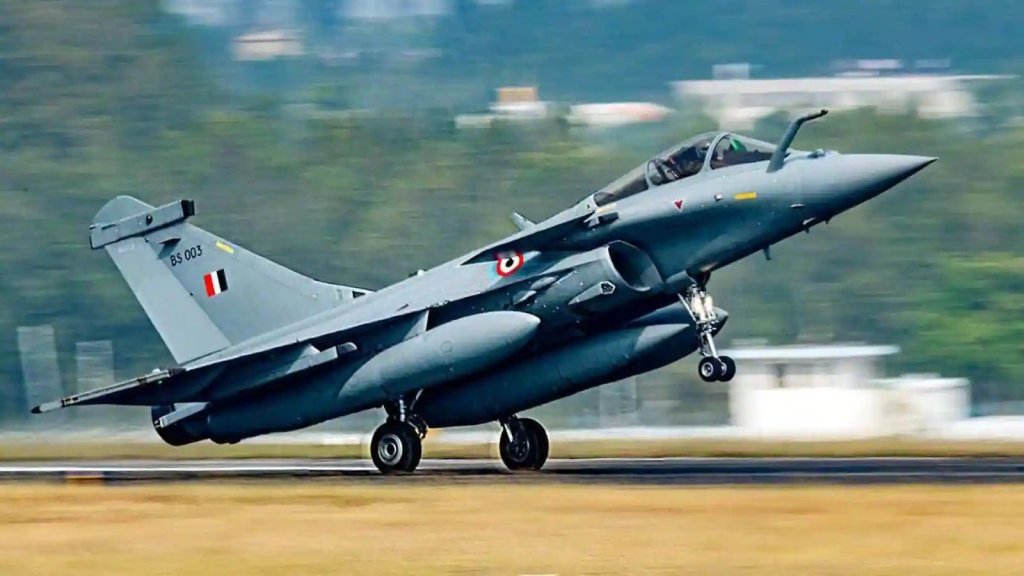
Pakistan – and India has now accepted the totals – managed to shoot down no less than five aircraft – three of them Rafale’s, a Mig-29 and an Indian built Su-30MKI. In addition India used several BrahMos attack missiles developed domestically.
The aircraft loss was quite hard for some to accept – the Indian Air Force seemed more than a little taken aback in private, and the French were frankly horrified, sending a team out to India to find out what happened – although all of the wrecks are inside Pakistani territory.
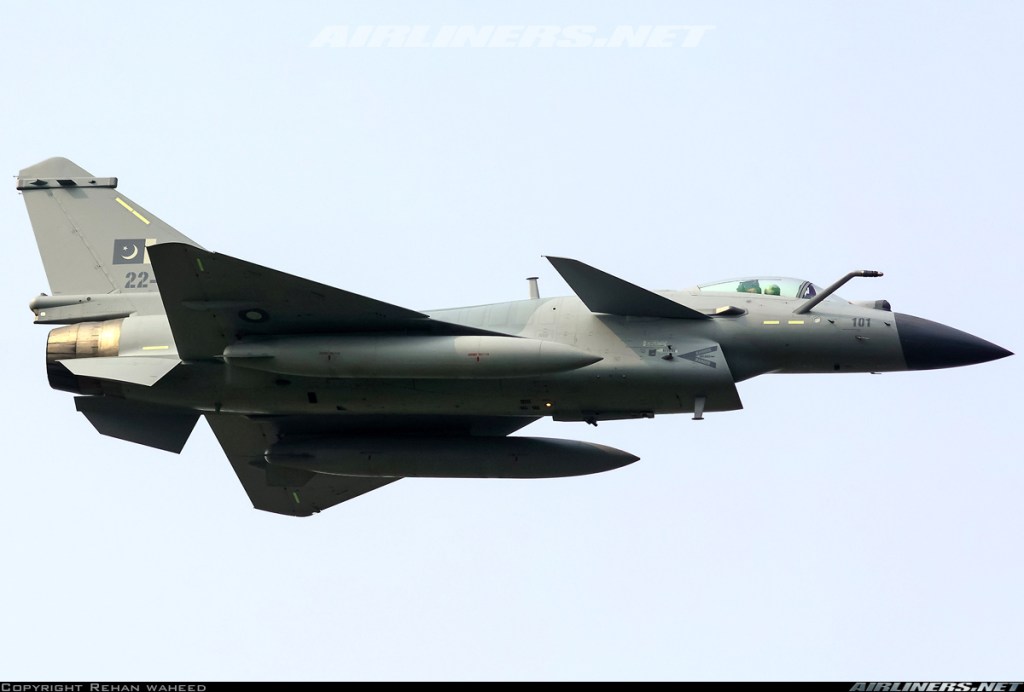
What we do know is that Chinese supplied equipment was responsible for the losses. A mix of the HQ-9P and HQ-9B variants, a Chinese allegory of the Russian S-300 system took out the Mig’s. Overall it’s considered to be a tier below the Russian version of the equipment which makes it seem even harder to contemplate. However what seems to have stolen the show however is the Chinese J-10 fighter Pakistan took delivery of from 2022. These are easily a match for the Rafale in capabilities and are equipped with the PL-15E. The missile supplied is the export version with a range of 145km, the PL-15E has a speed of Mach-5 – more than enough for the job it has to do. It uses an AESA radar and can be re-targeted by its launch aircraft or by an AEW aircraft. It’s also exceptionally capable against EW jamming, and with a 20-25kg proximity warhead, lethal. These seem to have been the principal cause of the losses.
If they are, then India has a problem, because it either grossly underestimated their capabilities – and many air forces do have a habit of doing that when it comes to Chinese equipment – or they have another problem to add to it. That problem is rumored to be a lack of training, especially flight time, and virtual zero time in real life simulated combat. What we don’t know is the mission profile. How did the Indians approach their targets? Hi-Lo-Hi, or Hi-Lo-Lo? The Hammer would have needed to be high to gain the altitude required to reach its target. The SCALP-EG doesn’t need to be so high up, but nor can it be so low down at the launch phase.
The Chinese J-10 fighter is equipped with an active electronically scanned array (AESA) radar. The most commonly cited system is the Type 1475 (KLJ-5) AESA radar, which is believed to feature between 1,856 and 2,200 transmit/receive modules, providing advanced detection, tracking, and electronic warfare capabilities comparable to those found on Western 4/4.5 and 5th generation fighters. However while it is considered superior to that on the Eurofighter and Rafale, along with older US fighter types. Only the F-35 seems to have an edge. The J-10 is believed to use advanced Gallium-Nitride modules that give it an advantage. (It also demonstrates the importance of ‘rare earths’ and China’s near stranglehold on their supply). The J-10 has been the subject of development for almost three decades, and is largely regarded as being a melting pot of stolen technology and design concepts.
PAKISTAN’S RESPONSE
Following the Indian attack, Pakistan retaliated against Indian bases under Operation Bunyan-un-Marsoos (‘wall of solid iron’) on May 10th. This shook the Indians because it was much larger in scale than they expected, far wider ranging and actually extremely successful. There was a profound re-evaluation inside Indian leadership about where this was going I’ve been told, because to match or exceed it would in effect be all out war. My understanding is Indian leaders saw it for the warning it was and resolved to go along with an immediate ceasefire if Pakistan would. It was going too far too fast in the wrong direction.
it was a large-scale, coordinated retaliatory strike against Indian military targets. The operation showcased the integration of Pakistan’s Army, Air Force, and Navy, utilizing a range of advanced weaponry and tactics. Below is a summary of the key weapons and systems used:
Missiles
• Fatah Series Missiles (F1 and F2): These are precision-guided, long-range ballistic missiles used to strike high-value Indian military targets, including airbases and logistics hubs.
• Fatah-I Missile: Specifically cited as being used in barrages against Indian airbases such as Udhampur, with a range of up to 120 km.
• Fatah-II Missile: Fired in a pre-dawn strike aimed at Delhi, though reportedly intercepted by Indian defenses in Haryanas Sirsa.
Drones and Loitering Munitions
• Armed Drones: Used for both surveillance and strike missions, including patrolling Indian airspace over major cities and sensitive government facilities.
• Long-range Loitering Munitions: Deployed to engage targets with precision, allowing for flexible targeting of mobile or time-sensitive threats.
Air Power
• Fighter Aircraft: The Pakistan Air Force (PAF) played a central role, with JF-17 jets reportedly equipped with missiles used to destroy advanced Indian air defense systems like the S-400 at Adampur.
• Precision-guided Munitions: Deployed by the PAF to hit military installations, airbases, and logistics centers.
Artillery
• Precision Long-range Artillery: Used to strike Indian positions along the Line of Control (LoC) in Kashmir and deeper inside Indian territory
Cyber Warfare
• Cyber Operations: Pakistan conducted cyber attacks that temporarily disrupted critical Indian infrastructure, including reportedly rendering 70% of India’s power grid inoperative.
Targets and Effects
• Military Installations: 26 Indian military targets, including airbases (Suratgarh, Sirsa, Bhuj, Naliya, Adampur, Bhatinda, Barnala, Halwara, Awantipura, Srinagar, Jammu, Udhampur, Mamun, Ambala, Pathankot), logistics hubs, radar stations, and command headquarters were engaged.
• Air Defense Systems: Indian S-400 air defense systems at Adampur and Bhuj were neutralized.
• BrahMos Missile Storage: Facilities at Beas and Nagrota were destroyed.
THE OTHER BIG ISSUE
As soon as the fighting broke out India used the opportunity to do something its been itching to do for years – it suspended its participation in one of the most important treaties ever signed in this region – and one that has helped stop wars even starting; The IWT – Indus Water Treaty, was signed in coordination with the World Bank in 1960.
Allocation of Rivers
• India received exclusive rights over the three eastern rivers: Ravi, Beas, and Sutlej, which collectively have a mean annual flow of about 41 billion cubic meters.
• Pakistan received exclusive rights over the three western rivers: Indus, Jhelum, and Chenab, with a mean annual flow of about 99 billion cubic meters.
• India is allowed limited use of the western rivers for irrigation and unlimited non-consumptive uses such as power generation, navigation, and fisheries, but must adhere to strict technical criteria.
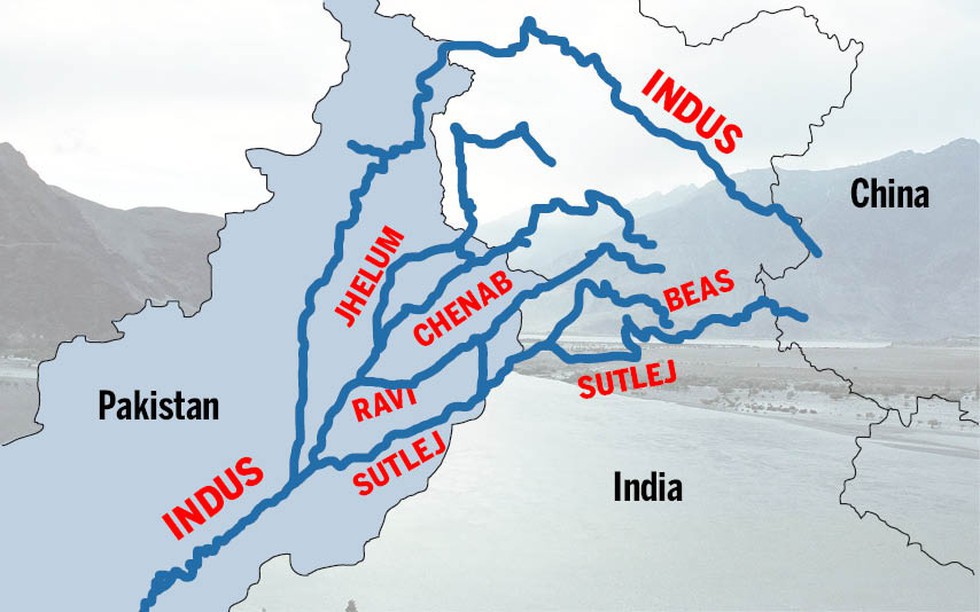
If you look at a map at first you wonder how it’s possible India even has a say over the western rivers because they run entirely through central and upper Pakistan. But look more closely and you find that all six rivers actually rise in Indian controlled Kashmir – the Indus actually runs into China and just through Kashmir, but much of its water runs into it in Kashmir. So technically India has almost complete control over Pakistan’s water supplies. As the years have gone by India feels that its not getting its fair share of the current water supply – about 20% to Pakistan’s 80%.
Pakistan cannot viably exist without the water from these rivers. 37% of its employment, 80% of its power, all but a fraction of its agriculture and drinking water come from them.
The treaty is seen as one of the most incredibly successful water sharing arrangements in world history. Wars between the two have not started because of water since it was signed. India suspending its participation is the biggest development in 65 years and it does not bode well for the future. Any unilateral attempt by India to change its access to the water – especially on the River Sutlej which forms part of the international border between them, will have grave consequences.
The model for the IWT has been suggested to Ethiopia, Sudan and Egypt because of the Ethiopians building a massive dam on the Nile that threatens Egypt’s only real freshwater supply. That got so bad Egypt threatened to bomb the dam. A treaty remains impossible while South Sudan can barely feed itself and the North is in the middle of a bitter Russian agitated civil war.
Water Wars have long been considered a major source of conflict. With more people, more demand, global warming driving fresh water availability globally (2 gigatons of fresh water have evaporated from the planet’s surface soils in the past 25 years, so much that its affected the Earth’s spin). The last place we need a water war is between two nuclear armed nations in South Asia.
The Analyst
militaryanalyst.bsky.social

 The Military Analyst
Here’s another angle that you might appreciate, copied from this slightly frivolous source on TwiX, that a Punjabi friend pointed me to.
https://x.com/samarkohli/status/1921199913423303153?s=48&t=CSIR0wXbw2gyXPHVWw5_kQ
The Sikh Revolt (Plot twist India forgot to read)
Back home, a pesky little inconvenience popped up for India. Sikh soldiers and ex-servicemen, historically overrepresented in India’s armed forces (they make up 20% of the Indian army but are only 2% of India’s population), started raising eyebrows. And voices quietly but loudly
Slogans like: 🗯️ “Not our war, not our problem.” 🗯️ “We defend Punjab, not political egos.” 🗯️ “No Sikh blood for Hindutva wars.”
Sikh regiments demanded clarity on why they should die fighting for India when Punjab itself has been under economic and political siege for decades. Some units in the Sikh Light Infantry even staged non-cooperation sit-ins in Amritsar and Ambala.
Fun fact: On May 5, over 12,000 Sikh soldiers and reservists filed leave applications en masse. Delhi called it “a coincidence.”
LikeLiked by 2 people
Most interesting.
I appreciate these contextual responses.
LikeLike
Worth bearing in mind that any serious attempt to interfere with the actual water flows of the six rivers would entail an enormous civil engineering programme over many years, probably in some very inaccessible places. (Six rivers or five? Punjab means pahch aab, five waters.)
LikeLike
There’s six in the treaty. I think one of them (possibly the Indus itself isn’t in Punjab).
LikeLike
Here’s another angle that you might appreciate, copied from this slightly frivolous source on TwiX, that a Punjabi friend pointed me to.
https://x.com/samarkohli/status/1921199913423303153?s=48&t=CSIR0wXbw2gyXPHVWw5_kQ
The Sikh Revolt (Plot twist India forgot to read)
Back home, a pesky little inconvenience popped up for India. Sikh soldiers and ex-servicemen, historically overrepresented in India’s armed forces (they make up 20% of the Indian army but are only 2% of India’s population), started raising eyebrows. And voices quietly but loudly
Slogans like: 🗯️ “Not our war, not our problem.” 🗯️ “We defend Punjab, not political egos.” 🗯️ “No Sikh blood for Hindutva wars.”
Sikh regiments demanded clarity on why they should die fighting for India when Punjab itself has been under economic and political siege for decades. Some units in the Sikh Light Infantry even staged non-cooperation sit-ins in Amritsar and Ambala.
Fun fact: On May 5, over 12,000 Sikh soldiers and reservists filed leave applications en masse. Delhi called it “a coincidence.”
LikeLike
With Muslims being Muslims and their thoughts on other religions or no religion, how smart was it for China to supply weapons to Pakistan when China tries to hold a no religion theme?
LikeLike
They have beef with India so supplying Pakistan is a no brainer from their perspective.
LikeLiked by 1 person
I was very disappointed that this article received so much flack on Bluesky yesterday. Totally unnecessary. I’m afraid I didn’t feel at all qualified to give a view, and now I’m glad I didn’t. I read it last night, perhaps a little too much wine over dinner.🙄
LikeLiked by 1 person