
The Twelve Day War left Iran, unquestionably, tactically and strategically defeated.
I don’t think there can be any other short-medium term conclusion. Israel conducted an exemplary planned strike against commanders, control centers, bunkers, air defences, missile sites and launchers. On top of that it persuaded the Americans they had done such a good job that the opportunity to attack the nuclear weapons production sites was now a once in a lifetime opportunity. There is a lot of argument over whether or not those strikes were completely or partly successful. Only time will tell.
Iran is humiliated and stunned. It simply did not think it was possible its military had been so deeply penetrated by Israeli intelligence, it has lashed out with roundups and no-trial executions based entirely on vague assumptions. It’s a wounded regime, shocked and horrified at its own inadequacies. It spent decades building up its confidence, taking the fight to Israel, an enemy it created for its own purposes, based on some medieval anti-Jewish religious nonsense. Its real aim was to have an enduring enemy to aid in the control of its own people.
It took the fight to Israel with Hamas in Gaza and Hezbollah in Lebanon. Israel’s reaction to Gaza and its subsequent chronic over-reaction that has gone way too far, left Iran shocked and its ally neutralized. Hezbollah was almost literally decapitated and then rendered near impotent. The Houthis, designed to hassle the Saudis and western shipping, were also hammered into the ground, both by Israel, the US and western allies.
The future of the Iranian regime is still questionable, though I doubt right now its in immediate danger.
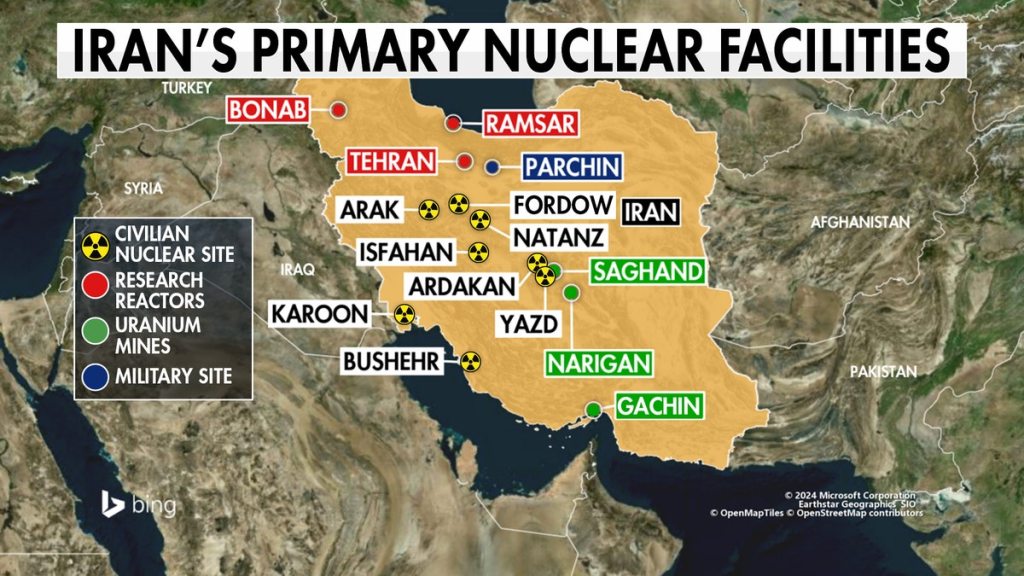
Yet there are things we know that cannot be ignored. The largest is that anything between 400-600kg of 60% enriched Uranium has been saved. I’ve seen the satellite images that clearly show the evacuation using specialised radioactive material falsk carrying trucks, they were clearly carrying something away from Fordow before the attacks.
The Fordow plant used some 20,000 centrifuges to spin the Uranium and separate it into increasingly fissile material. To get from 60 to 98% and a viable weapons grade material is still a major undertaking. If Fordow is as destroyed as America claims it is, then we’re talking 3-4 years. If it is only partially damaged, potentially 1 or so.
What did Iran learn from the attack? One principle lesson. It was attacked by two nations who are both nuclear armed. Everyone and their aunt knows that Israel has as many as 200 nuclear weapons. It’s the most open secret in recent history.
The attack on Iran tells Iran that it is far less likely to be attacked if it does have nuclear weapons. In fact it’s likely to reduce the likelihood dramatically. Just as it has for N.Korea and was the motivation for their nuclear weapons program. Nobody will risk attacking them because the consequences will be too grave, but at the same time they can almost do what they like and not risk some conventional response, because their leadership is unstable enough to never quite know if they might just use one, or more.
Iran now knows that its always going to be subject to attack and not be able to do much about it – but if it had nuclear weapons it could lob at Israel or eventually at the US – then maybe they’ll be able to dissuade any attack in the first place. Because the Iranian regime is just as oddly unpredictable as North Korea’s, why would the US or Israel risk it?
And if Iran has a bomb then Saudi Arabia will not be far behind.
And then who else? Egypt? Taiwan? Vietnam? The Philippines? South Korea has been on the cusp for decades. How long before these weapons are inevitably allowed to reach non-state actors hands and threaten just about anyone?
For decades the US has used a mix of diplomacy, trade and strength to keep nuclear weapons out of the hands of those it and most others didn’t want to have them. The use of the Nuclear Non-Proliferation Treaty has been a cornerstone of that policy. Yet the current administration is undermining the moral purpose of the treaty and disinclined to use crucial American soft power – a concept it doesn’t seem to even grasp.
To many nations the US and Israel have demonstrated exactly why nuclear weapons are a good thing if you happen to be opposed to their world view. For those who face countries like China and N.Korea it seems almost a no-brain argument. Why would you not want nuclear weapons?
Who will be the first to offer to buy and receive nuclear weapons off the shelf? That day cannot be far off.
We’ve entered a new era where for the rest of the century nuclear proliferation isn’t just more likely, but almost inevitable.
And the one scenario that has lurked only in the back of our minds as a nightmare, and for 80 years we have avoided, that a non-state actor gets a nuclear weapon and uses it in a terrorist attack, is closer to being a real problem. How does even a nuclear armed state respond to a non-state actor carrying out such a strike? Who do you hit back at? What use are your nuclear weapons then?
There are some serious questions we must ask of ourselves, and about what we do. The only real answer is non-proliferation but the nuclear cat is long out of the bag. The UN is a toothless talking shop long past its sell by date, rendered meaningless by vetoes and self interest. The US seems to no longer wish to enforce and persuade as it once did, lacking the comprehension or skills to contain the problem. Bombing alone is no solution.
I fear we are about to enter, if not already in, a dangerous new world. The ‘new’ members of the nuclear club – India and Pakistan – came closer to a nuclear exchange than anyone realized just weeks ago. The Pakistanis told of a point where they knew India had fired a Brahmos cruise missile into Pakistan, likely aimed at an air base. These are nuclear capable. There was only one incoming. The Pakistani’s admitted they had just minutes to decide if it was nuclear or not, and if they should respond. It wasn’t and they didn’t. This time.
The more nations there are with nuclear weapons and without the radars, classification systems and intelligence – and just as much, the time, to determine what is or is not heading their way, the more chance there is of a mistake. A major catastrophic mistake. We’ve had more than a few during the Cold War – there’s plenty of material out there about several, including the 2015 documentary “The Man Who Saved The World” – an extraordinary film. The recent book by Annie Jacobsen ‘Nuclear War, A Scenario’, isn’t just brilliant, it’s a deep dive into how it would unfold and why – how the ‘system’ of nuclear war works as told by those who operate it. It’s basically a book that covers barely an hour – from the time to decide a launch to the end of the world.
We face one of the most challenging periods in human history. Exacerbated resource depletion and demand, global accelerating climate change, authoritarian politics, energy sourcing and increasing demand, much of it generated by Ai, itself a major issue. Drones, technologies advancing at a pace we can barely hope to understand and a world of gaping inequality between the super rich and everyone else. All of it in the mix at the same time is a heady concoction and beyond any one person to deal with. And nuclear proliferation to the mix, cyber warfare, biological threats, and it’s enough to make you buy a tinfoil hat and sit in a bunker.
Government’s that make these scenarios worse or more likely to spill over into a disaster are the most dangerous of all. The US, Israel, Iran, Russia, China, India, Pakistan and N.Korea – all nuclear armed states – are the worst of all and the most likely of all to make things go off the rails. Is it any wonder others want to join the ‘invincible’ club? Nuclear weapons seem to grant immunity from responsibility or facing consequences. That’s the lesson Iran has learned. Others have too.
The next few years will be deeply challenging. How the war ends and what happens to Russia is going to be a major problem, whether Putin retains power or if Russia collapses. Either way huge challenges face us.
China’s determination to take Taiwan and expand its control over the seas around it, while extending its power into other oceans – even the N. Atlantic, is clear and obvious. It’s building a navy on a scale nobody else can even start to match and expanding its naval base operations into West Africa.
India and Pakistan will always be at each other’s throats until their dispute is resolved.
Iran will not sit there and suddenly become friendly. It just cancelled its order for Russian Su-35’s and signed a contract with China for J-20’s having seen how effective the Chinese fighter was against India.
India has been told by the Russians they won’t be getting the S-400’s contracted for. That will spur on another military arms race and force India into becoming ever more self sufficient and/or cooperative with Western defence industries.
As to America? Who knows what will happen? The randomness of its policy and its leadership is so inconsistent and inexplicable it changes like the weather. It has its own issues and Europe+ is treading a tightrope trying to understand where its position lies.
Nothing is consistent, nothing is reliable, nothing is easily predictable. All we know is that there is trouble ahead. Forewarned is forearmed. Getting ready for what might happen is the best we can do. The writing on the wall of the Venetian Arsenal, where the Venetian fleet was built and maintained states, “Happy is the City that in times of peace, prepares for war.” It was true then, and it’s sadly, just as true now.
The Analyst
militaryanalyst.com


Very sobering reading, TA.
Although few would lament the Iranian regime having its wings clipped extensively, the “once in a lifetime opportunity” was always likely to be subjected to the laws of unintended consequences. Most of which are bleak.
Those scenarios are also difficult to dispute.
LikeLiked by 1 person
In what way have nuclear weapons protected Israel? Their intelligence and western weapon systems combined with effective air defence seem to have been more effective.
LikeLike
In what way have nuclear weapons protected Israel? Their intelligence and western weapon systems combined with effective air defence seem to have been more effective.
LikeLiked by 2 people
The original Israeli concept was to stop the Arab armies – especially Syria and Egypt in scenarios such as 1973 where Israel did actually fly a pair of A4’s armed with a nuke out at sea in case they had to be called in.
After 1979 and the peace with Egypt the Iranian revolution the same year and its plan to wipe out Israel, rather added to their concerns. Then there was Syria’s attempt to build a reactor and then Iraq’s. Both of which Israel destroyed.
LikeLiked by 1 person
Well that cheered me up TA!
Sometimes it’s nice not to know exactly what’s going on in the real world. Oh well, we can’t have it all, that would never do!
Thanka for another good article .
LikeLiked by 1 person