
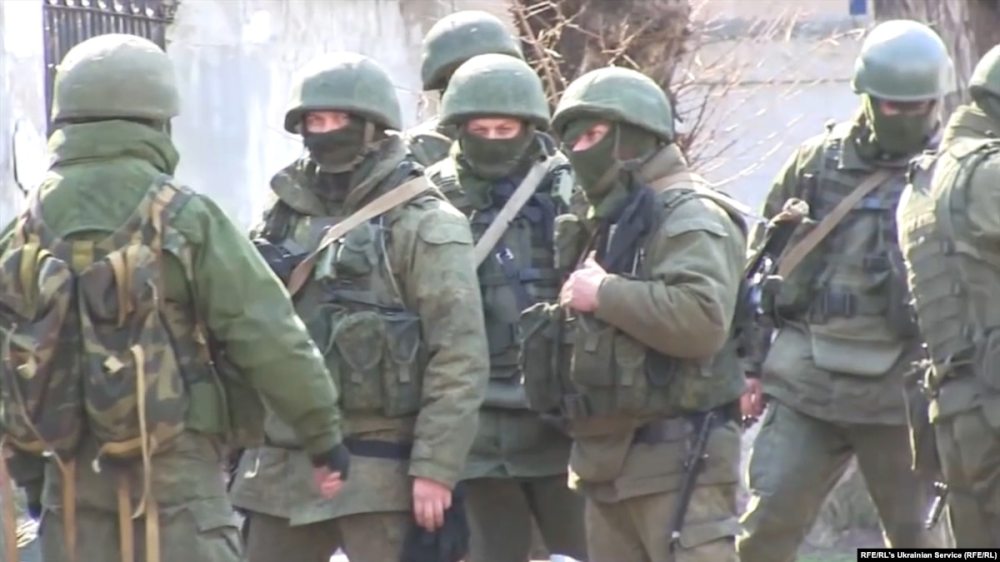
The infamous invasion of Crimea by Russia’s ‘little green men’ – basically soldiers dressed in green combat fatigues, their faces covered and with zero identity, was one of Putin’s few major strategic successes. He used the turmoil in Ukraine’s political situation to seize the peninsula and there was basically nothing Ukraine could do about it.
Worse still with people like Angela Merckl in charge of Germany and totally oblivious it seems even in hindsight, to the threat and implications of the move, led a pathetic response the weak President Obama followed. The west tutted and did nothing. In doing so it committed an act of appeasement that motivated Putin to think he could do the same to the rest of Ukraine- first in the Donetsk and then the entire country.
Putin became incredibly popular in Russia for this annexation of a land that most Russians felt really was Russian. In Soviet days it was a place of family holidays, warm weather and happy memories, almost nobody saw it as a bad thing inside Russia’s sprawling empire. Even Alexei Navalny said he would not be willing to give it back. Putin’s popularity hit a genuine 86% favourability. I suspect that in his mind this was the point he knew he could never give up power and could do whatever he wanted.
Nearly 12 years later I’m sat here watching video of the inside of Simferopol hospital. The paint is peeling off the walls. Black mold is almost everywhere you would think it would be given water ingress. There’s no equipment, the beds have no sheets. There’s no heating, it’s freezing cold and the water supply is intermittent and stone cold.
A Russian woman who has lived in Crimea her whole life and used the hospital many times, laments its dire condition. “This”, she says with quiet but dignified derision and defiance, “is what 12 years of Russian investment looks like”. She has much else to say but little that explains her feelings better.
After the annexation the Russians encouraged other Russians to move there and set up businesses. A typical example of Russian colonialism that’s gone on for centuries, under the Czars, the commissars and now the oligarchy. Always at the expense of displaced Ukrainians, seized properties, Crimean Tartars chased down and dispossessed or arrested for dissent – again.
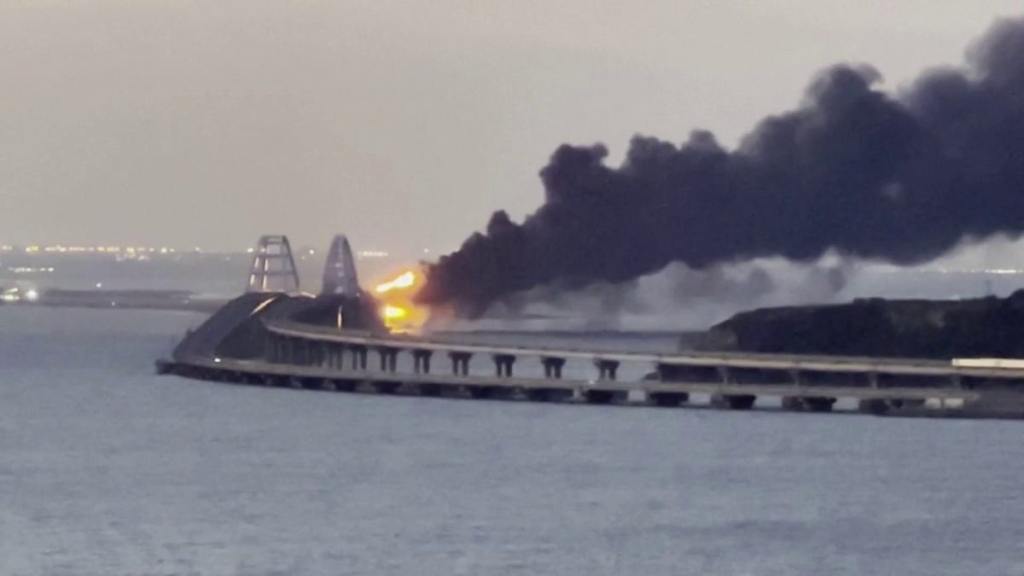
Putin built the bridge – his personal involvement making it all the more important in Russia generally and later as a target.
Russia’s military was also well aware of the strategic value of the peninsula and still are.
Ideally placed at the top of the Black Sea, it offers air control over the entirety of central and eastern Ukraine, naval control over anywhere in that region and potential dominance over Romania, Bulgaria, Moldova and the Caucasus coast. Turkey is opposite and they were very aware of the implications. They have always been against the annexation by Russia, despite being generally accommodating of Putin. Crimea is somewhere they would very much like to see out of Russian hands.

The Russian invasion of Ukraine and the way the war has subsequently changed, has imperiled Russian control and its future ownership in ways that nobody ever expected. Not only has it changed the physical reality on the ground, it’s overturned the strategic view of the peninsula completely. It’s gone from being a Russian weapons platform they never ever used properly to a military and civilian liability, that any sensible government would realise it should withdraw from. But ‘pride commeth before a fall‘ and nothing will make Putin give that order. That is the pin that makes Ukraine’s long term strategic goal so successful and viable in the first place.
Initially the threat from Crimea was clear and it was the base from which the initial invasion struck into Kherson and Zaporhizia. The threat to Odessa was real and the Russian navy posed a continuing danger to the rest of Ukraine’s coastline.
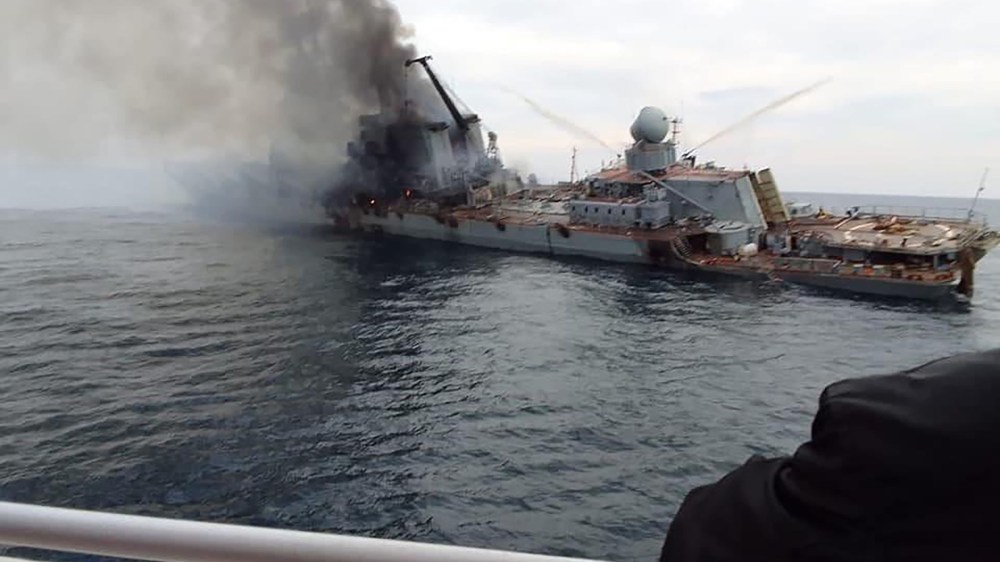
The sinking of the Moskva was a triumph and a warning the Russians didn’t ignore. Their complacency had been dramatic. Ukraine’s strategy to keep taking out air defences and radars on the peninsula was critical to getting StormShadow and naval drones into the area, eventually forcing out the entire Black Sea Fleet, with severe losses. Never before had a country with no navy other than in name), caused such a massive defeat for a modern fleet. The Russians eventually withdrew to Novorossissyk in the Caucasus. Their commanding admiral taken out as a StormShadow went in through his office window in the HQ building in Sevastopol. That was a deeply significant moment for the Russian fleet command. Nothing said more about complacency, hubris, like refusing to work in a secure space and that you were untouchable. He was not and paid the price.
The attacks on the Kerch bridge have been damaging for morale but have also placed engineering constraints on its function.
The rail line hasn’t worked in over a year and most road freight is limited. Ukraine has wisely not taking the bridge down – yet – making sure Russian settlers have a way out. The only real way out away from the front. The amount of road freight that comes in is limited.
The ferries have been destroyed that carried cars and trains.
The endless pounding of Crimean air bases drew in ever more air defence units which Ukraine destroyed bit by bit, only to have them and their radars replaced and destroy them again and again. This was not a concern for Ukraine – it was a key part of the attrition strategy.
Crimea was a great way to distract ever rarer air defences and sophisticated radars away from other fronts – especially the domestic interior of Russia where by now, Ukraine’s strategic drone war was and is causing economic devastation and re-writing the way this war might end.
Yet what is Ukraine’s ultimate goal?
To force Russians to leave. And it’s working.
The attacks on the Feodosia fuel processing and storage facilities this past week or so have been crushing. Crimea is by far the worst affected region in Russia for fuel shortages. There are widespread power blackouts as electricity grid nodes are taken out. There’s almost no air defences left, the air bases have been destroyed over and over to the point of uselessness. When they do try and shoot down drones, patrolling Russian fighters end up the victims – to the point where after last weeks loss of another Su-30 the air force will no longer use aircraft to intercept drones.
The army in occupied Crimea and Kherson complains they hardly ever get food, and never enough of it. Water is in terribly short supply and according to some Telegram accounts, men have been forced to drink their own urine at least twice a week. Many have died. Drinking from filthy ponds is not uncommon. Illness is widespread. Fuel for vehicles non-existent, relief is a pipe dream.
The economics of Crimea have also been largely destroyed. Mostly agricultural and without a single river, the only water supply for occupied Kherson and southern Zaporhizia as well as Crimea, came from a canal at the side of the Novokokhovka Dam, which the Russians blew up, emptying the reservoir and cutting off the water supply. Yet another strategically disastrous self inflicted move, that so far has done more damage to Russian interests in the long term than Ukrainian.
The little water in Crimea is in underground cisterns that have long been close to depletion, and said to be running dry. Without power to pump the water or treat it, let alone heat it, the basics of life have been eroded for the civilian population. They have a choice to leave. And they’re starting to.
Just as Crimea was the gateway to Kherson, so Kherson is to Crimea over land. Ukraine has in effect established its dominance over the peninsula against huge odds. It’s dragged in and attrited hundreds of air defence units, helicopters, fighters, soldiers, radars. It’s cost Russia billions in military hardware.

The occupied Kherson region is also suffering from the consequences of geography. The furthest leg of Russia’s supply lines, often overlooked and ignored by Russian authorities it’s becoming logistically ever more challenging.
The rail line from Crimea is cut at the Kerch bridge and the new line that runs from Rostov only reaches Zaporhizia and is in range of Ukrainian drones that hit it often. There are few parts of the frontline as vulnerable as Kherson if Ukraine chose to do something monumental. Getting support there would be deeply problematic for Russia.
Crimea has in many ways been neutralized. Its resident colonists are feeling the effects and leaving. Its military validity to Russia has been proven of little value other than as a place of net expense. Yet hubris means its status is impossible to surrender, at least while Putin is in power.
As long as the war goes on Crimea is effectively a no go zone for the Russians. It’s lost its strategic value, and it certainly doesn’t have an economic one. Ukraine must get it back and eventually bring down that bridge.
The risk to Ukraine of not getting it back is huge. Once peace comes the Russians will re-militarize it in ways we can’t even imagine and they won’t be inclined to let their grip loosen in any way. It will become again, that strategic threat that Putin’s pathetic regime has let it lose. All the effort Ukraine has spent to neutralize the peninsula will be reversed and worthless. Only Crimea’s return makes any strategic sense.
Ukraine’s relentless campaigns against the peninsula have worked on many levels. Only Crimea’s return will guarantee Ukraine’s success and security. It’s up to us in the collective west – but especially Europe – to make sure this is not overlooked. Yes it will mean Putin must be removed from the situation and someone more amenable to a real peace installed. And it won’t be easy. Peace never is, but if that’s what a new government in Russia wants it cannot expect to profit from its aggression or it’s no better than the Putin regime it replaced.
Ukraine’s biggest problem is the vacillating position of the Americans. Putin has an inordinate influence over Trump as last weeks Thursday telephone call proved. Putin successfully converted Trump back to his anti-Ukraine stance with one phone call. The discussions at Friday’s Zelensky-Trump meeting were nearly as bad as February with Zelensky and his team bombarded by demands from Witkoff and Trump to surrender the rest of Donetsk for a peace deal – which they won’t do, because its just not that simple. Putin caused yet another not quite behind the scenes rift, although Trump seemed less inclined to make it public. Probably because he knows that the vast majority of Republicans, never mind the general population think the US should arm Ukraine and offer aid.
Those of us who know enough always knew that Tomahawk was never on the cards, for practical as well as political reasons. Putin because of his influence over Trump – and one day perhaps we’ll find out what leverage he actually had – made it certain. It’s probably his biggest victory this year. But while it’s an entirely political-diplomatic one, it won’t last. Ukraine doesn’t need Tomahawk, even if they would never have said no to getting them.
Crimea is just a foretaste of what the long range war really means for Russia. Its oil refineries, its electricity and gas distribution, its airfields, ammo depots, manufacturing, rail Ines and logistics are going to be plunged deeper and deeper into trouble they won’t come back from. And each day is not just another economic blow, to an already weak economy on its last legs, it’s the beginning of the end of an increasingly paranoid and worried Kremlin leadership. And they have every reason to be worried.
The Kremlin’s leadership is almost paralyzed with indecision, unable to come up with new ideas or policies at the pace needed as the economic and military situation changes. Its almost overwhelmed – an authoritarian regimes worst nightmare is too many decisions that need an increasingly paranoid leaders time and stable judgment – for which he needs understanding and facts. The first he has no time to learn and the later in a dictatorship, are only those people want him to hear. The decisions he makes are therefore increasingly incorrect.
Crimea is a clear demonstration of what should be obvious. Russia has already been defeated there – any sensible military and regime would withdraw and leave it as a neutralized battleground. Putin can’t do that; his reputation would be sunk. Not being able to make that decision as it should be made is his greatest weakness. The same is going to start happening in other areas. He may have Trump on his side – but that’s not enough to win the war anymore. If anything its shows Europe and the Ukrainians their future without America is ever more essential. And Ukraine is turning the tide. A major strategic war on Russian electrical grids, trains and oil refineries will bring it down before this time next year. Even the Chinese can’t stop that.
The Analyst
militaryanalyst.bsky.social
OpenAI again blocked use of its services when creating a post summary for this article. Its bias against Ukraine is increasingly obvious.

 The Military Analyst
Russia lost this war the day they started it. Glory to Ukraine, Glory to the heroes! Слава Україні Героям слава!
LikeLiked by 6 people
What a great analysis. Your articles are on point and full of great insights and what I believe to be very accurate assessments and predictions of how the war in Ukraine will pan out. Thank you TA.
LikeLiked by 4 people
Excellent commentary!
LikeLiked by 4 people
Another exceptional analysis. We are honored that your career and knowledge of warfare is shared with us, and we greatly appreciate your time and interest in educating us about a future that very few people in my world seem to have even the slightest grasp of it’s significance.
LikeLiked by 3 people
Thank you. That’s very kind.
LikeLiked by 3 people
FYI from OpenAI:
Summary — The Crimea Gambit: Ukraine’s Strategy for Its Return (The Analyst, 20 Oct 2025)
Main point:
The article argues that Crimea — seized by Russia in 2014 and long thought an unassailable Russian strategic prize — has been turned into a costly liability by Ukraine’s sustained campaign of strikes on its military, logistics and infrastructure. Kyiv’s aim is to force Russian settlers and forces out and ultimately restore Ukrainian control; the author contends this is both strategically necessary and increasingly feasible if the West stays committed.
Key points
Conclusion / Tone:
The article is emphatic that Crimea’s return is indispensable for Ukraine’s security and that Kyiv’s attrition strategy is working. It calls for sustained Western (especially European) support, warns that U.S. political vacillation is dangerous, and predicts mounting pressure on the Kremlin that could force major change if the campaign continues.
If you want, I can now:
LikeLiked by 4 people
A sharing slide would be cool.
Wordpress feed the article to summarise in 35 words – usually does it really well but lately it’s getting almost impossible to get it past their ‘moderation’ system.
LikeLiked by 2 people
I think very few western sources can understand the significance of the loss of the source of water into the Crimean canal from the Kakhovka dam destruction. Without that dam there is no source of water in Crimea and the entire agricultural economy on which their society was based before the invasion has been lost forever, or until the dam is rebuilt, hopefully by international pressure taking seized ruZZian assets to rebuild the dam and restore the Crimean canal after ruZZia occupation has been expelled and the ruZZians removed from Crimea altogether.
LikeLiked by 2 people
Thanks TA. What a great way to start my day.. Nice hot coffee, and a slice of TA brilliance. Take care, and keep typing.
LikeLiked by 4 people
Thank you TA. An excellent overview of what and why it all happened in Crimea and the impact it has had on Ukraine since 2014 and the current war. Merkel an Obama should lead the West in hanging their heads in shame. For all the West to openly turn their backs on the wonderful people of Ukraine is unforgivable. Only you provide reality in your analysis, this is so important, it’s a real privilege to be here.
LikeLiked by 2 people
Thank you T/A very informational again and with a positive outlook.
LikeLiked by 3 people
Thanks for a good article!
This is most likely the leverage Putin has over Trump. Tree ex-KGB agents have said he was recruited by KGB in the 80s as an asset it seems more and more likely when you look at the facts and how Trump acts 🤬
https://thehill.com/opinion/international/5162890-assessing-new-allegations-that-trump-was-recruited-by-the-kgb/
Now beside many other sources and the good article from renowned The Hill the President of Portugal and a British PM has also been convinced by the facts.
https://www.portugalpulse.com/marcelo-says-that-trump-has-been-acting-as-a-soviet-asset-of-russia/
https://kyivindependent.com/british-mp-trump-could-be-a-russian-asset/
So hope you will write about it ☺️✊🙏
Regards from Norway
LikeLiked by 3 people