
One of Putin’s personal capabilities is the ability to look you in the face with an unnerving confidence, that’s so seemingly unshakable western politicians tend to believe everything he says even when he’s blatantly lying and means none of it. That capacity has granted him the ability to seem unshakable and that when he says Russia is, and will win, it’s hard to ignore it might be true.
As steely confident as it may seem, he knows its not true and he knows he’s running out of time. Time is now what this war is about, who lasts and who does not. Ukraine trades land on the frontline for more time. Every day it’s about holding Russia back as long as possible, living to fight another day, costing Russia far more than it costs Ukraine. The harder it is for Russia the more time Ukraine gains, and for Russia, the less time it has to make a decisive effort. Indeed it’s beyond ever being able to do that now, and they slowly seem to be understanding that fact. That makes them prone to ever more rash choices and increasingly erratic strategic options that don’t make much sense. There’s an air of desperation creeping in.
Nothing demonstrates that quite like the gold sell off.
PLAN A – Use the National Wealth Fund
Use the National Wealth Fund to pay for the war. This was always what the NWF was for, to back up the states finances in a time of crisis. It sat at around $177 billion in February 2022. It had however been ‘de-dollarised’ with the money being split into Yuan, Euros, and Pounds Stirling that month. Around $67 billion was in cash or gold abroad with some in Russia. Russia managed to gain access to and withdraw enough to have around $131 billion in liquid assets in the country by March 1st 2022.
Around $280-335 billion was held as frozen assets of the Central Bank of Russia, around $220-235 billion of that in Europe – much of it was on its way back to Russia via Euroclear when it was frozen.
Between $58-70 billion has been frozen of privately held Russian assets. Most of that is illiquid and would need to be sold to realise the asset values.
Because Putin didn’t want to sound the red alert on when he was going to act by pulling back all of Russia’s assets and because he thought Ukraine would be defeated so quickly, it wasn’t considered wise to pull the assets back to Moscow. The war won, the West would just let Russia carry on as normal. Well that didn’t happen.
So Russia ended up with around $131 billion it could really use to prop up the budget over the coming months they assumed. That figure, according to data derived on November 1st 2025 is at best now $52 billion in liquid assets – if we believe the Russians. However they’ve been lying for two years about their economic data and the real figure is estimated to be zero in available funds. It was far higher, but the collapse in oil prices and sanctions have triggered an ‘end game’ for the cash element in the NWF. The even more significant indicator is the sell off of gold reserves.
Central Bank Gold
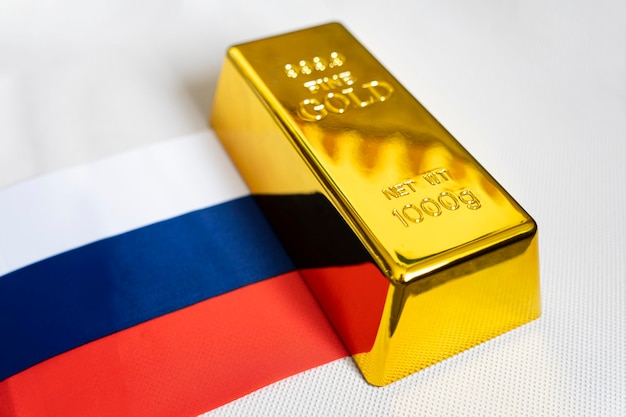
The Central Bank of Russia’s gold reserves are reported at about 2,330 tonnes in 2025, valued in the low‑to-mid‑$200 billion range earlier in the year and over $300 billion after the latest price spike. This gold is physically stored in Russia (primarily Moscow and regional vaults) and forms roughly one‑third of the country’s total international reserves by value.
Government National Wealth Fund Gold
Before the full‑scale invasion, the National Wealth Fund held about 406 tonnes of gold on its own balance sheet, separate from the central bank.
The Finance Ministry has since sold around 230 tonnes of that to the Central Bank to cover budget shortfalls, leaving roughly 170 tonnes in the NWF as of late 2025. Once sold to the Central Bank, that gold becomes part of the Central Bank’s reserves, not a separate government stash.
So what you have is the government selling its own gold to itself, technically covering the issue of trillions of rubles in ‘printed’ money, which partly financed the war and deliberately generated inflation. Yes the inflation is deliberate, because higher inflation creates more direct and indirect taxation and is used surreptitiously to steal cash from the average working Russian. However its a one way road to disaster and the government knows it.
The problem is that inflation has effectively run its course as a viable way of taking money off the population. It cannot be allowed to go much higher without risking social unrest. The fuel shortages caused by the damage to oil refineries, very high levels of personal and corporate debt, delinquencies on domestic finance agreements from mortgages to cars and loans, especially credit cards, have reach worrying highs. Inflation is no longer viable. It’s that simple. Yet without printing yet more money there’s only one way out: sell off more gold.
PLAN B – PUBLICLY SELL THE GOLD
This is where we have to understand that Russia is not a normal country. The reason nobody is up in arms about 1,000,000 dead is because the men who signed up for it and got paid high salaries and bonus payments knew what they were doing, and if they got killed, well that was their own fault. Russians are known for their zlorádstvo, their word for schadenfreude, but translated to ‘malicious gloating’. Inflation however isn’t funny and it’s getting at everyone. The government can’t let it get worse, which means it has to stop printing money. That means it has no choice but to sell the only thing it has left, its gold reserves.
There hasn’t been a better time to do it, prices are high, largely because China, pre-war Russia and private individuals have been buying up gold because its a solid fall back and in may ways portable if it needs to be. Its actually exceeded the stock market in terms of returns and that’s almost unheard of.
But who to sell it to? Sanctions make international sales impossible unless it’s done surreptitiously. But this is Russia, and it’s not a normal society, it’s a corrupt gangster state made up of multiple oligarchs who control vast swathes of the economy and they always have money, always. And the state doesn’t expect them to hand it over for nothing.
The oligarchs can feel the end is coming. They don’t give a damn about Russia, or Putin, but they do care about money and their lives. Gold is the ultimate way to hedge your bets. When the end comes they’ll need it to seize power in their regions, buy protection and potentially pay to fight for their lives or their power in a free fall environment, as the federation breaks up. So the government offers them gold and they buy it. Cash is returned to the state to keep financing the war. Many of them remember the 1990’s and the turf wars that raged around the new Federation – they expect much the same again – only this time more fundamentally diverse and complicated. If it can be put off by Putin’s war economy, so be it, but they know the writing is on the wall. When you have to sell your gold to pay the bills, things are tight – ask any pawn broker.
However for Russia it’s unwillingly signaling things ARE bad, things are very bad, and no amount of pretense will cover it up. What happens after the gold sale and even the Oligarchs can’t buy any more? Nobody else will. Nobody else can. Time is running out, fast. There’s no long term solution except to stop spending and end the war. Yet Putin has insisted he would rather fight to the last Ukrainian, only this past week. It leaves little room for any compromise.
The thing is it leaves no room for those who would remove him to do anything else other than kill him. It leaves them, as time goes on, to have no choice but to remove him. If he won’t negotiate in good faith and end the war – and he won’t because he simply can’t accept what that implies, then they have no choice. He has to go. The faster they remove him the more intact Russia will be, but the longer they take, the more complex it will become. Nobody wants to be the first to move.
THE END
Russia bares many of the distinguishing characteristics of dictatorships everywhere and through history. The most obvious of these is reliance on fear. With the regime promoting the idea that the FSB security service is all-seeing, most Russians continue to be extremely guarded when voicing complaints about the state.
There is also that other feature intrinsic to dictatorships, one that often leads to grinding inertia or grievous self-inflicted wounds: stupidity, a default mode of profound, even impregnable passivity that grows more acute the closer one gets to the locus of power.
This passivity is also rooted in fear, the worry of losing personal standing within the power structure, or, in a more robust dictatorship like Russia, of falling from a hospital balcony. It is the constant second-guessing of what might please the President or his representative at the next level up the governing ladder, that causes the lower-level functionary to gradually lose the ability to act or think independently at all.
On the contrary, the best and safest course in this kind of society is to never question or initiate, to simply go along with whatever edict or passing whim works its way down the chain of command. In just this way, the senior government minister subjected to the utterances of the President hears only brilliance, while the lowliest traffic policeman accepts without question that today he shall ticket only blue cars or allow only right-hand turns.
It’s in a government of inadvertent but inevitable paralysis like this that mistakes are made. Stupid, silly mistakes that should be avoided at all costs, but in such a system, nobody says anything to anyone up the chain to point out that mistake. Eventually something breaks. Hitler broke the German army at Stalingrad, then again at Kursk. There was no way back. Those who wanted to challenge him were gone or too scared to. Napoleon’s invasion of Russia was his fault, his responsibility, nobody called him out.
There’s even one incidence when the Shah of Iran wrote a piece for a small newspaper in late 1978, not in his own name, but it was published on his insistence. He was personally miffed over a minor incident and criticized clerics who he deemed responsible. He was not checked, nobody thought to stop him, despite the article going around various ministries for comment nobody would step up and say this was a bad idea even though many thought it. The published article caused mayhem. Rioting and protests erupted that rapidly spread and led to his overthrow a few months later. All because nobody would say no to him, or was even willing to suggest why it might be a bad idea.
Putin’s end is not far off. His overconfidence betrays deep economic and institutional failure. If he lasts another year I’d be surprised. One mistake is all it will take.
The Analyst
militaryanalyst.bsky.social


I’d assume that there are a few unscrupulous persons outside of Russia that might be interested in getting their hands on the gold that can’t be sold to the oligarchs. Who knows, perhaps even cheaper than the official gold price, as with the oil.
LikeLiked by 4 people
IMO the end is near because Ukrainian drone boats just set two ruZZia destined tankers ablaze just above the Bosphorus straits. I do not think another tanker owner will send his vessel into the Black sea now destined for Novorossiysk to ship out the ruZZian crude any longer.
If Denmark will now begin to detain the ruZZian tankers in the Denmark straits, and force the captain and crew ashore while they wait for verification of the Insurance and seaworthiness it will begin a total collapse of the shadow fleet entry into the Baltic sea as well.
RuZZia will be finished within 2 months, they will beg permission to give back all of the territory they have taken and sign a binding security agreement with Europe and the Ukrainians within 4-6 months and putler will be in hiding somewhere long before that IMO.
LikeLiked by 6 people
I also largely agree with this line of reasoning. With an average selling rate of 5.3 tons per month, and with the previously calculated danger threshold at 160 tons, it means there are only about three months left before Russia’s NWF gold holdings enter the danger zone.
So the model itself is correct. However, as has happened many times throughout this war, our models are often distorted by other extreme factors. I think we need to consider what those could be. Linear and short-term calculations are especially prone to error in the specific context of Russia.
LikeLiked by 1 person
Thank you TA for your confidence boosting view of the final fall of the Putin regime and the potential consequences for the eventual future of what we currently know as the Russian Federation. Remembering “The Emperor’s New Clothes” makes me feel how the story could apply not only to Putin, but probably Trump as well. If Putin’s inner circle are not telling him what is really going on, this is probably true. This now makes me consider the situation within Trump’s inner circle. Are they telling him the whole truth about the situation in Russia, or do they tell him what they think he wants to believe? Perhaps there are those in the Vance camp with their own ideas regarding the future of the US presidency. Will Trump fall before Putin?
LikeLiked by 6 people
Thanks TA. The level of mistrust amongst the elite, and the oligarchs must be palpable. Who can you talk to? Who is your friend? Who has a wire under the lapel. As you say, no one wants to be first to shout Snap.
LikeLiked by 5 people
I watch every day hoping to see Russia to collapse economically. It can’t happen a day too soon. And every day the USA fails to properly sanction Russia I get more and more angry with the USA.
LikeLiked by 7 people
How long can Russia’s regime keep using accounting tricks to stay afloat? What sort of accounting tricks, like selling gold to yourself and the oligarchs, should we expect to see?
LikeLiked by 5 people
Trump, Vance and Witkoff have their eyes on that gold but hopefully Russia will collapse before they can get it
LikeLiked by 2 people
Hoping to see an implosion of the Russian economy any day now!
LikeLiked by 2 people