
Nobody could have overseen how this war would pan out. We did know that drones – which are a low level of robotics in the view of some proponents, would play an important role, and they did from the start. Yet nobody expected the massive multi-million unit production levels and what almost amounts to each Russian soldier having their name on one of them as they head to the front.
Ukraine has – and the Russians will be the first to tell you so – seized the drone initiative, not just in manufacturing, but in quantity, type, speed of development, tactics and strategy. Having secured that initiative they are going out of their way to hunt down the Russian drone operators so that they, under Russian plans, never get to develop at a level that risks them regaining the upper hand. Ukraine has the advantage and they intend on ensuring they keep it, because the battlefield feels increasingly like its reached a turning point. Even the Russians seem to think so.
So often in war we reach the point where the war ends unexpectedly right at the point one side – usually the winner – is about to deploy something even more remarkable than what came before. The war ends and the pressure of expense and development suddenly vanishes and governments lose all interest. Projects that are then left to the historians like me to sit and wonder years later ‘what if..?’
The reality is that Ukraine is reaching a point where it’s about to introduce systems that will change the battlefield for ever, certainly by next year, probably later this. It’s Both exciting and yet frankly the stuff of science fiction – made a reality out of military necessity and the heat of war.
In January 2026 alone, Ukrainian ground robotic systems (UGVs) conducted over 7,000 missions, the vast majority being logistics and casualty evacuation runs into high‑risk zones.
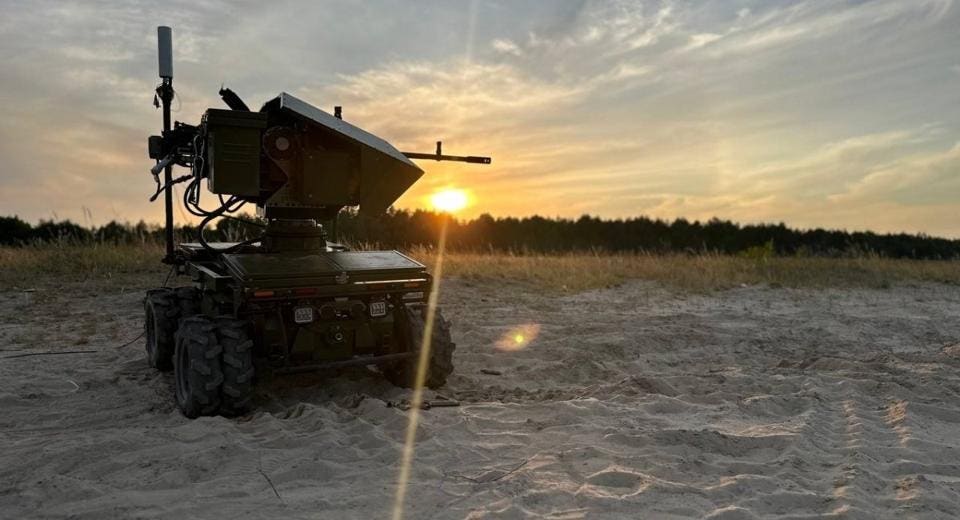
These robots are routinely used to deliver ammunition, food, and other supplies; evacuate wounded personnel; perform some demining and engineering tasks; and in a growing number of cases provide remote fire support from fixed positions.
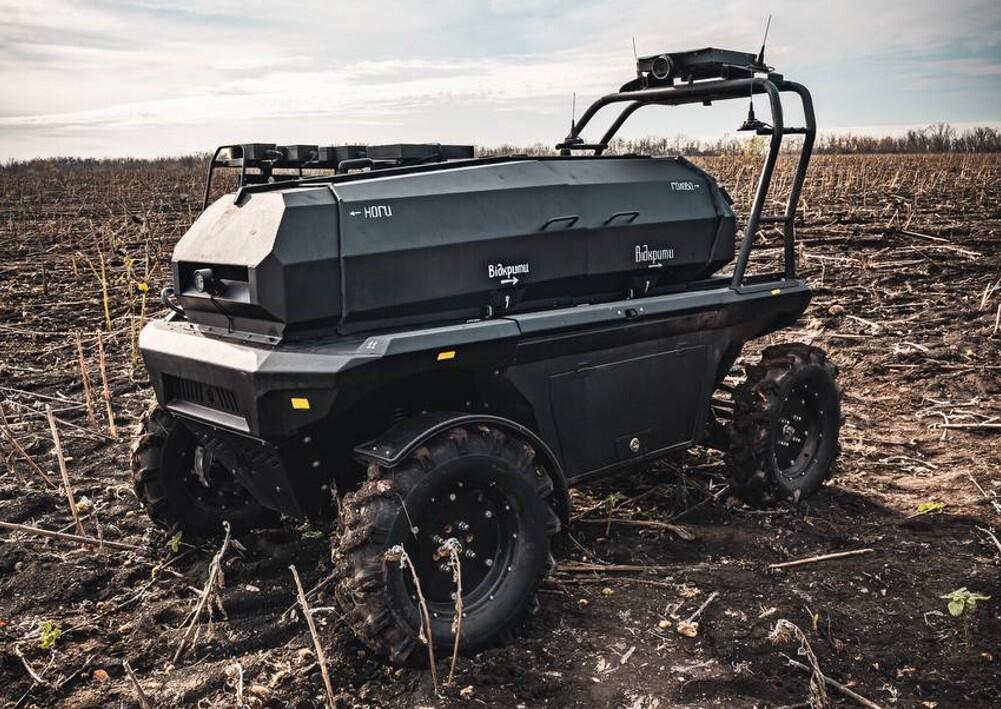
Heavy cargo variants can carry up to roughly 500 kg over “tens of kilometers” in difficult terrain, allowing them to take over the classic “two‑ or three‑man resupply team under fire” type of task, which is notoriously dangerous. Unlike humans these robots produce little heat, so that they’re often mistaken for small animals and ignored if they’re unlucky enough to be spotted by an IR drone. Generally they’re escorted by aerial drones equipped with anti-drone nets. Their success rate is extremely high. The Russians have failed miserably to adopt such a system, largely because they don’t have much regard for their men and see them as expendable.
The Ministry of Digital Transformation and Ministry of Defense state that 2026 plans include “increased production and procurement” of ground robotic systems plus upgrades to communications and command‑and‑control, with an explicit goal of shifting frontline logistics to ground robots, “wherever possible.”
A Ukrainian plan reported in 2025 spoke of deploying around 15,000 combat robots (primarily domestically produced) to the frontline by 2025–2026, with six initial contracts in late 2024 expanding to 31 contracts worth about 150 million dollars by early 2025.
The Armed Forces also plan to create dedicated ground‑robotics companies in every combat brigade, responsible for logistics, fire missions, mining and evacuation, which effectively embeds UGVs as a standard support asset rather than an ad‑hoc gadget.
One of the most significant changes is the intention of having at least one brigade in each corps equipped with around 15% of its equipment as actual combat robots. The issue is training the operators. Once thats complete (and one brigade is already operating in this format), its a question ironing out the problems – there will always be problems – and then ‘train the trainer’ begins, so that trainers in each corps and brigade can introduce the new equipment and operators.
Eventually the plan is to roll out the combat robot level to 30% of the brigade, replacing manpower which can be taken out of the immediate danger zone, providing what amounts to a force multiplier without additional personnel. this is how you win a war. You reduce your manpower demand and make each soldier more powerful through equipment enhancement – fewer soldiers become more lethal by several factors.
Of course eventually, the elephant in the room is bound to make a tempting appearance – someone will push for it – Ai. The possibility for Ai to truly automate combat robots will grow in pressure. Temptation will then want to use a unified Ai control, though I think thats a way away yet, if the war continues (which I doubt) beyond 18 months it’s going to happen, the pace of the rate of development is staggering.
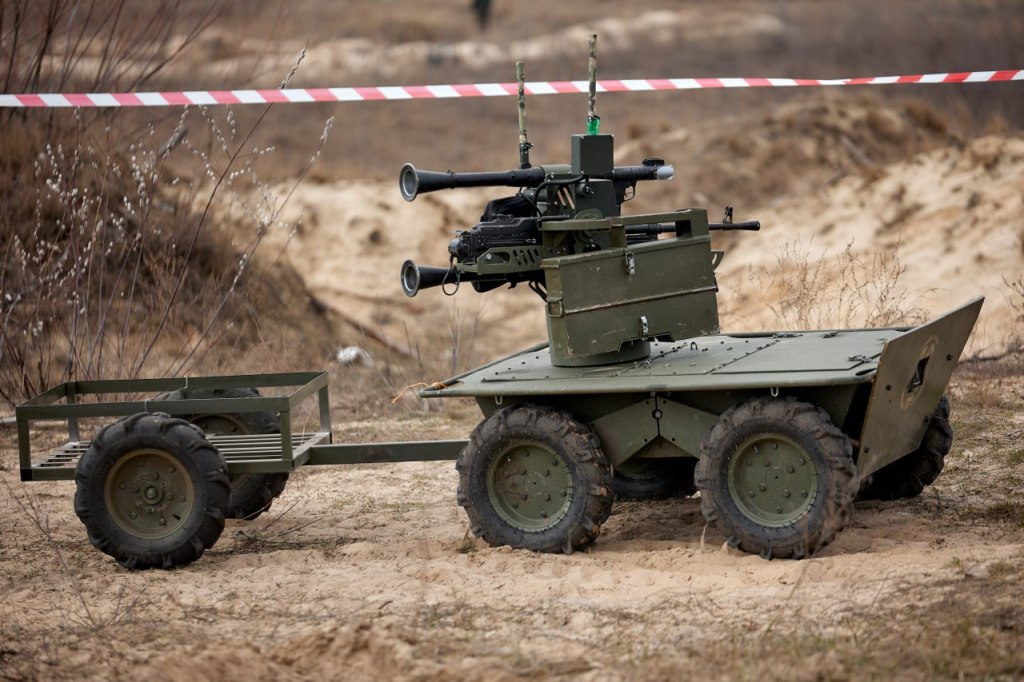
One of the first combat drones, the Lyut, has already demonstrated its capability last year. Armed with a 7.62mm machine gun and supplied by ground drones, it held its position for 45 days against Russian attack.
None of the first generation of combat robots is going to go into combat and clear Russian units – although that has happened with test equipment and last year Russians surrendered to an armed ground robot with a machine gun and escorting FPV drones. It was more out of fear and situational awareness than a routine operation. Armed robots are ideal for defence and counter-flanking operations in the initial phase of deployment. However you can never discount the novel ways the Ukrainians are likely to come up with in using them, they are exceptionally innovative.
Ukrainian officials frame the policy of introducing robots both armed and logistics, as “human‑centric,” explicitly aimed at “getting more troops off the front lines” and reducing exposure, especially on high‑risk logistics routes and static firing positions. Thats an entirely understandable reaction. Ukraine cares about its people.
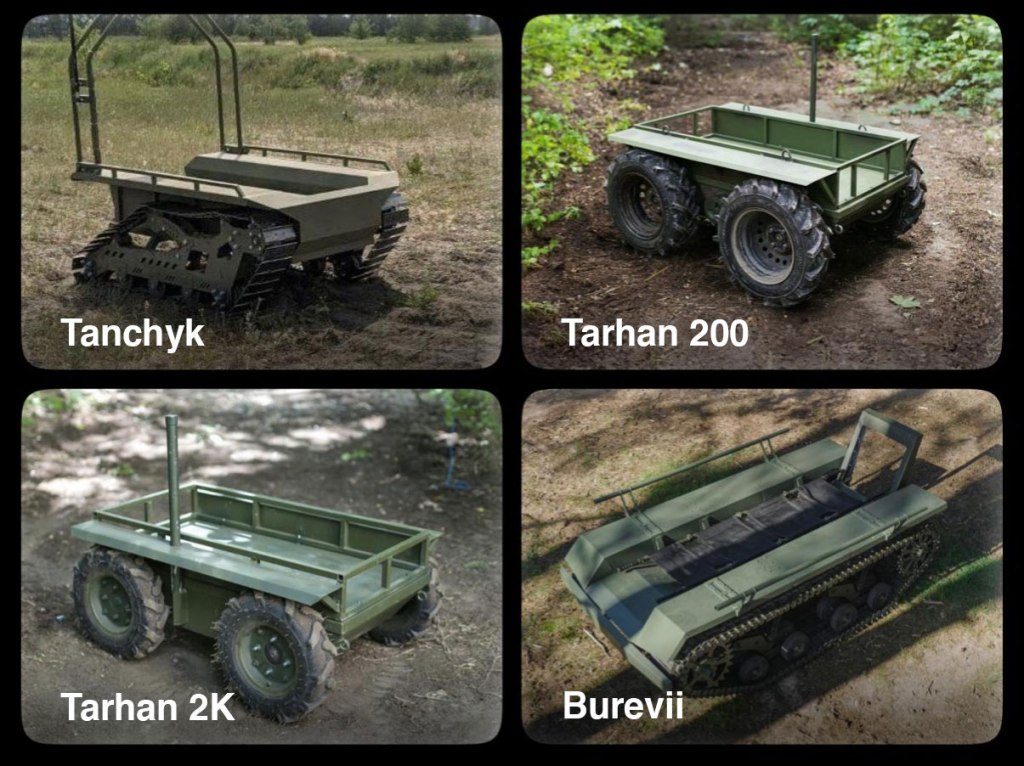
The “Army of Drones” / Brave-1 Market platform already lists 13 ground robotic system models, which units can “buy” using combat points, and a DELTA‑system module now lets units plan, track and report ground‑robot missions like any other asset. Commanders are being given modular platforms that can be reconfigured between cargo, CASEVAC, engineering, and weaponized roles by swapping mission modules and payloads. It’s already part of the system and as with everything, the Ukrainians are doing what they can to maximize availability and effectiveness. I simply do not see or hear of anything like this coming out of Russia, the whole concept is outside of their experience to imagine let alone implement.
As an example, each logistics UGV sortie typically removes the need for at least a small driver‑escort team (often 2–4 soldiers) to move cargo through contested areas; with 7,000 missions in a month, that implies many thousands of individual “person‑sorties” no longer exposed to danger, even if crews still operate the robots remotely from safer locations.
The example of a 45‑day deployment of a single armed UGV in a frontline position, substituted for a small fire team that would normally have to man that position in shifts, illustrates the concept of robots covering static posts that would otherwise tie up scarce infantry.
The plan to assign a ground robotics company to every brigade, suggests an intent to structurally offload a bundle of support tasks (logistics, medevac, some engineering), from regular infantry and support companies by moving them to robotic detachments. However, these units still require operators, maintenance personnel and command staff, so robots are more accurately displacing high‑risk exposure and some headcount at the very front, they’re not by any means eliminating manpower from the force entirely and likely never will.
In short, Ukrainian planners are clearly treating cargo and combat‑support robots as a way to systematically substitute machines for humans in the riskiest support and fixed‑position roles over 2025–2026, but they stop well short of claiming that robots will replace infantry as such; instead they emphasize casualty reduction and sustaining and even magnifying combat power under manpower constraints the country has operated under through the entire war.
One of the reasons the Ukrainians lead the way is that they are willing to try these things out in the field. The DELTA system is probably one of the most adaptable and flexible command and controls systems ever created and it records vast amounts of data that contributes to operational understanding. Add to that soldiers are encouraged to use specialised apps to offer feedback on anything and everything. The level of data means production can be modified quickly and the industrial machine behind all this is set up to respond and be flexible. New iterations of the same equipment base can be produced in 2-6 weeks at most, a remarkable feat commercial industry could not even hope to achieve, but a again this is war, and war is the mother of necessity.
It is not that Russia hasn’t tried to come up with logistics semi-autonomous vehicles. They just don’t have the command system, (hence the over reliance on Telegram and Starlink), they can’t adapt and the corruption that runs rife coupled to the doctrinal process of the army generally, as well as technological capability, has seen them come to nothing.
Ukraine is leading this war technology wise. The Russians are starting to see it for themselves at every level. And it’s beginning to worry them. They don’t know how to counter it, they can barely believe it’s got to this point, and they no longer believe they can win. That means they are edging closer to accepting defeat.
Ukraine is remarkable, what its achieved and will achieve is staggering. We in the rest of NATO need them with us and teaching us and showing us the way. Not tomorrow, but today. We must embrace them as our allies and friends and have them show us how it’s done. Time is running out quickly to be ready, and they are, we’re not.
The Analyst
militaryanalyst@bsky.social

 The Military Analyst
Thank you TA for spending the time what many of us knew already, the Ukrainians are an inspiration we should be following as well as admiring. On top of all they can do, their motivation is not only about surviving and winning, it is about respecting it’s greatest asset, it’s people. Something that far too many of our leaders just don’t understand.
Let us make sure they are always on our side!!
LikeLiked by 7 people
I have followed this from a distance in youtube videos of a few situations but this was a great in depth explanation of how it has been integrated into the Ukrainian command structure, which places such great value on the wellbeing and survival of their men. Something the ruZZians will never have, even after their defeat.
I wish that Ukraine could muster the popular support within their country (and from it’s allies) to continue to push hard against the faltering, deserting, ruZZian army in the near future in hopes of causing such a rout of the ruZZians positions, robbed of support by corruption and the coming collapse of the internal political structure of the ruZZian army, that might allow them to make a huge breakout so deep that they can drive to Melitopol and then on to the sea of Azov. Cutting off the entire ruZZian corps just as the Crimean bridge is finally weakened enough by storm shadow missiles to make it unusable. My hopes in a nutshell.
LikeLiked by 5 people
The resilience, ingenuity, and clear-eyed objectivity of the Ukrainians under the weight of staggering pressure from all sides deserves the utmost respect.
Ukraine will win this war.
LikeLiked by 6 people
Thank you T/A. Always upbeat and informative. I am wondering how a robot can maintain power and changing ammunition over a 45 day mission?
LikeLiked by 3 people
They get replacement power packs delivered by robot logistics vehicles that use drones operated remotely to extract old batteries and replace new ones. Simple drop in and pull out modules.
Sometimes they require manual intervention but that’s minimal. They’re very modular, designed for simplicity.
LikeLiked by 6 people
Thanks for the report TA. Ukraine has now become the most sophisticated military on earth. Casualty avoidance is critical for all western militaries and I hope they have been learning the lessons, although to date there are no signs of mass drone / robotic adoption outside of Ukraine.
LikeLiked by 3 people
Those robotics, ariel drones along with the smart mines Ukraine, Poland, and Estonia are developing have(will) changed the face of modern conflict
https://militarnyi.com/en/news/ukraine-poland-and-estonia-launch-joint-development-of-smart-minefields/
LikeLiked by 2 people
Dear Analyst, thank you for this awesome report. Looks like the Ukrainians are doing all they can to put less attrition possible to their men.
Do you think Ukraine can solve it’s manpower problem? Robots can do a lot, especially in defence, but I fear Kiev cannot retake the initiave on a large scale without a more consistent infusion of personell.
LikeLiked by 1 person